What writers know about keeping an idea alive
Most organisations say they want to turn ideas into value and rarely manage it. Writers do it for a living. Here's what their craft teaches us about keeping an idea's meaning alive, from seed to shipped work.

I co-host a podcast called Stationery Freaks. We didn't build it for the usual reasons — downloads, audience, money, the normal measures of whether a thing is working. We built it to learn. About ourselves, about the quiet power of analogue, and about how other people take a seed of an idea and turn it into something real.
Sometimes that something is a business. Sometimes a learning system. Sometimes artwork. Often, given the company we keep, a book.
What the craft of writing teaches us about taking ideas to value — without losing their meaning on the way
My co-host Helen is a budding author – as such she writes. So, in my own way, do I. And because we do, we tend to draw writers into our orbit — we interview authors, and readers and would-be authors gather round the show.
Which means we spend a lot of our time in close proximity to people who do the exact thing most organisations are trying to do: take an idea and turn it into value.
It is worth watching closely. Plenty of authors never earn much money from a book, but not one of them comes away empty. They are learning the whole time — how to write better, and how to take an idea and keep its meaning intact as it turns into words, into a manuscript, into a finished object made for other people. They learn when they ship. They learn from editors, from readers, from the tools in their hands, and from watching their own capacity to turn private thought into something a stranger can use. That last part, by the way, is precisely what we do at work.
Editor's note — where this sits
This essay draws on the craft of writing — how authors take a seed of a thought and protect its meaning all the way to a finished object made for other people — as a lens on how ideas move through organisations. It sits in the Engine layer of the Idea to Value system — the layer concerned with creativity, climate, and the conditions that let good work happen. It also touches the Physics layer: the funnel from seed to shipped value, and where the meaning of an idea leaks out along the way.
The Idea to Value system — five layers
A nudge before we start
There is a whole genre now of copy the author. Here is the exact morning routine. Here is the notebook they use, the hours they keep, the desk they sit at. Do this, and you too will write a great book.
It doesn't work like that, and it's worth saying so before we go any further. A routine is the visible residue of a person solving their own problem in their own circumstances.
Murakami's four-in-the-morning start suits Murakami's life; it is not a lever you can pull in yours and expect the same results. Copying the habit is borrowed seeing — installing someone else's answer to a question you likely haven't actually asked. It worked for them, in their context, which is not your context.
What travels is never the habit. It's the principle underneath it. So take everything that follows not as a template to install but as something to be inspired by, to learn from, to try, and then to make your own. That, as it happens, is the same mistake and the same remedy we'll meet again in business, where borrowed frameworks get bolted on by the book instead of studied, tested and adapted to the actual place they land.
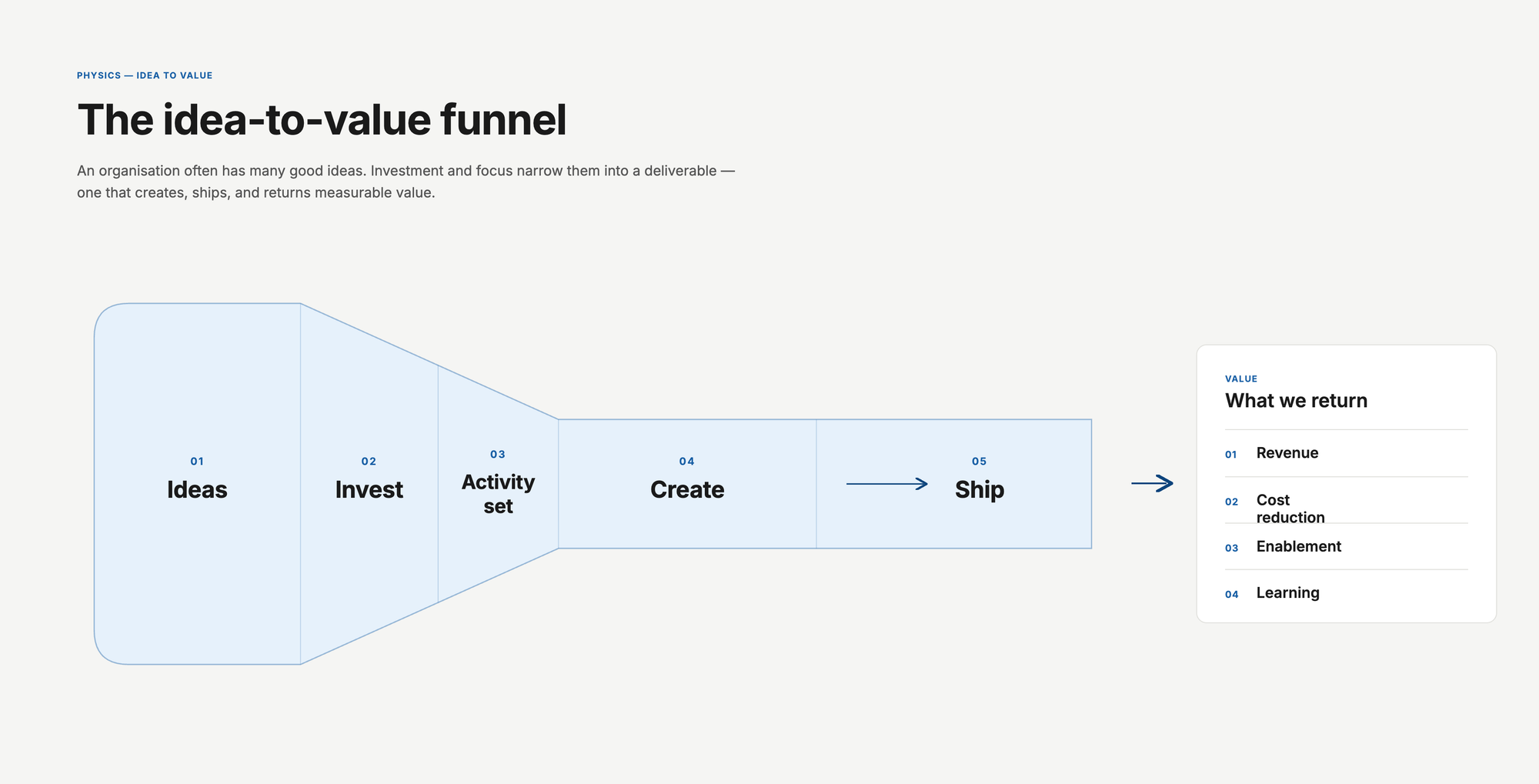
With that said, here is what I keep seeing, and I'll frame this against the funnel layer of the Idea to Value system, something we call the physics.
The ideas
Start with the idea, because the idea rarely arrives from anywhere in particular. Most of the writers I speak to, and I do this myself, keep a commonplace book — a hopper, an ideas folder, an observation book, whatever they call it. The name doesn't matter. The habit does: capturing what catches your attention.
A conversation, an observation, an article, a quote, an image, a fragment of something that snagged. Any one of them might be a seed. Or two might rub together and spark a third. A single line captured on a walk becomes a line in the book, or a character, or a scene, or even the entire book in expanded form.
Business tends to solve this differently — it buys tooling. And the tooling, in my experience, quietly kills the spirit in which observation happens. The platforms often assume that crowdsourcing is the road to the next big thing. It might be. It usually isn't.
People submit ideas, a leader-board forms, votes accumulate — but who is voting, and why, and for what? The submissions skew heavily commercial: new products, more of what already sells, ideas already pre-filtered through the lens of will someone with a spreadsheet back this.
Rory Sutherland puts it well: the creatives always have to win the approval of the non-creatives. And Peter Drucker reminded us long ago that a business really has two functions — innovation and marketing.
So in our commercial world we capture filtered, analysed, half-solved solutions rather than observations. An observation is rarely complete. It is a snippet of something seen, and something merely seen looks less commercial than a plan to push more product.
Yet with space, time, care and a little safety, a collection of those snippets can become something large — something that matters to the business, the customers and the people inside it. Ideas rarely arrive fully formed. They are seeds, and seeds need tending in the conditions they find themselves in. They do not need upvoting against every other seed that hasn't yet shown what it could become.
None of this argues against investment, or against ever weighing an idea for value — an idea does eventually have to stand up. It argues that we've skipped a step. Before the demand-management machine, before the voting and the sponsoring, there is an earlier mode of work: the open-mode thinking, as John Cleese named it, that takes a seed and builds the right climate for it to reveal what it is. No upvoting required.
And one more thing on ideas — the moment we throw them open for a public vote, and make the price of entry purely financial, we attract ideas hugging the shoreline of people's daily work. Comfortable, close to hand, and possibly not the best thing for the wider system.
Good writers don't rush the seeds. They gather them, keep them, revisit them, turn them over — and eventually something arrives. In my book Zero to Keynote I make the same case for talks: keep feeding the hopper. That chapter on idea generation is a free download if you want it.
The best writers work hard to create the conditions for ideas to appear at all. Some sit where other people are and simply watch and listen — ideas are everywhere if you're paying attention. Ernest Hemingway wrote for years in the cafés of Paris, drawing on the faces and fragments of overheard talk around him.
Craig Mod is well known for walking — miles at a time — as the mechanism for being alone with his thoughts and letting ideas surface. Others mine their own experience, given enough quiet to do it.
Making the conditions is the first half of the job. Giving the seed enough time to take a usable shape — not the finished idea, just enough to move on — is the second.
Business tends to rush both. We stage the investment, demand certainty upfront, and lock the idea down before it has shown its real form. We engineer the conditions for productivity, and forget to engineer the climate for thinking, for seeing, for turning a thing over in the hand.
Investment
The thing that strikes you talking to authors — and they are not all alike — is the nature of the commitment. A few run two books in parallel. Most don't. They commit to one idea and work it until it's done. That investment is partly money, but it is always time, energy and attention.
The road can be long and hard, and committing to it means cutting off the alternatives. They make a decision. They throw themselves in, often at the cost of other ideas they'd love to write.
Like a good business, they have no shortage of ideas; the discipline is in funnelling down, choosing one, and knowing their finite attention will now be spent on it — for months, sometimes years, occasionally decades. How much they give is personal. Some write before work, some on their lunch break as I do, some in the evenings, and for some it is the day job.
Business prefers to believe people can carry it all at once. Leaders fill the top of the funnel with lots of ideas (work) and then act surprised when the delivery end is overflowing and quietly burning people out.
The investment stage matters most for what it decides not to do. It's hard too, because the meaning of an idea shifts as you bring it to life. The platform you think you need at the start is almost never the shape of the thing that should be delivering value at the end.
As we learn, gather feedback, and discover what it actually takes to build, we have to adapt, change and pivot while holding the essence, the meaning and the value of the original idea steady in mind. We don't change for its own sake. We change to stay true to the value.
Yet many organisations lock the idea in place, the designs and tasks harden into the plan, and from then on delivery against the plan is the only thing that counts — even as the idea is trying to become something better.
Almost every writer, once the writing starts, twists and explores what the book is meant to be. It all began as a seed, and the seed is still growing.
Activity sets
An activity set is anything that pins an idea down long enough to begin: a rough outline, a simple diagram, a plan, a character sketch, the "world" the book lives in, a handful of chapter headings, a notebook kept for thoughts and offshoots as the story evolves.
A surprising number of the authors I've spoken to buy a new, dedicated notebook for each book — and often one whose colour or cover carries the feeling of the idea. A book about nature earns a green notebook, or one with trees on the front. The instinct is consistent: a single container for the thinking and the working parts of this book and no other.
The notebook is not the book. It is not the words, and it is not the idea by itself. It is the container that holds the work and the thinking, the aid that helps the words reach the page and the value reach the book.
I describe every work-tracking and productivity system we use at work in exactly these terms — a container of work with a few rules around it.
Agile, waterfall, whatever the flavour, the principle holds: ideally one container, holding the work being done plus some rules. The container holds the thinking; the rules keep the idea true to its nature, meaning and value while helping people do the work to make something real.
Some writers love a tool like Scrivener — a container — with enough rules to be useful, flexible enough to bend to their own way of working, holding the plot, the summary, the characters, the world and the writing itself. Others use whiteboards and walls. Either way, the container holds the idea's parts while it is being turned into something you can hand to another person.
One of the core principles of taking an idea to value lives right here: at work, we should be able to see the investment being made — money, time, energy, attention — connected down to the work that brings the idea to life (and only that work), through the making, and out to the value at the end.
There is a trap, and it has two jaws.
The first: as the writer writes, the activity set has to flex with what's being learned. Feedback should change what we do and how we do it as the idea grows and matures — but not send us lurching off course at the first stray comment.
A writer who set out to write about an enchanted forest of Elves rarely ends up turning that book into a definitive history of cycling. The idea, the meaning and the value tend to hold; what changes is the form the thing takes as we learn.
And so the activity sets change with it, in a tight loop — capture, try, learn, move on. When putting pen to paper reveals three missing joins in the middle, the writer updates the story arc and carries on. When a scene shows that the carefully defined lead is the wrong person to carry the book, they maybe change the character rather than protect a decision made too early. The plan serves the story, not the other way round.
The second jaw is the one I see most in business: enormous amounts of time spent noodling, planning and trying to squeeze the uncertainty out of an idea before anyone makes anything. A kind of insurance against the changes that are coming regardless. It rarely buys the certainty it promises, it is all cost, and — worse — it can turn accurate feedback during the creation into an enemy, because now the goal is delivery against a plan even when the plan is wrong.
Here is the distinction that keeps you honest: an activity set that holds the idea still long enough to start is doing its job. An activity set built to remove uncertainty before starting is the trap. Same tools, opposite intent.
Some writers dwell here, exploring story and character and outline before a word of the book is written. Others jump straight in, trusting their craft to keep them true to the idea - building the activity sets as they go. Both can be right.
What is rarely right is spending the money, time and attention on the sets, the models, roadmaps and mitigation plans, and then clinging to them so hard that the idea is never allowed to change shape, or even get started in the first place. We learn about the idea when we try to bring it to life.
There's a reason so many projects, a year and a fortune in, ship something that returns almost nothing.
Creative action
Now we make the thing. This might be the writer who leaps in with almost no plan, or the one who starts from bare bones — but at some point the idea, the outline, the concept has to become something tangible. A writer who never writes isn't a writer.
In the writing is where human potential shows itself.
We find out what we're made of. We make something from nothing and watch the idea come alive. I've made that sound thrilling, and sometimes it is. Often it isn't.
The messy middle is where the real spirit and strength are found, and it is also where the resistance is highest — Steven Pressfield's Resistance, in The War of Art, the force that wants you to give in. It's hard. It's frightening. It isn't working, then it is, then it isn't again.
There's a myth worth naming here: that writing is a gift of genius, that the writer waits for inspiration and the book more or less writes itself. That is not what I've learned.
One author I've spoken with works on her books six days a week, all day, doing something towards publication. Another works seven. Murakami keeps a near-monastic rhythm — rise at four, write for five or six hours, then run or swim, read, listen to music, and sleep, day after day, month after month.
In this excellent short video, we get to see the day in a life of writer Jerry B Jenkins - a daily routine, time locked away, some may say monotonous — but monotonous, by the way, does not mean joyless. The same shape every day. Discipline. Long days, often more than Monday to Friday, all in service of getting the idea out into the world.
Our modern working pattern is exactly that — modern. It was never unusual, outside the factory floor, for people to work long hours. The entrepreneurial folklore online tells you to grind without a day off, and I think that's mostly wrong. What I've learned from writers is not the grind or the hours but the sustainable rhythm — the long journey, not the hustle. There are consequences to never taking a day off.
The hours and the days form a routine, and the routine's real gift is not consistency for its own sake but attention and focus. It isn't about being busy. It's about getting the priority work done.
Our businesses are busy — back-to-back calls, competing priorities, deadlines, drama — but busy is not the same as effective. Take on too much, wreck the conditions for good work, scatter people's attention, and you burn out the very people bringing their creative best to the work.
Great work is rarely easy or quick. It is the unglamorous commitment to an idea and the plain discipline of showing up, with focus, to get the thing done. The best places to work know this. They don't force the result, and they don't try to shorten the distance from idea to value at the expense of the people, the climate and the culture. They protect that distance on purpose, because it's what keeps the idea's meaning and potential intact as it changes shape into something real.
Shipping and value
And then the writer ships. The manuscript goes to an editor, then a publisher, then — the frightening part — a reader or two. Shipping is not the end of the work; it is its own stage of it. The editor sends the idea back sharper. Every writer I know learns more in the months around publication than in some of the years before it.
Shipping is also where we finally get to say what the value even was. For most writers it may never have been about the money. It was the learning — a truer sense of their own craft — and it was the gift: something made and handed over so a reader could use it, feel it, be less alone with it.
At work the value might take a different shape. It might be money earned. It might be a cost taken out. It might be something that makes other work possible. It might be learning we couldn't have bought any other way. Naming which type of value you're actually chasing, before you ship, is how you know whether the thing you shipped was worth the finite human attention poured into it.
This is where the loss lives, too.
There is an unnerving sadness in watching an idea reach the world as a hollow version of itself — shipped on time, to plan, and empty, because the meaning quietly leaked out somewhere on the way down the funnel. The whole point of protecting the essence at every stage — the tending, the honest investment, the flexible activity sets, the disciplined making — is so that what arrives at the end still carries the value it promised at the start. That is not sentiment. It is the difference between a thing that matters and a thing that merely met the deadline.
The layer around it all: climate and conditions
Everything so far is the journey — the funnel an idea travels from seed to shipped value. But a funnel is only a shape. What decides whether it moves, or quietly strangles the value inside it, is two things that sit around the whole of it. The first is the climate it runs in.
Talk to writers and one thing is striking: how fiercely many of them protect the conditions and climate around their work.
They keep dedicated spaces. Those spaces change over the years but stay remarkably steady while a given book is being written. One author has a fixed spot in a local coffee shop — so fixed that the café has put up a small plaque and guards the seat for her. Another writes only in her small garden office; when she's there, that is the work she does. Roald Dahl had his famous writing hut. Maya Angelou rented a bare hotel room by the month and wrote lying across the bed, the walls stripped of anything that could distract her.
They guard these spaces because they know an environment is never neutral. The clutter or the calm, the tools within reach, the people, the noise, the light — all of it shapes whether good work is possible. They work to find what suits them, curating attention, and then they defend it, because attention is the scarce material and everything in the room either protects it or spends it. Many of them, tellingly, don't keep a phone beside them while they write.
They also turn that same care inward, working out what they personally need in order to show up and be at their best.
The space is arranged so they can drop into the right headspace and move between open and closed modes of thinking. The tools reinforce it — a notebook, a typewriter, a computer with no connection to the internet — chosen to fit the process rather than to look the part.
And underneath it all, they know why they're writing this book, which is the thing that carries them past the point where giving up would be easiest.
Our workplaces, more remote by the year, seem to have forgotten this. Even in the office we sit in open-plan rooms that are good for collaboration and poor for deep work. Alerts, channels, a bottomless inbox, back-to-back meetings, six versions of the same file, no clear painted picture of where we're headed — each one makes showing up and doing good work harder than it needs to be.
The climate isn't a nice-to-have around the funnel. It's the air the funnel breathes.
The second layer: learning that compounds
The other thing wrapped around the whole funnel is learning, and it's the glue that holds the rest together.
An idea is never fully formed; learning is how we work out what it needs to become. We learn when we share it with someone who sees differently — the Creativity of Constraints workshop works precisely because you watch someone unlike you meet the same constraint, and you learn from what they did if you choose to look.
We learn when we try to make the idea real. We learn when we ask for feedback. Writers learn from editing, from publishers, from readers, from the market, and most of all from watching their own capacity to turn thought into something tangible grow over time.
Work is no different. Learning is everywhere, if we choose to look and then decide to act on what we see. There is no good reason for a team to keep making the same mistake. There is no good reason, if learning is genuinely the thing we do, to keep reaching for borrowed frameworks to solve problems we may not even have — which brings us back to where we started.
We can learn to be better at the craft, better with each other, better at reading the wider system we sit inside. We learn when we ship something that returns the value we hoped for, and when it doesn't. We learn which ideas deserve to be carried forward and which can rest on the backlog a while longer. We even learn to take an idea to value more surely the next time — if we choose to see it.
The learning doesn't step forward and introduce itself. It waits in plain sight for us to notice, understand and act. Not every workplace is built to get better at this, nor, sadly, do some even seem to want to get better, but we don't have to wait for permission to learn for ourselves.
A writer is always learning, and always trying to be a little better than the last book. The lessons are already there, in the room, on the page, in the reader's response. Every one of them is another turn of the wheel — another chance to make ourselves, and the work we bring into the world, a little more of what it could be.
Workshop · with Helen Callaghan & Helen Lisowski
The Creativity of Constraints
The workshop referenced in this piece. You watch someone unlike you meet the same constraint you did — and learn from what they chose to do with it. Co-facilitated with Sunday Times bestselling novelist Helen Callaghan and organisational development specialist Helen Lisowski
Read about the workshop →Workbook · £21.99
Effective Workplace Communication
If the argument in this piece resonated — that communication is how ideas either move or stall — the workbook is the practical companion. A self-paced way to sharpen how you say what you mean, and make sure it lands where it needs to.
See the workbook →