The story I hadn't written yet
Adrift and driving cheap sports cars I couldn't afford, I wrote down the future I wanted after my first son was born. It wasn't manifestation. It was orientation — and everything downstream changed. The same thing works in work.

Painting a picture of the future: vision as orientation
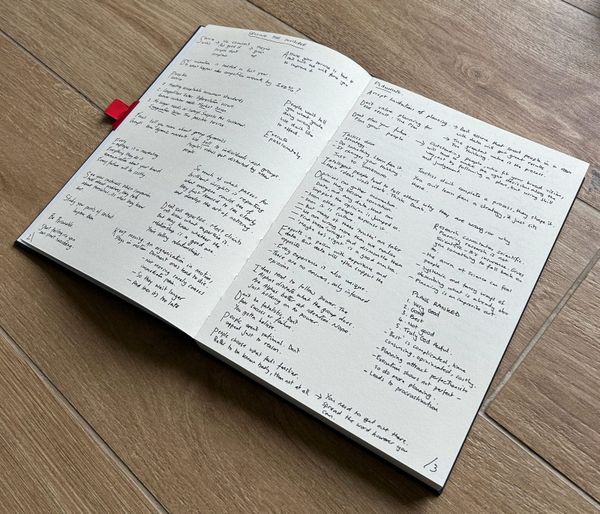
A few weeks after my first son was born, and after getting used to a whole new sense of responsibility, I wrote down what I wanted my life to look like.
I'd be lying if I told you I did this from a position of strength. I didn't. I was coasting – playing a great deal of video games, driving a succession of cheap Japanese sports cars I couldn't really afford, but sorely wish I'd kept now, and wishing my life were different without doing very much about it.
Then our son arrived, and with him the remarkable, total reordering of my life that a baby brings; the baby effect was strong. Somewhere in the sleeplessness I made a decision. Not to cope. To thrive.
So I wrote it down. Not a plan – a vivid and compelling painted picture. What the days felt like. What kind of father I was. The work I was doing, and why it mattered. Where we lived, how we spent a Sunday, the sort of person I'd have become by the time he was old enough to notice. How much money I wanted to earn, and what I would do in return for that money. I wrote it in the present tense, as though it were already true.
Here's the part I wish to be careful about. That page wasn't manifestation and powerful wishful thinking. It wasn't passive. It wasn't a spiritual hope that I put out into the universe believing that the universe would read it and start rearranging the timelines of my life.
It did something far more ordinary, and far more useful: it orientated me. It was compelling enough, specific enough, exciting enough that it began to pull me toward it. It was the ending of a story that hadn't been written yet – and my job, as I saw it, was to work out how to bring that chapter to life, and write the interesting story between now and then.
When, some years later, I'd more or less arrived inside that picture, I did the only sensible thing. I wrote a new one. And I do the same thing still today.
"You must know for which harbour you are headed," Seneca wrote, "if you are to catch the right wind."
I've come to think that's very nearly the whole essay right there. No need for more words. But maybe I should elaborate a little further.
In Seneca's quote, my version was not about the wind. Nor the boat. But squarely about the harbour. Almost everything else – the route, the plan, the effort, the problems, the opportunities – arranges itself around a destination you can actually see in your mind, or on paper too. Take the destination away, and all that delightful potential we all have has nowhere solid to move towards.
I've done the same thing at work for twenty years, and it does the same work there too, which is rather nice. Because underneath the personal version sits a question that hangs above everything else we spend our days on. Not how do we work better, ship more, move faster, get sharper at turning ideas into value? Those matter. But above them: what is all of this actually for?
It's a question you can go a tragically long time without asking. And a team that hasn't asked it can become superb at the wrong things — optimising, accelerating, improving, all in a direction nobody actually chose. People work hard and feel very little, because the work is competent and pointed at nothing in particular. You can stay busy for years that way. Plenty of us have. It's the difference between the map and the engine — and no amount of engine saves you if the map is missing.
Now, I think that's a powerful idea to spend time with, because the fix isn't more effort, or more plans, or making up a destination that doesn't mean anything.
It's painting a picture in words, or if you're good at graphics and art – why not a visual too?
A painted picture is a plain, vivid, compelling, exciting, interesting and honest description of the future you're trying to bring into being — written as though it already exists. Present tense. Specific enough to feel. Ambitious enough to create a little tension, and a slight pang, with where you actually are today. People should be able to place themselves inside it, engage with it and be emotionally drawn to it.
It isn't a mission statement – those are mostly written for the organisation's comfort, fine tuned and whittled until every trace of a human being has been polished out. It isn't a vision statement, which tends to drift off into abstraction. It isn't a set of targets, which describe what you want to measure, not what you want to become. A painted picture holds three things a spreadsheet never can: why you exist and who's better off for it; what it actually feels like to be here, in behaviours rather than what's written on a wall; and what changes in the world because the company existed.
"We're in business to save our home planet." That's Patagonia's, in a single sentence. It isn't about jackets, and it isn't about margin. It guides the hiring and the products and the hard calls – not because it's laminated next to the fridge of free drinks, but because it's believed, and repeated, and it's why people want to work there in the first place. Set it beside a company whose great ambition is to be "destroy the competition," and you can feel the difference in your chest. One pulls on people's hearts. The other moves spreadsheets and investment decks.
The worry I hear most often is: but we don't know how we'd get there. Good.
The how isn't your job at this stage, and trying to solve it too early is precisely how most pictures die — shrunk down to something safely achievable, with a three year plan, a governance model and some sales goals to boot.
Paint the destination boldly and honestly, as humans to humans, and leave the route out. The how has a way of finding you, especially if you have good people around you. Which is the rich commercial secret inside all of this: you don't attract good people with a plan. You attract them with a picture worth walking toward. The plan is the thing they arrive to help you write.
So, grab a nice coffee or tea, create a majestic, simple, compelling painted picture for two to five years out — far enough for real change, close enough to feel real. Suspend the constraints and inevitable downplaying for a first draft; define what you genuinely want before reality gets to creep in and spoil it all.
Write it in the present tense, because we deliver every week without drama inhabits parts of the mind in a way we will aim to never manages. And make it move you — read it aloud, and notice the lines that land flat. A read around is not just for a good talk, it's for any prose that is aimed at landing something. If it sounds like a committee wrote it, rewrite it. If it sounds like a corporate statement, rewrite it. If nobody feels anything, nothing moves – and that, likely, is the actual acid test for it.
And then — this is the part that always gets skipped — you have to say it. You have to tell people about it. You have to believe it and repeat it, in your own words, until you feel like a character in the story, because you are – maybe the main protagonist.
Your tenth repetition of it might be when someone else truly hears it for the first time. A picture shown once at an all-hands and never mentioned again isn't a painted picture. It's a slide.
I suggest it has to turn up in the ordinary places too — the one-to-ones, the reasons you give for a change to how things are working, the story you tell about why this and not that — and be specific enough that someone can repeat it back in their own words without breaking it.
The test is simple, and slightly frightening: can the people around you describe the future you're trying to build, and say how their own work connects to it? If not, either you haven't communicated it, or it isn't yet worth remembering, or it's simply not compelling enough.
You'll know it's working because it will start changing behaviours. More people helping each other. Better decisions. More energy in the room. More willingness to own problems that don't seem to belong to anyone. Someone willing to do a genuinely hard thing because they can see what it's for and have decided it's worth it. More people gravitating toward helping you make the future real.
If none of that is happening, one of two things is true: the picture isn't bold enough to be worth the effort, or something in the system is still pointing everyone back at the past while you ask them to face forward to a bright future. Both are fixable. You just have to know which one you've got.
One more thing, learned the hard way across several rewritten pictures. If the first draft feels easy to reach, make it bigger. The whole point is the tension — the fascinating gap between where you are and where you could be. That gap is the wind from Seneca's quote. You have to supply the harbour and the right climate.
And one last thing. You don't need a compelling event like a baby, or a market crash, or the loss of a customer to paint a picture of the future. It's available to all of us, in work and life, right now.
Now, I need to get my eldest son, the one at the beginning of this story, all set for University. My how time flies. Worth remembering that when you consider delaying crafting the bright picture until next week, month or year.
Where this sits in the Atlas
Orientation·Idea to Value·Communication·Creativity & Climate·Learning