More than meets the eye
A five-part spine for writing a change narrative people can see themselves in - plus free edition of The Department of Interesting Things, the canvas, templates and workshop guide.


Which Shape Are We Becoming?
When I was a boy, the toy of the moment was Optimus Prime. I remember unwrapping him on Christmas morning and spending most of the day on the living-room floor, surrounded by bits of Transformers. For anyone who missed these particular legends of the 1980s, Optimus Prime was an articulated truck which, with a satisfying series of clicks, became a giant robot. Then, with another satisfying series of clicks, he became a truck again. Oh yes, and a battle station too.
This was the entire magic of Transformers. You knew what you had. You knew what it was becoming. And you knew when you had got there.
I found myself thinking about Optimus Prime again the other week, which was odd, because I was standing in the middle of a transformation programme. It was a remarkable company doing genuinely remarkable work, and it had embarked on a remarkably ambitious change programme. There were teams, budgets, meetings, consultants, roadmaps and a considerable amount of PowerPoint. There was just one small problem. Remarkably, nobody could tell me what the company was being transformed into.
This seemed like an odd omission. A Transformer, after all, is quite good at transformation because it has been designed with the destination in mind. Optimus Prime doesn't spend six months becoming something and then ask the children gathered around him whether anyone has any thoughts about what it might be.
The truck becomes the robot. The robot becomes the truck. Everyone is clear.
Nature does this too. A seed becomes a plant. A caterpillar becomes a butterfly — either nature showing off or nature's small joke. Even the dull grey electrical box at the end of my road has a defined purpose. Electricity arrives in one form and leaves in another. Nobody has put a little laminated sign on it saying:
TRANSFORMATION UNDERWAY
Destination: TBC
Business, however, has become rather fond of the word transformation. We have transformation programmes, transformation directors, transformation offices, transformation roadmaps and transformation strategies. Sometimes we even have transformation manifestos. And yet, every now and then, someone asks the entirely reasonable question:
Into what?
This programme had reached that point. The lever had been pulled. Millions of pounds were in motion, along with the more expensive currencies of people's time, attention and energy. Things were happening everywhere. But ask five people what the business would look like when the transformation was complete and you got five answers.
There were diagrams. None quite joined up. There were opinions. Most were held with impressive confidence and less impressive evidence. There were plans. An astonishing number of plans, actually. What there wasn't was a picture of the shape we were trying to turn into.
This matters more than it sounds. If you don't know the destination, almost any movement can be mistaken for progress. A team can deliver something and call it progress. Another team can reorganise itself and call it progress. Someone can launch a new platform, hire a new leader, close an office, open another one, redesign the operating model or produce a 74-page strategy document and call it progress. All of it is movement. But it doesn't necessarily takes you anywhere.
We had three choices.
We could let the programme run and see what emerged. This was essentially gambling a very large sum of money to find out what would happen and whether it would be any good at the end. In other words, just keep going as we were. We could look at everything already underway, leave it alone for a while and declare the emerging shape to be the destination. This had the appealing quality of being practical, although it did leave the accident in charge of the map, and that felt somewhat unsettling. Or paint the end shape deliberately, and nudge everything in flight towards it. Which would you pick?
We chose the third. Not because it was clever. Mostly because it was the only option in which someone had actually chosen the destination. And something very interesting happened once we had one. It worked, more or less, for exactly that reason. The people leading the change could see the destination, which meant they could course-correct, reset when they had to, and nudge everyone a little closer to a shape worth turning into. Choosing the end shape handed us back some control of the outcome – which, if a change is worth doing at all, is meant to be a better business for the people in it and the people it serves.
We didn't land it perfectly. Change in an organisation is never a clean switch from truck to robot; it's a messy tangle of needs, constraints, politics, egos and people, and it rarely goes to plan. But we got close. And close to a shape you chose feels a great deal better than close to a shape you never defined and were never sure was an improvement in the first place.
At the centre of it all was not a plan, not a timeline, and certainly not a Gantt chart. It was a narrative – a short, honest story of the future. Where we were, where we were headed, what it would cost to get there, and what role we would all collectively play in it.
The destination didn't tell everyone exactly what to do. It did something better. It gave people a way of deciding for themselves. That, I think, is the bit that gets lost in a lot of transformation work. We spend enormous amounts of time explaining the change and surprisingly little time describing the thing we are changing into. People don't necessarily need a 90-page strategy document. They need to be able to picture the future well enough to make today's decision.
It seems reasonable to share the five things a good change narrative sits on. A signal – what's happening, what problem needs solving and why it can't be left alone. In other words, the cost of inaction. A promise – the shape on the other side, drawn clearly enough that someone can understand it, and would be able to walk towards it. The challenge – an honest appreciation about what will be hard and why it will be challenging to everybody. A story that pretends the route is easy is a story nobody believes. The urgency – not fake, or manufactured panic, but why this matters now, and not next year. And participation – where each person fits, so the change becomes something they help write rather than something that lands in their inbox.
Signal, promise, challenge, urgency, participation. It's the oldest shape there is – where am I, where am I going, what's in the way, why move, and who am I in all this. We've used this shape to make sense of things since we told each other stories around fires, long before anyone hoped a slide deck might improve on the whole thing.
Let's be clear, none of this replaces the conversation. It anchors it. A story on the intranet doesn't stop people talking – it gives them something steady to point at while they do, so that every meeting doesn't open by re-deciding what on earth is going on, and the plan stops being whatever the loudest person half-remembered from the corridor conversation they overheard. That is the big trick in it: a shared story lets a few hundred, or a few thousand, people move roughly together without anyone standing over each of them to explain what to do every day. It does require you to trust people to make the right decisions though. And, let's be clear, this doesn't negate the need for governance, plans and actions with reporting etc. It sits above that.
In the end the change happened – not to the plan, because there never really was one, but through the story we kept telling about where we were going.
Organisational change will never be as tidy as a toy robot; we don't snap between two perfect, finished states, and anyone who promises you otherwise is selling something worth being dubious about.
Before you ask people to change, show them what they are becoming. Optimus Prime always knew which shape he was becoming. It's a low bar, when you say it out loud or write it down. But, perhaps that isn't such a bad place to start.
Department of Interesting Things
The Department of Interesting Things, other than being a fun name, is a monthly letter, with practitioner guides to seeing, thinking, working and communicating better.
Each edition begins with one ordinary thing and follows the idea wherever it leads, always giving you practical and tactical advice you can directly apply to your work.
Edition No. 001 is The London Tube Map - and how to build a change narrative guide. You'll like this one.
Change Narrative Canvas
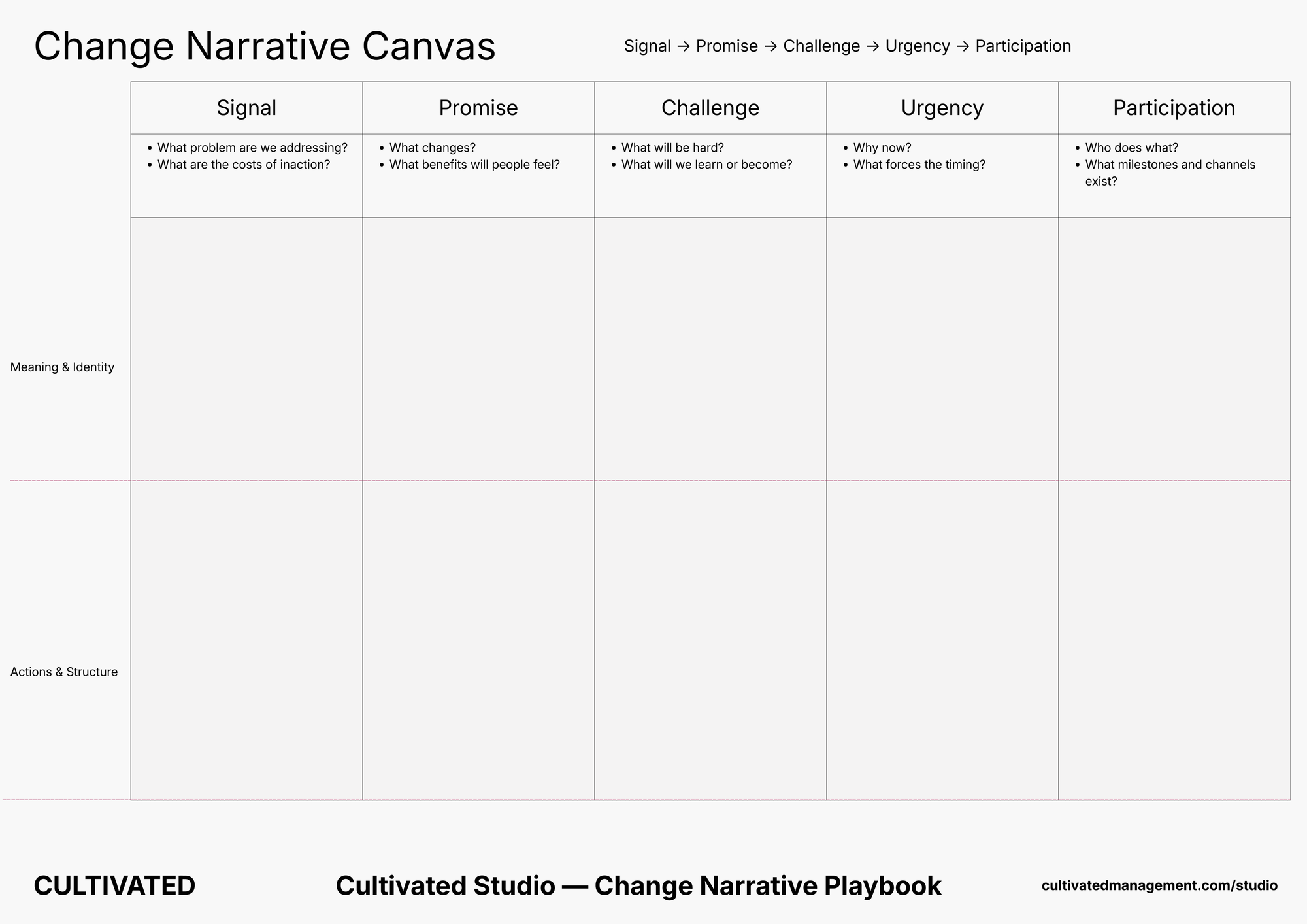
The Change Narrative Canvas is a one-page visual tool for aligning people around transformation.
It translates strategy into a shared story that teams can see, discuss, and contribute to.
Use the Canvas in leadership sessions, workshops, and planning meetings to structure conversations around five core elements of change:
- Signal — What problem are we addressing, and what happens if we do nothing?
- Promise — What changes, and what benefits will people experience?
- Challenge — What will be difficult, and why is this journey meaningful?
- Urgency — Why now, and what forces the timing of this change?
- Participation — Who does what, and how will we move together?
The Canvas is designed for A3 (workshop wall) and A4 (desk reference) printing. Leave space for sticky notes and handwritten contributions; the goal is not perfection, but shared understanding.
Download from the dedicated downloads section at the end of this page.
How to Use the Canvas
- Start with Signal and Promise with leadership to establish clarity and intent.
- Co-create Challenge and Urgency with teams to surface reality and commitment.
- Define Participation with delivery and enablement leads to translate narrative into action.
The Canvas works best as a living artefact—revisited, updated, and referenced throughout the change.
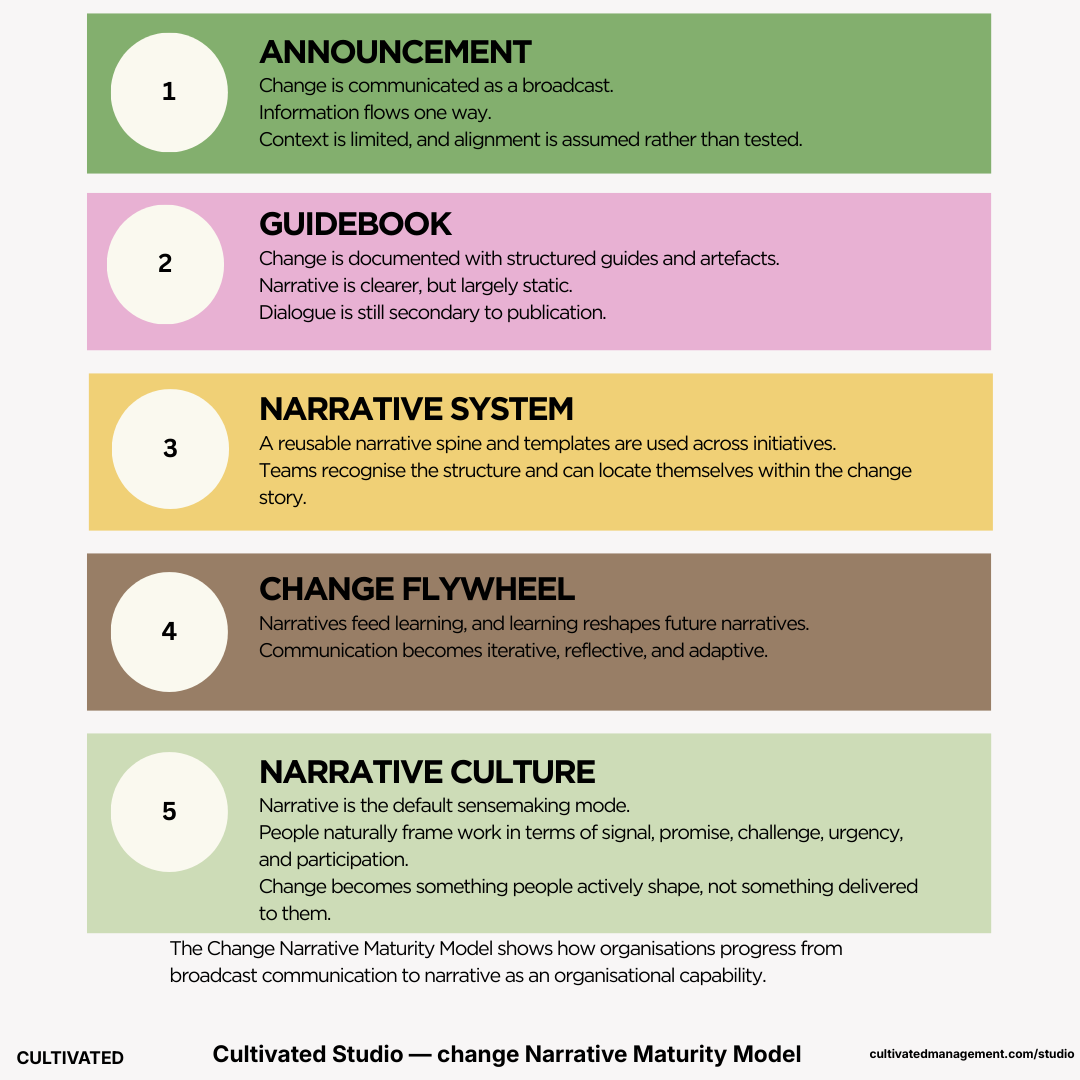
Change Narrative Maturity Model
This model extends the narrative playbook into an organisational capability framework.
Download from the dedicated downloads section at the end of this page.
Change Narrative Checklist
This one-page checklist provides a quick review before publishing or presenting a change narrative. It ensures clarity on the problem, the proposed change, and how people will participate.
Use it as a pre-flight check for documents, presentations, and leadership communication.
Download from the dedicated downloads section at the end of this page.
Workshop: Change Narrative Alignment
This workshop helps leaders and teams align on a shared narrative for change.
Participants clarify the problem, define the future state, surface challenges, and agree how they will act together.
It is designed to work with the Change Narrative Canvas and can be run with leadership teams, delivery groups, or cross-functional stakeholders.
The Canvas and workshop structure draw on patterns used in Cultivated Practice when working with leadership teams on transformation.
Facilitator Notes are available to download from the dedicated downloads section at the end of this page.