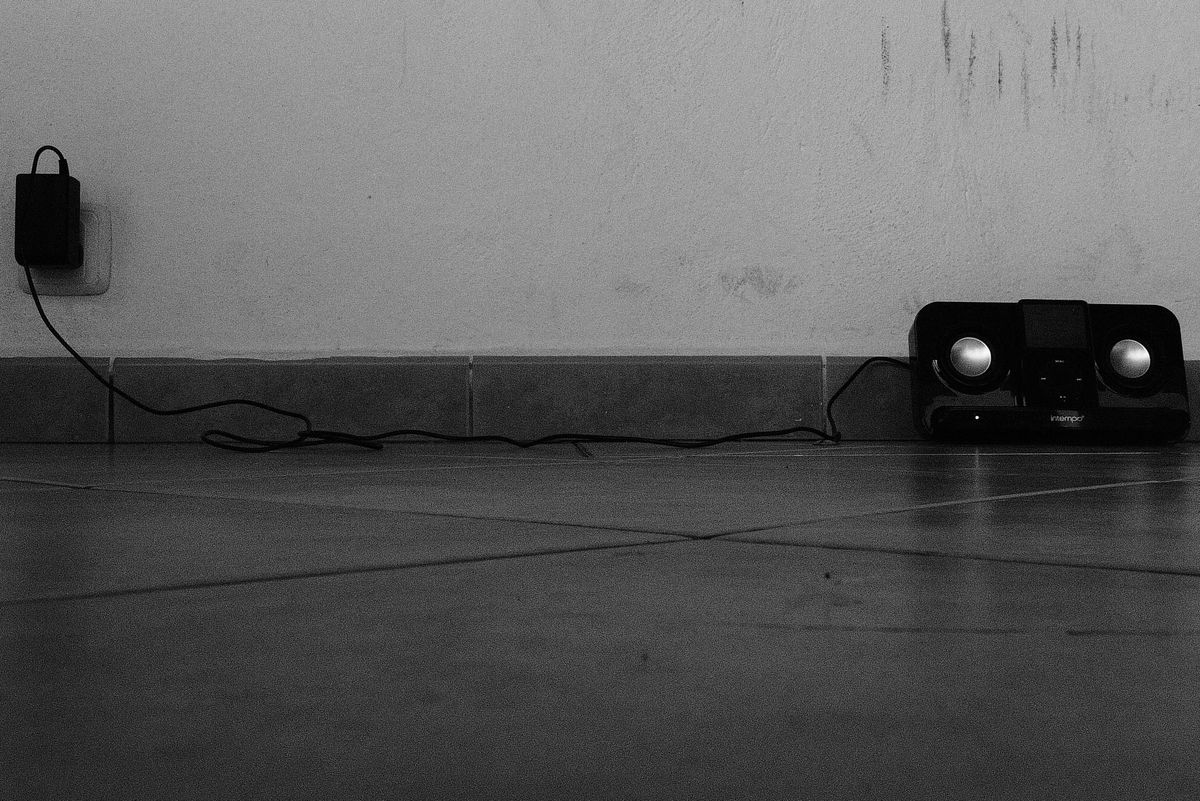
The system had fallen over
In the startup, on any given day: customers calling, ops drowning in alerts, execs pinging chat. All of it communication - and all of it affected by noise. On the four kinds of noise, and why your message didn't land.

I worked in a startup for a while, from early days to exit, and like most startups, it was under-structured, under-funded – in the early days, at least – and largely held together by everyone doing a bit of everything to keep the lights on and the product itself running. Which is exactly why startups are thrilling and awful at the same time, often in the same afternoon, sometimes within the same hour.
A lot of those early days was helping promising-looking ideas move toward shipping, then watching closely once they shipped to find out whether they were actually worth anything. That's the great advantage the small and scrappy have over the big and cautious: they can test things faster, cheaper, and with more learning. The downside nobody prints on the job description is that it can be, in a word, chaos.
I tell you all this to set the scene for a communication idea worth playing with: noise.
On any given day, the customers were calling in relentlessly (the system had fallen over). The operations team was drowning in a thousand automated alerts (the system had fallen over). The execs were pinging the chat channels because their friends were complaining (the system had fallen over). And sales were out there, in the field, trying to sell something that wouldn't work in the demo (the system had fallen over).
This happened with a frequency that would be funny if it hadn't been happening to us – a rich area for improvement for sure, and not at all unusual for anyone pushing the boundaries and reaching for the stars in business.
All of that is communication. And all of it creates noise – messages flying in every direction, channels lighting up, everyone rushing to make the thing work again. It's no wonder, in all that immense racket, that messages didn't always get through. The signal was simply too low against the noise.
The email asking for a case number vanished under the deluge. The polite request to send a report on something landed as a personal affront on someone already at breaking point. The hasty chat reply, mashed by hilarious autocorrect and clumsy fingers on a phone, and subsequently turned into nonsense, was ignored because nobody could understand it. The message sent at seven in the evening arrived in the inbox of a colleague who was, by then, asleep at his desk after an all-nighter, his face planted firmly in a pizza box.
All noise. All of it crowding out the signal. And every one a different kind of communication problem – which, lovely for us, helps us work through it.
Because whenever we communicate, we're up against noise. In communication theory, noise is anything at all that interferes with a message – how it's sent, how it's received, how it's understood. It's everywhere, and it's especially loud at work. The better we understand it, the better our chances of cutting through it and actually landing what we meant to say.

It's tempting to think communication is simple and that's it's purely the transmission of information. You have an idea, you share it, someone receives it, done. But that's rarely how it goes, and it's this belief that often causes many of the problems in our workplace.
Communication is not about the transmission of information alone. It is the creation of understanding between people. The sender has to encode an idea clearly; the receiver has to decode it accurately; the medium or channel has to carry it; and noise can creep in. It's why messages go astray, why people talk past each other, and why "but I've already explained this" is one of the most-uttered sentences in any organisation. The old Shannon and Weaver model captures it simply enough: a source – you, with a purpose – encodes a message, sends it down a channel, and an audience decodes it and decides what it means. Noise is whatever gets in the way, anywhere along that chain.
And it's extremely helpful to know that it isn't all the same noise either. There are four kinds – and the startup story, nicely for us, gives us a perfect example of each.
Physical noise is interference in the channel itself – the literal racket, the broken internet line, the inbox so full, and getting fuller, that the real message disappears in the mess. The lost case-number email was pure physical noise: nothing wrong with the message, everything wrong with the crowded channel it landed in, the receiver likely didn't even see it. The fix is rarely a better message. It's a better channel, like, maybe going to speak to them, or, as the dread seeps in at this one, picking up the phone and calling them.
Physiological noise is the state of the body – tired, hungry, unwell, running on no sleep. The colleague asleep at his desk, with his face in an empty pizza box at seven, wasn't going to receive anything, however well phrased. Timing and human attention capacity are part of the message whether we like it or not; a brilliant note sent to an exhausted person is a message that may never arrive.
Psychological noise is the state of the mind – stress, fear, defensiveness, the mood someone's already feeling before you say a word. The polite request was read as a personal attack not because it was one, but because it reached someone under enormous pressure, ready to hear criticism in almost anything and not thinking entirely rationally. When the emotional temperature is high, the words barely matter; the feeling gets there first – and people tend to remember how you make them feel.
Semantic noise is interference in the meaning itself – jargon, ambiguity, the message that autocorrect and clumsy fingers made unreadable. The autocorrected chat reply was semantic noise in its purest form: the sender knew exactly what they meant, and the receiver hadn't a hope of working it out. Clarity here isn't a nice to have. It's the whole job. A quick check of the message before sending is always a wise move.
Communication is a shared act, and the listener has a real part to play. But the responsibility sits, mostly, with the sender. It's on us to choose the right medium, to strip out the noise we can, to adapt the language and make sure it is clear, to be aware of the timing and the context – and to be in a fit state to communicate while helping the other person be in a fit state to receive. Which is why, when a message doesn't land as you expect, the powerful question is never "why didn't they get it?" but "what could I have done differently?"
So the next time something you've sent doesn't land, it's worth a moment's diagnosis before you simply say it again, only louder, and in ALL CAPS. Which noise was at play – the channel, the body, the mood, or the meaning? Could you simplify it, move it to a better medium, or send it at a more appropriate time? Was the room too crowded, the audience too large, the moment in time just not right?
Understanding noise, and the role it plays in communication, won't make communication problems disappear – nothing will do that – but it remarkably improves the odds that the thing you actually meant is the thing that actually arrives, and, crucially, creates understanding. Which, in a working life largely made of communication, is a superpower in the world of work.
The system, for what it's worth, eventually stopped falling over. Mostly.
01
Physiological
Physical state
The sender's or receiver's physical and mental condition — fatigue, stress, hearing, energy levels.
e.g. Tired in a long meeting. Stressed during a difficult conversation.
02
Physical
Environmental barriers
External interference — inbox overload, notification noise, poor audio, distracting environments.
e.g. Email buried in a full inbox. Camera off in a video call.
03
Psychological
Mindset & emotion
Emotions, assumptions, power dynamics, and confidence — the most overlooked form of interference.
e.g. Anxiety before a senior meeting. Boredom in a long briefing.
04
Semantic
Meaning & language
Words interpreted differently than intended — jargon, ambiguity, technical language, cultural gaps.
e.g. Acronyms that exclude. Vague instructions that create assumptions.
Based on the Shannon & Weaver model of communication — adapted for organisational practice
Where this sits in the Atlas
Orientation·Idea to Value·Communication·Creativity & Climate·Learning