The Everyday Communication Workshop
Watch what happens in a good meeting when someone paraphrases another person and gets it back slightly better than the original speaker put it. A nod, a laugh, and the room moves. That moment is understanding — and it's the thing every good outcome downstream depends on.
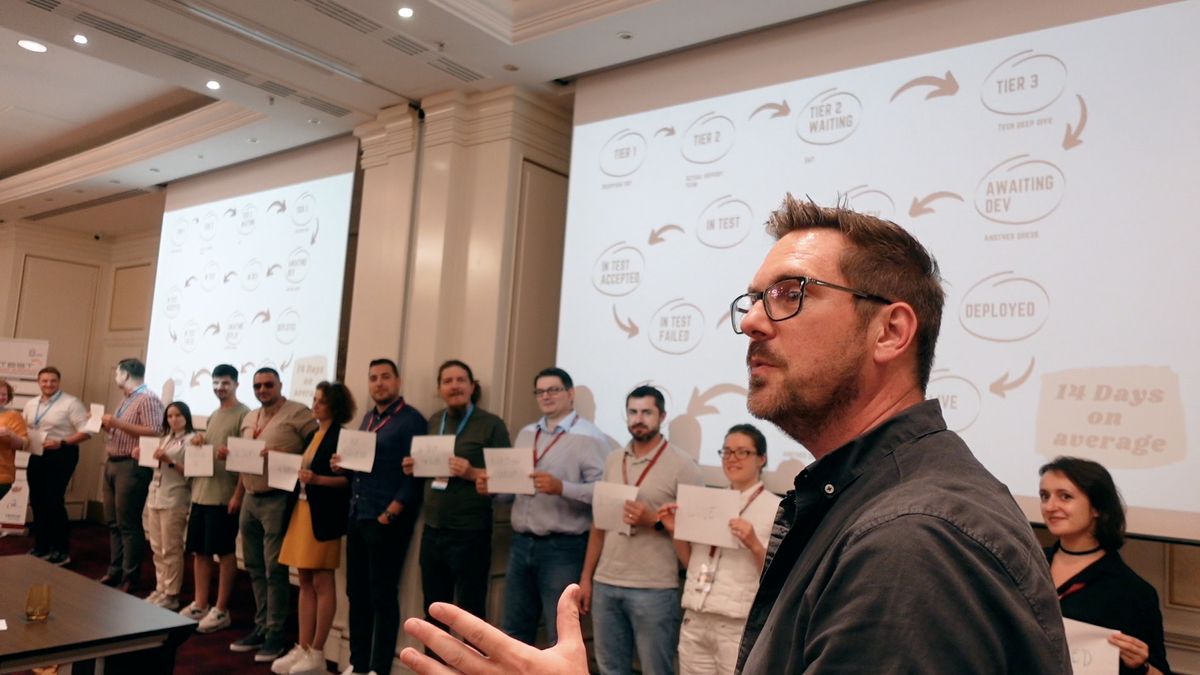
For the meetings, the messages, and the conversations that make up the actual working day. Award-winning, and run over 250 times inside organisations and at events.
How understanding actually happens between people at work
Watch what happens in a good meeting when someone paraphrases what another person has just said, and gives it back slightly better than the original speaker put it. There's a small moment — a nod, a laugh, sometimes just a change of posture in the room — and then everything moves. Understanding has happened. And whatever the meeting was for is now possible.
That moment is worth more than most of the process an organisation runs on. It's the everyday workplace communication that determines whether decisions travel, priorities align, difficult conversations resolve, and ideas grow into whatever they were meant to be. When two people genuinely understand each other, they can move in minutes what teams without understanding spend weeks turning over in different rooms.
The interesting question isn't why organisations have communication problems. Every organisation does. It's why understanding — the thing everyone claims to value — is so rarely the focus of how people are actually developed. Meetings are trained. Presentations are trained. Slides are trained. The thing underneath all of them, the thing that determines whether any of them actually work, is usually assumed rather than developed. And that is understanding.
This workshop makes it the focus.
Why I call it the wiring
Every organisation has visible things — the strategy, the plan, the roadmap, the deck — and the invisible thing that makes them work: the ordinary communication between people. The wiring. How meaning travels from one head into the work a team does together. How decisions get made, how priorities align, how trust builds, how ideas keep their shape as they move through people.
When the wiring is good, work becomes lighter and everything moves. Meetings produce clearer decisions. Feedback lands as feedback not criticism. Difficult conversations get handled early. People feel understood — which, it turns out, is the first condition of anyone feeling able to contribute properly. The climate around the work improves. Not because anyone announced anything, but because the ordinary exchanges between people got cleaner.
I call it a superpower internally, and the language sometimes slips into the room, because the effect at the individual level looks like one. Someone whose communication is clear appears more confident, more decisive, more influential — usually without seeming to try. Their thinking wasn't better than their peers'. The wiring between what they think and what they say was.
A note I make at the start of every session, and it's worth making here. These are powerful skills, and they're the same skills that let people manipulate as well as influence. The techniques that move a team into positive action move people the other way just as easily. I teach them because I trust the people in the room. Use them for good. I'm only half joking about that last part.
What this workshop is not
Most communication training treats communication as a surface skill — style, energy, tactics — and teaches one person's version of it to a room full of different people. And participants either end up performing someone else's personality or quietly conclude the training wasn't for them. Anyone who has spent time in HR or L&D has seen the pattern often enough to be cheerfully sceptical of most communication workshops on the market.
The Everyday Communication Workshop is built differently, because understanding — not performance — is the thing we're actually after.
I bring a grounding in Media Science: the empirical study of how messages move between people, why they distort, and what happens between what one person means and what another person receives. From that foundation, the workshop is built around a single principle that underpins all effective communication, in every context.
Participants don't have it handed to them in the first ten minutes. They discover it together through a sequence of exercises early in the session, which is one of the more enjoyable things to watch unfold. Once the principle lands, everything else has somewhere to anchor.
From there, the session layers in ten further elements — each context-specific, each grounded in communication science and twenty years of practitioner experience — before moving into non-verbal communication and then applying everything to the real conversations participants walk back into on Monday morning.
Quick reference — eleven principles
The wiringEleven principles of effective communication
Not rules — orientation points.
Purpose, audience, context
Communication falters when any of these three is unclear.
Care creates energy
Enthusiasm is not performance. It is conviction.
Responsibility sits with the sender
If it did not land, it did not work.
Stories travel where facts cannot
Humans are wired for meaning before data.
Attention is expensive
Respect it. Know your content. Be brief.
Practice is preparation
Confidence is earned before the moment arrives.
People remember how you make them feel
Emotion outlives information.
The body speaks first
Presence is persuasive before words appear.
Similarity builds trust
Rapport precedes influence.
Physiology shapes performance
State changes signal clarity.
Listening is the highest form of respect
Understanding precedes being understood.
Knowing yourself comes first
Understanding travels both ways. And the first step to understanding others more clearly is understanding yourself — your natural style, your strengths, and the places where your defaults quietly work against the version of you that lands most cleanly.
This is why the workshop is built around self-awareness rather than imitation of a single ideal. Some people are naturally direct and are wonderful in a crisis but benefit from softening the edge when the stakes are relational. Some are naturally warm and hold rooms together but need to land more firmly when a decision has to be made. Some are quiet thinkers whose strongest ideas need more space to be heard. There is no universal correct setting. There's just the version of you that lands most cleanly with the people in front of you, in the situation you're in.
For corporate clients, I encourage every participant to come in with their DISC, Insights, or equivalent profile. It's not required — The Everyday Communication Workshop works perfectly well without it — but it sharpens the personalisation, and it means the language you already use for your teams runs through the day. The principles are universal. The application is personal. Knowing ourselves is the bridge between the two.
Why this works for cross-functional groups
This session is most often run for cross-functional groups inside an organisation — people from different teams, sometimes who don't know each other well, all identified as wanting to develop their communication. It also works beautifully for stable, well-formed teams that want a shared standard, and for conference audiences where the whole room is strangers.
The grounding principle is universal, so the substance doesn't depend on shared context. And mixed groups often produce the strongest learning. Participants get to practise building understanding across genuine difference, which is a lot closer to the real texture of an organisation than practising with people who already understand them.
The session is consistently rated as one of the most interactive, useful, and genuinely enjoyable communication workshops people have attended. I take that last part seriously. People learn more when they're engaged and laughing, and they engage more when the practice is relevant, the exercises work, and the room has some life in it.
What participants leave with
A grounding principle that applies to every situation where they need to communicate clearly, and the framework to recognise when they're moving away from it. Fresh self-awareness about their own default style and how to use it deliberately, and when to shift to meet the audience. Practical capability in the situations that matter most at work — meetings, interviews, presentations, written communication, difficult conversations, conflict, and influence. The ability to read non-verbal communication, both their own and other people's, and adjust deliberately rather than default.
And a way of thinking about communication that compounds. Most participants describe noticing things in conversations the week after the session that they would have missed before — a colleague's genuine question, a shift in the room, a chance to paraphrase back and land the point cleanly. That's the work continuing on its own, at the desk, in the meeting, in the corridor — which is where any real change actually happens.
What changes for the team and the organisation
When communication improves across a team, the work around them starts to feel different. Not because anyone becomes more talented, but because the environment they're working in gets clearer, calmer, and easier to move in.
Understanding creates clarity: people know what the meeting was actually about, what the feedback actually meant, what the priority actually is. Clarity creates alignment: teams stop solving different versions of the same problem in different rooms. Alignment creates momentum: work moves, because it isn't hitting invisible friction between people. And momentum turns into the outcomes the team was set up to produce.
Meetings get shorter and produce clearer decisions. Difficult conversations get handled earlier and more calmly. Feedback becomes something people can actually use. Individual presence sharpens — not louder, not more animated, just clearer. Collaboration runs more easily, because meaning is travelling more cleanly between people.
The culture shifts too, though it takes a little longer to name. Teams whose communication is reliable trust each other more. People raise concerns earlier. Ideas that would have died in a corridor find their way into rooms where they can be used. The workplace becomes somewhere people can do their best thinking — which is the condition every other outcome quietly depends on.
Who this is for
HR directors, L&D leads, and senior leaders looking to raise the communication standard across a team or a whole function. Managers whose people are capable and whose ideas deserve to land at the level their thinking already reaches.
Organisations going through change, growth, or restructure — where the communication load is about to increase and the leadership team wants the wiring ready for it. Customer-facing functions whose work depends on clarity under pressure. Professional and technical teams whose people know more than they're currently able to express.
The common thread: teams of capable people whose communication could be as sharp as the rest of their ability — and leaders who understand this is one of the largest returns available to them.
How the session works
Delivered in person, on site, in a single working session — half-day or full-day depending on depth and the number of applied scenarios in the afternoon. Groups of 12 to 55. The smaller end allows deep individual practice; the larger end works well for whole-organisation rollouts, all-hands development days, and conference settings.
The shape of the session: discover the grounding principle through interactive exercises, interactive game to demonstrate, quite clearly, why communication is essential in creating value, layer in the ten context-specific elements, work through non-verbal communication, and then apply everything to the real conversations and situations participants are walking back into.
For corporate clients, I scope the session with the buyer — usually an HR director, L&D lead, or the senior leader whose team is attending — beforehand, to tailor the afternoon scenarios to the specific dynamic the group is working through. It's what makes the session land rather than glance off.
What people say
"Of all the training I've done over my career, this is the one that's had the most immediate and positive impact." — Sylvia
"Practical, engaging, and immediately useful." — Scott Summers, Director
Highly rated at every conference and corporate engagement it's been run at. Award-winning across multiple industry conferences.
A body of work behind the workshop
The workshop stands on its own. Teams and organisations run it as a self-contained session and get the value they came for — a clearer, more reliable way of communicating across the group, and a set of practical capabilities that hold up once people are back at their desks.
It also sits inside a longer thread of writing and practice about how organisations turn ideas into value, and where understanding tends to make or unmake that along the way. If a team runs this session and finds it useful, there's more to draw on — writing, other sessions, a companion workbook. Nothing in the workshop depends on any of it. The session is the session.
About Rob
I'm Rob Lambert — a writer, teacher and workshop leader whose work is about learning to see. Twenty-five years across engineering leadership, HR, and consulting, including senior roles as VP of Engineering and VP of HR at the same high-growth company, gave me an unusual view of how ideas move through organisations from both sides of the wall. The Whole Journey is the workshop that most directly teaches what I've learned from that view.
I've written several books, including The Life of an Idea, Zero to Keynote, and Workshop Mastery. The Whole Journey draws on all of them, but it's built for the room — not for the page. What you get on the day is the practice, live, in one place, on your organisation's actual work.
More about the wider practice →
A simple starting point
If you've got a team of capable people whose communication could be as sharp as the rest of their ability, this is the session for precisely that. Teams tend to feel the difference within the week.
The first conversation is twenty minutes. I'll spend it understanding what your team is working on, and then propose something honest about how the workshop would be scoped for you — including format, group size, and investment.
Start the conversation
A twenty-minute call to scope the right session for your team
I'll spend it understanding what's actually going on for your group — the friction, the audience, the context — and then propose something honest about how this workshop would be scoped for you. Including format, group size, and investment. No pressure, no follow-up sequence.
Continue the work — from the Cultivated library
Effective Workplace Communication
162-page workbook · Digital PDF
For individuals who want to develop the underlying capability of effective communication.
A practical workbook covering the grounding principle, the eleven principles in depth, the elements of communication, individual style, non-verbal communication, active listening, writing, and meetings. Built from the same material the workshop is grounded in.