Paper is thinking technology
In a world built for speed, a blank notebook offers something rare: bounded space, physical presence, and attention with a bit of friction. On analogue tools not as nostalgia, but as environments for thinking.

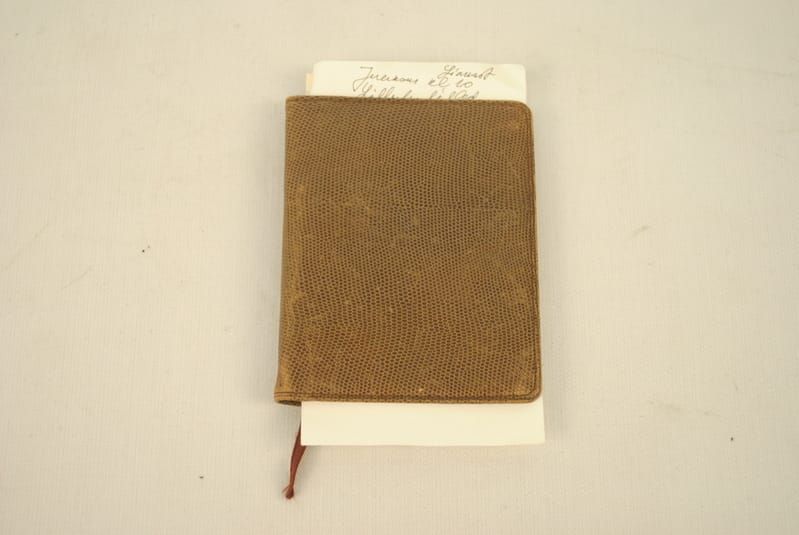
Writing by Hand: The Friction That Makes You Think
There's something slightly ridiculous happening with stationery. You know – pens, paper, rulers, binders...
We've spent the last thirty years in work and life making everything faster. Faster computers. Faster internet. Faster search. Faster communication. Faster apps. Faster cars. Faster ways of writing things down, finding things, sharing things, storing things, moving things and getting things done.
And now we're buying notebooks. Sometimes very expensive ones, with thick 120gsm paper. And we're buying nice pens. Some of us, yes, like me, have even bought typewriters. Not that people weren't already doing these things, but lots more have joined the fun.
There's a reason the analogue practitioner posts on this site do so well, and probably the same reason the Stationery Freaks podcast I co-host keeps growing too. It isn't simply a fetish for Ivory 120gsm paper and beautifully machined ink pens, although I am absolutely not going to pretend that isn't part of it. Something else is going on.
We're beginning to realise that making everything easier isn't always the same as making it better.
Sometimes the useful thing about a notebook is that it doesn't have search. Maybe it's because it also has edges and boundaries. It's finish-able, which is a strangely wonderful trait in today's infinite digital editorial space.
The useful thing about a pen is that you can't press undo. The useful thing about paper is that, eventually, you run out of it. And that little bit of inconvenience changes the way you work.
I was scrolling the other day – yes, the irony is not lost on me – when I came across a post by Gary Vaynerchuk, the sweary marketing chap you've almost certainly encountered if you've spent any time on social media, predicting that one of the big things for 2026 and beyond will be analogue.
I thought: Well, isn't that's an interesting place for the future to arrive at, from the mouth of a digital social media guy?
But he's not alone in noticing it. A friend of mine runs a stationery shop and tells me sales are flying. Through the podcast I hear similar stories from makers, printers and binders. People are coming back to paper. And I think I know why.
We've become very good at removing friction in our lives. Which is potentially a good thing. If you want to send a message, you don't want too much friction. If you want to find a document, you don't want friction. If you want to share a photograph with somebody on the other side of the world, you definitely don't want friction.
But we've started applying the same logic to thinking too. And thinking is different. With thinking, sometimes friction is where the good stuff happens.
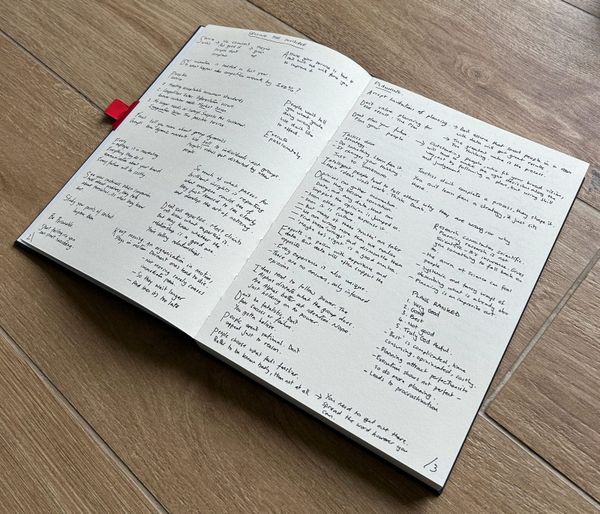
Take a notebook. You have a page. And that's it. There are no notifications, or tabs, or pop-ups, or widgets showing the share price. There's no inbox telling you there are 3134 unread emails for you. No algorithm deciding what you'd like to see next based on what you've seen before. Just a rectangle of paper and the wonderful realisation that you've got to decide what deserves to go on it.
You write something, then cross it out, then draw an arrow, then re-write it and write some more. You run out of space so turn the page. You write some more, doodle a diagram, carve off a portion to the side and capture some further ideas. You discover that the thing you thought was a problem was actually three problems.
You now have a formed idea and then sketch something in five minutes that would have taken twenty minutes to craft in PowerPoint. The notebook hasn't really made you more productive, it has made you stay with the thought. It's helped you clarify it, noodle it, break it apart, rebuild it five times, find the thread, discover the principle, and find the right words to express what's in your head.
Digital tools are brilliant at what they're brilliant at. They are fast, searchable, collaborative, connected and great at taking something you've already figured out and moving it around the world.
But they're not always particularly good places to figure something out. A blank document on a screen can feel like work. A blank notebook can feel like possibility.
With paper there are no specifications to optimise and no software update to install. There is just the page. And the page has edges. This is one of the great advantages of analogue tools: they have limits and constraints. A notebook runs out eventually. A page fills up. A typewriter ribbon eventually stops working, or the hammers get tired and lock, or the key just stops working.
With analogue tools you have to choose how to use it, which is rather liberating. You have to stop, turn the page, grab a ruler, rub something out, sharpen a pencil and refill the ink. And all of this sounds horribly inefficient.
It is. And that's the point. Because on the other side of all this friction are rewards.
Writing by hand puts pauses into your sentences. Crossing something out leaves the history of the thought sitting there in front of you. Numbering pages makes you aware that you're building something rather than merely producing another stream of text.
Even the stupid little things matter like ticking something off a list you've already completed, or choosing which pen to use with which paper. Finding an old note six months later and discovering that the idea you thought was rubbish was actually quite good – I do this often.
These absolutely aren't productivity hacks but they are part of the experience of thinking.
And perhaps that's what the current analogue revival is really about. Not nostalgia. Not a rejection of technology. Not some fantasy world in which everyone throws their MacBook into a hedge and spends the afternoon writing sonnets by candlelight drinking Yerba Mate tea.
It's about choosing where to put the friction back, for you, in a way that helps you – to get the rewards that come on the other side.
I want my messages to still travel quickly with limited friction. I want my photographs backed up automatically to the cloud. I want to search 15 years of documents in three seconds to find the one I'm after.
But when I'm trying to work out what I actually think? I'll take the notebook.
I think there's also something wonderfully physical about it all, although I am, clearly, bias. A thought that exists only in your head is rather easy to argue with. Put it on paper and suddenly you can point at it and it stands up to more reasoned analysis.
You can move it, circle it, cross it out, highlight it, add something underneath or expand it in several directions. When you draw a line between two things that didn't seem connected ten minutes ago, you might get the next big breakthrough you need.
The thought becomes an object. And once it's an object, you can work on it. That's why I sketch and write plenty of ideas. It's why I write things out by hand, including entire presentations and keynotes. It's why I keep different notebooks for different sorts of thinking. Not because I've discovered a magical productivity system, but because the tools change the work.
The notebook isn't neutral. Neither is the laptop. Neither is the whiteboard. Neither is a camera.
Each one gives a slightly different way of looking at the world. A camera makes you notice. A notebook makes you linger. A sketchbook makes you experiment. A journal makes you remember. While a very good pen makes the whole thing far more enjoyable. And enjoyment matters too.
We have a tendency to turn every tool into an optimisation problem. What's the best notebook, or camera, or app, or system for this and that? I think we're asking the wrong question.
Try: What makes you want to do the work?
That's a much more interesting test. Because the best tool might not be the fastest one, I suspect it won't be. It might be the one that makes you sit down, pay attention and be more curious about what might happen on the next page. It might just be the one you enjoy picking up the most. And if that happens to be a beautifully made notebook and a ridiculous fountain pen, well, there are worse vices.
The digital world isn't going anywhere though, and nor should it. I'll happily use every bit of technology available when it's useful.
But I've started to think that the future of good work might involve a slightly more complicated relationship with speed. Sometimes we may want things to move faster and with less friction, and to stay out of the way of it all. And sometimes, when we're trying to think about something that matters, we need a little friction between the thought and what it brings out to the world. Because, on the other side of that friction is a wonderful reward that makes it all worth it.
So I'll keep using the notebooks and the pens and the typewriter. I'll keep writing things down that could probably be typed much faster on the computer. Not because paper is better than a screen.
Because sometimes slower is where the interesting bit starts.
Creative Soul Projects
There's a video that goes with this piece about my top stationery items.
It's over on Creative Soul Projects. Same person, same observation – just followed on camera instead of on the page. Explore the channel.
Where this sits in the Atlas
Orientation·Idea to Value·Communication·Creativity & Climate·Learning
Join the Studio
Most of what I make is free – the essays, the letters, the podcasts, the guides, the Commonplace Book. The Studio is the deeper room. Here's what studio membership brings:
The Department of Interesting Things (DOIT)
The Department of Interesting Things, other than being a fun name, is a monthly practitioner guide to seeing, thinking and communicating better.
Idea to Value - Practitioner Handbook
The full practionery handbook for helping ideas move to value, and making it worth being part of the work that gets it there. Twenty-six principles, full idea to value flow, all designed to help you see where value is stuck and intervene with confidence.
Guides, templates and canvases
Studio member only templates, guides, and frameworks to use straight away.
Studio notes and working drafts
Behind the scenes, in the work itself
Direct access to Rob
Email me, response within 24 hours.
Discounts on products and services
10% off everything in the store.