The talk that ate the afternoon
Here's how to structure a talk with a two-pound stack of index cards - plus the full step-by-step method, free to read in a complimentary edition of The Department of Interesting Things.

A Lost Keynote, a Stack of Index Cards, and the Difference Between Writing a Talk and Arranging One
I once sat in row H of a hotel ballroom, nice cup of tea in hand, and watched a very clever person lose two hundred people. Even though, let's be honest, she had a wonderful font on her slides, with lovely images.
She knew her subject astonishingly well. The opening was good. There was a proper connection with the room. For the first ten minutes, I thought, and no doubt others did too: this is going to be good.
And then, somewhere around slide forty, the talk stopped going anywhere. There was no great crash, or astonishing moment. It simply wandered off. As did many of the audience too. A fact appeared. Then a diagram. Then a story which began somewhere near the subject, took a scenic route through several other subjects, and eventually disappeared out of view.
The man two seats along started answering his emails. Three people near the back were asleep. A woman near the front turned her conference badge over and began reading the back of it.
The speaker had lost the room.
The interesting part of this was that the base material was very good indeed. There were interesting ideas, useful examples, good stories. The problem wasn't a shortage of things to say. It was that everything had arrived in roughly the order she'd thought of it. She hadn't run out of material. She had too much, and didn't follow a thread the audience could connect with.
I recognised it because I used to give exactly this talk. And spend a lot of time now helping people avoid this same mistake.
In my early speaking years, I'd sit down to “write” a keynote, which was shorthand for opening PowerPoint and making slide one. Then slide two. Then slide three.
This is an extremely satisfying way to make a presentation. A nice pot of tea, the search for the right font, liberal use of nice images. It's marvellous. You can see your progress. Little rectangles accumulate. Adjustments to sizes, themes, backgrounds, graphics and images is all rather satisfying. You start to feel productive. By eleven o'clock you've made 37 slides and have acquired a real bond to a diagram you spent 45 minutes aligning, even though PowerPoint did it's best to mess it up for you.
What a wonderfully productive day. You decide to call it quits for the day on slide 38 – the one with the lovely animated arc that took twenty minutes to create. You've also spent a significant proportion of your finite supply of time, energy and attention on something that may turn out to be slides 1 to 38 in a talk that doesn't actually work.
Still, there's more to tinker with. So you change a headline. Move a bullet. Try a different photograph. Delete slide 19 and feel briefly elated. Like you've masterminded becoming a ruthless editor.
Then put slide 19 back because, actually, it was quite a good slide and it took such a long time that, frankly, it's earned its place. You change a word from “important” to “essential” and tell yourself you've improved the structure.
I've been there. The problem, I eventually realised, begins with the word write. We say we're going to write a talk, so we reach for the tools of writing and start producing sentences. But a talk isn't really written. It's arranged.
This sounds like a small distinction. It isn't.
A good talk is a route through an idea. The audience needs to know where they are, roughly where they're going, and why they should come with you. They want to understand something, from their perspective, not be bombarded with lots of information that makes sense in your mind, but not in theirs. Slide software is not particularly good at helping with this. It is brilliant at making things permanent. That's rather different.
The moment you've spent an hour making a beautiful slide, you don't want to move it. The moment you've found the perfect image, you don't want to cut it. The moment you've built a clever animation, you certainly don't want anyone suggesting that the entire section might be unnecessary.
You start defending it. And so you end up with a talk designed around the things you've already made rather than the thing the audience actually needs to understand. Your talk becomes something chosen for you, rather than something you absolutely controlled.
Which brings me rather swiftly to the solution. It costs about two pounds. The magical index card. A stack of them.
You don't need the expensive ones. In fact, I'd suggest ignoring the expensive ones. This is not the moment for your nice stationery, as much as that pains me to write.
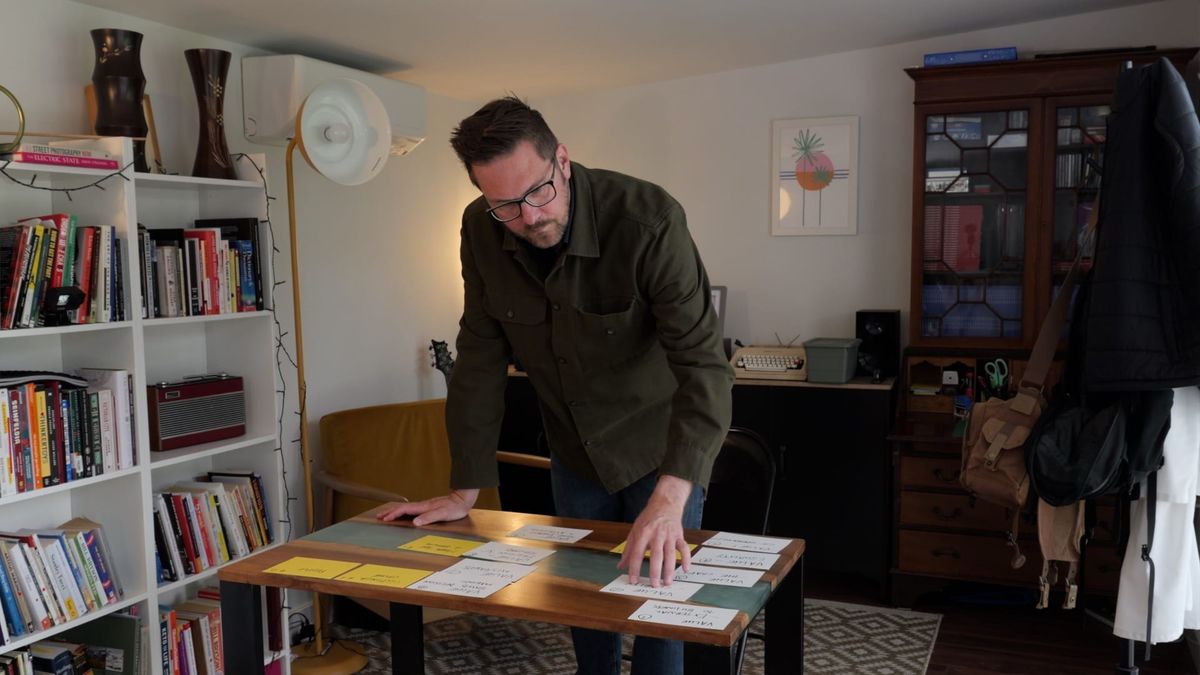
One card. One idea. You empty your head onto the cards: points, stories, examples, facts, observations, good lines, things you think are probably important. These are not replacement for slides. They are not the slides at all. They are simply what you hope to say in the talk, everything, written one thought per card.
Then you put them all on a table, or a wall, or a desk and become that master of talent show silliness, Simon Cowell. Your task now is simple, judge each card, as though it were in an audition, and ask, does it earn it's place? Keep it. Cut it. Move it.
The beautiful thing about an index card is that you don't care very much about it. You haven't spent 45 minutes aligning it. You haven't found a beautiful photograph for it. It isn't animated. You wrote it in Sharpie in about a minute or less. So when you realise that something is actually quite dull when seen across the whole, you can throw it away. This is much harder to do with a slide. Or a £14 Moleskine page.
The cards also reveal something you can't easily see when you're building a deck: the shape of the idea. You start moving things around. These three belong together. That story actually needs to come earlier. That example is doing exactly the same job as this other example. This point was me trying to be clever, and not quite landing it. This story adds very little to the talk, and it's not helping anyone understand it. Eventually, a handful of cards begin to emerge as the spine of the talk.
Five, six or maybe seven key ideas. I call these beats, or the big movements, or the key points, or the point of view in a few cards. Not the details, but the salient points of the talk. The things that matter to the point of view and purpose of the talk, and the things that matter to the audience. In some respects, if someone were to ask you what the talk is about – well, those cards are it in a nutshell.
If you can't see the whole talk in about seven cards, and you cling to 10 or more, you probably don't have a talk yet. You have a subject. You have a collection. That's an important distinction. A subject can contain 200 interesting things. A talk cannot.
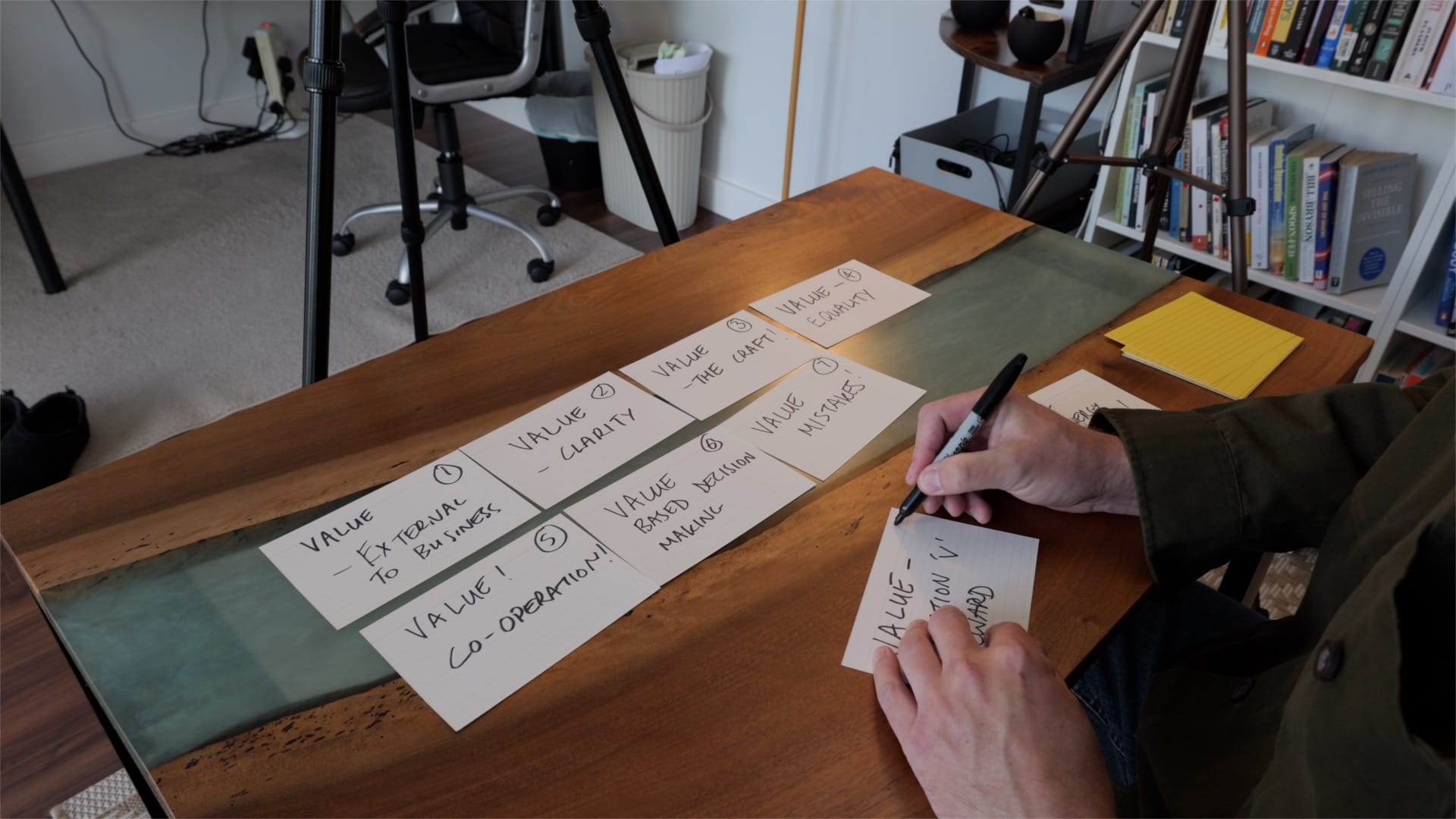
Once the spine is clear, you can start adding the detail back in. Stories that bring the facts to life, evidence that supports your claims, examples that help the audience understand the point more clearly.
You slide these new cards underneath the big ones and gradually build the structure out. The spine stays consistent, the new cards expand below it. Number the cards, because at some point you will drop them on the floor. The spine gets whole numbers, one through to seven, or so. The examples, stories and evidence sit below in increments of decimals. 2.1, 2.2, 6.1 and onwards.
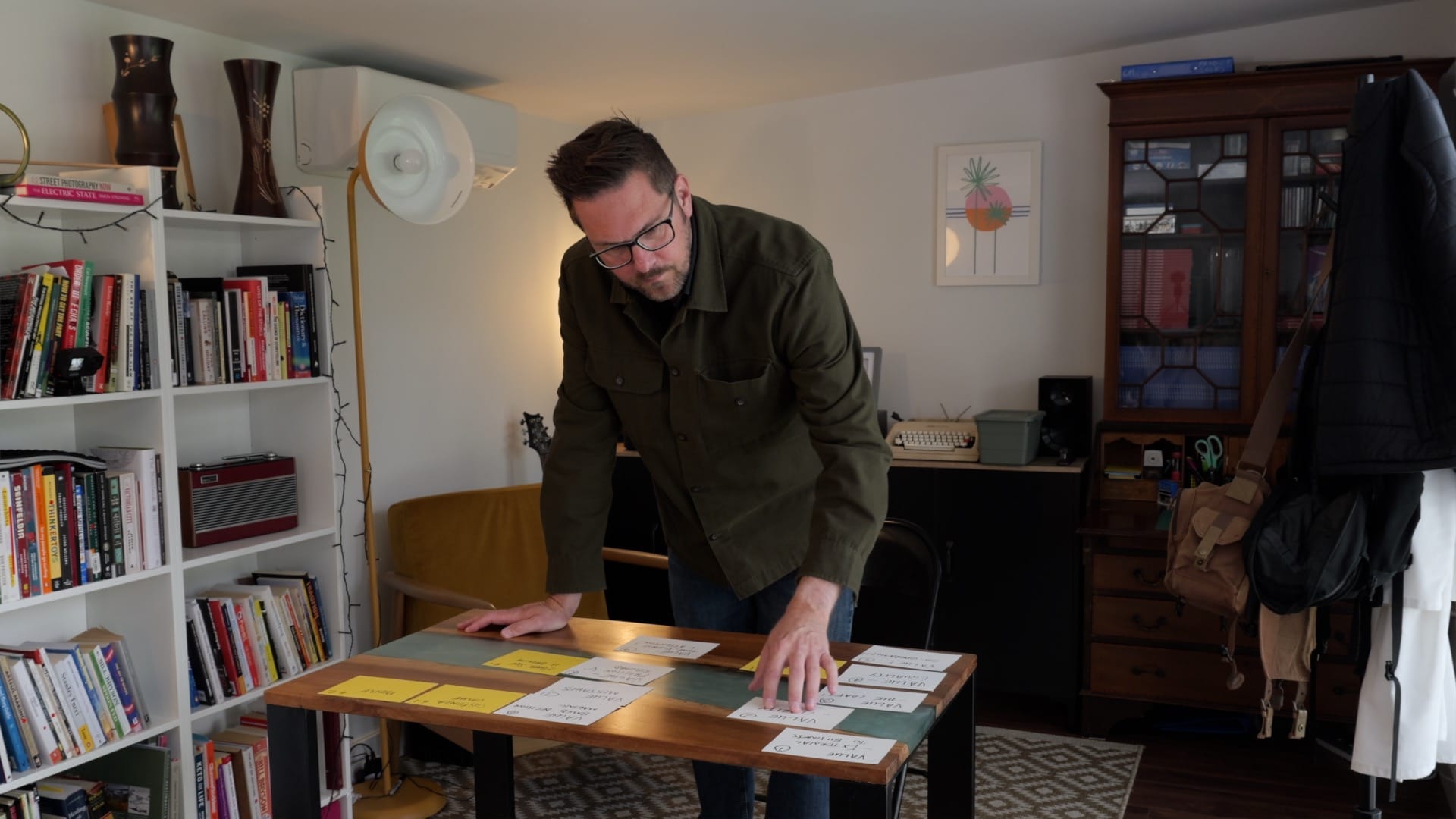
If the talk is too long, drop some decimals. If it's too short, add some in. This way you're keeping the thread and the spine of the talk intact, and you are bringing it to life, and within time, in the details that support it. Drop the stack of cards, which is likely, and without a numbering system you have a mild panic, tears and a puzzle. With numbers; you just put it all back together.
Then you script the talk, print it, read around, edit, fine tune, drop the big words and complicated sentences, and ensure it sound like something you would say. And maybe here, at last, the slides might make an appearance.
Now you can ask the much more useful question: Does this idea need a slide?
Some cards would benefit from a slide. Some clearly would not. Maybe a photo is better, or some light words, or a diagram. Some need three words in enormous type. Or, maybe, it's better to refine the sentence, let it land and let the audience digest it – with absolutely nothing on a slide because the audience should be looking at you. The slides support the talk rather than the talk becoming the slides.
And I think there is a bigger lesson hiding in this analogue system. Good thinking often needs to happen in a medium where changing your mind is cheap. Index cards are cheap. PowerPoint slides are expensive, not financially but psychologically. The minute you've invested an hour in something, your brain starts trying to justify the investment. This is why people keep bad meetings, bad strategies, bad websites and bad presentations alive.
Not because they're good but because they're theirs and they invested in them. The card breaks that connection. Index cards make ideas portable, movable and disposable. You can try something and you can change your mind. You can throw it away and you can start again.
The speakers we describe as naturals are often doing something much less mysterious than it looks. They've already walked the route, a long time before the talk itself. By the time they stand in front of you, they've moved the ideas around, cut the dead ends, found the sequence and worked out what matters, to you, the audience. They'd been the X-Factor judge.
The audience is experiencing the final version of a journey that the speaker has already taken several times in private, maybe on index cards too. What looks like effortless delivery is often just well-hidden arranging long before the stage called them up and the audience applauded. And that's why I think we should stop saying we're going to write a keynote. Writing is part of it, for sure. But first, arrange the thing, get the ideas out, put them on the table, move them around and throw some of them away. Find the spine, then write.
And, if you can possibly help it, don't start with PowerPoint. Start with something that costs about two pounds. You'll probably save yourself several hours and, more importantly, a room full of people reading the back of their conference badges and wishing they'd joined another track.
Finding something worth saying is a different puzzle, and a lovely one. I've given that chapter away in full over here if that's where you're stuck. This is the puzzle that comes afterwards. You've got too many good ideas, too many things to say, too much material, more things you want to share than a room full of human beings can reasonably absorb. Now you have to arrange them into something that another person can follow. That's what the index cards are for.
I've laid out the whole method step by step in the free public version of The Department of Interesting Things – some potted history of the index card, how to use the cards, how to play the judge, how to find the spine and how to build out the messy middle.
It's the way I build every talk I give, and how students in the Zero to Keynote workshop do too. And, as a useful side effect, it's the reason I no longer find myself at 11.47pm changing “important” to “essential” and pretending I've improved the keynote.
The cards cost about two pounds. Start there.
Creative Soul Projects
There's a video that goes with this piece, on Creative Soul Projects. Same person, same observation — just followed on camera instead of on the page. Explore the channel.
The Department of Interesting Things
As a studio member, you can access all editions of the Department of Interesting Things letters, and find all other membership benefits on the central studio page.
Thanks again for your support. It is appreciated. Catch you in the next seminar. Explore your Studio access.
In this edition of DOIT, we explore how to use an Index Card for assembling a great talk, from initial idea to the core thread that runs under a good talk. There's some history of the index card, how to use them, how I use them, how to play the judge of your own ideas and how to label them effectively.
If you want to find the thread of your talk, and you like analogue approaches, this one's particularly helpful.
Thanks
Rob
Studio Download