Workshops & Training
Award-winning workshops from the author of Workshop Mastery — scoped to your team, never off-the-shelf. Communication, creativity, management, and presentation training, delivered by Rob Lambert.
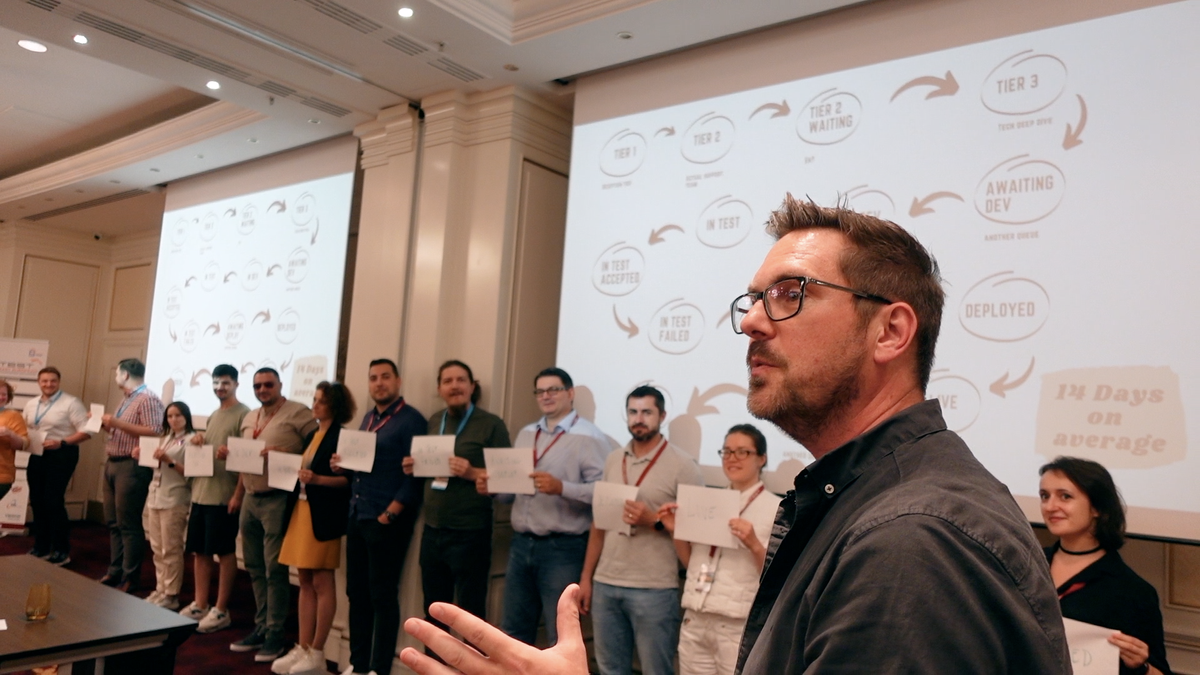
Training built around the conditions that turn good work into value
Training is one of the clearest ways to help good people get even better at what they do. A talk opens up a way of seeing the work; training is where a team takes that thinking and turns it into an ability they keep — the outside perspective turned into shared language, sharper skills, and habits that hold.
The work here is built for exactly that. Rather than a fixed course delivered the same way to everyone, each session is shaped around your people and the work actually in front of them — so what they learn lands, holds, and compounds week after week. Twenty years inside organisations, across publishing, leadership, engineering, and HR, sits behind every session. People leave with shared language, a clearer view of the work, and practical tools they can use the same week — and the work moves faster from idea to value as a result.
Spending money on learning compounds. The shared language and clearer thinking show up in every meeting, every handover, every decision, for years after the sessions. A good workshop is a small, one-off cost a team keeps drawing on long after they've forgotten what it cost, and more of their good ideas make it into the world as a result – sooner, and with less lost on the way.
How I think about workshops
Twenty years of teaching, running workshops hundreds of times, and writing the book about the art and craft of good teaching, has left me with a set of principles I return to for every session I design. They aren't rules. They're the checks I keep coming back to — and the standards I hold every workshop against, before it runs and after it ends.
01 - A workshop is teaching, not facilitating.
Every workshop I run is taught, not just facilitated. There is a subject, a structure, and someone in the room whose job is to help your people leave knowing something they didn't know before. That framing shapes everything — the depth of preparation, the discipline of the material, and the seriousness with which each session is designed.
02 - Avoid dullness at all costs.
Attention is the currency of learning, and enthusiasm is the fuel. Every session is designed to hold attention across the full day — through pace, variety, story, teaching methods and a genuine care for the subject that shows in every transition. Dullness is the one thing I refuse to let creep in.
03 - Purpose, audience, context — before anything else.
Every workshop starts with what your team actually needs to be able to do, who's in the room, and what constraints they're working inside. Everything downstream — the structure, the teaching methods, the specific examples — is shaped by that groundwork. It's the principle I return to most often in design, and the one that most reliably makes a session land.
04 - Simple to complex, one thing at a time. Real learning is laddered — starting with a grounding principle or truth, then adding the next layer, and the next, each building on the one before. Every workshop I design uses this inductive structure. Grounded first, built out from there, so what your team learns holds together in their heads, builds on what has gone before and stays long after the session ends.
05 - You can't teach everything you know.
Twenty + years of thinking about a subject has to become a session a room can absorb and put to use. That means keeping only what earns its place in the time available. The discipline of what to leave out is what makes what stays land properly.
06 - Interactive work must earn its place.
Every interactive moment in my workshops has a specific job — making an abstract idea concrete, checking comprehension, giving a new skill somewhere to land. Practical work carries the learning; it never fills time. When your team's hands and minds are active in one of my sessions, it's because the concept needed hands to make it real.
07 - Enthusiasm is not optional.
Genuine care for the subject is what carries a room across a full-day session. Enthusiasm isn't performance — it's the natural result of preparation, subject mastery, and actually caring about the people learning. It's what keeps energy in the room when the material gets harder or the afternoon gets longer.
08 - The teacher is still a student.
Every workshop I run, I learn something — about the subject, the room, my own approach. I keep a logbook after every session and refresh the material regularly. The Everyday Communication workshop has run over two hundred times, and I still find something to sharpen each time it runs.
The workshops
Over the years the same themes keep surfacing — communication, creativity, management, agility, presentation, and the underlying question of how good work actually moves.
These are the workshops that have emerged. Each is scoped to your team's specific situation rather than delivered as a fixed programme, but the underlying material is well-tested and ready to adapt.
Creativity of Constraints
With Sunday Times bestselling novelist Helen Callaghan, and organisational development coach Helen Lisowski
A collaborative workshop on turning real constraints into creative fuel — built on the principle that limits, properly understood, are the conditions for original thinking rather than the obstacles to it.
See the workshop → Manager developmentThe Manager's Practice
Management is a practice, not a position. This workshop is for managers who want to see how value actually moves through their team, intervene where it matters, and build the everyday conditions that help their people do their best work and grow.
See the workshop →Also available
Other workshops available — usually engaged by teams who've already identified what they're looking for, or by readers arriving from a specific essay on the site.
-
→
The Zero to Keynote Workshop
Practical presentation training for leaders and client-facing teams preparing high-stakes talks.
-
→
The Idea to Value Workshop
A working session on where value actually flows through your organisation, and where it slows.
-
→
Releasing Business Agility
A seminar on what business agility actually requires beyond the methodologies. Includes the legendary puzzle game.
-
→
The 10 Behaviours Workshop
A facilitated session where your team defines what the ten behaviours look like in their specific context.
How we work
Every team is different. The way one group works — how they communicate, how they think together, where their best work comes from — looks nothing like the next. That's why we don't run off-the-shelf training. What develops people is built around how they actually work.
Every engagement begins with a conversation about your people and what they're working on. Sometimes the right answer is one of the workshops above, scoped and adapted. Sometimes it's a sustained programme built around a particular capability the team wants to grow, or a change they're moving through.
Sessions run as half-day, full-day, or multi-session formats — in-person where possible, virtual where it makes more sense. Team sizes range from groups of six to cross-functional cohorts of forty.
All workshops are designed and delivered by Rob Lambert. Where a session draws on specialised expertise — the Creativity of Constraints workshop, for example — we co-deliver with a trusted collaborator named on that workshop's page.
The craft underneath the training
I've been teaching workshops for over twenty years, and thinking about the craft of teaching for almost as long. That work is public. I wrote Workshop Mastery — the practical guide to designing learning that actually changes behaviour — and its methods sit underneath every session I design. The Everyday Communication workshop, my most frequently delivered session, has run over two hundred times and won best-of-event awards at conferences across multiple industries.
The point of naming this on a training page isn't self-promotion. It's a specific reassurance. When you book me to run a workshop for your team, you're not booking someone improvising with material they haven't tested. You're booking someone who has thought about the design of learning — the structure, the pacing, the teaching methods, the recovery moves when a session drifts — as deliberately as the content. Your people get a session built for them, with material that has been refined against hundreds of rooms before them.
One story worth telling here. A few years ago I ran my presentation training for my own team of four, preparing to submit talks to an industry conference. All four of us landed on the agenda. All four of us finished in the top four of the event, ranked by the audience — first, second, third, fourth. I was quietly pleased to come first. The point isn't the ranking. It's that when the workshop material is built well, the results are transferable. Give people a real method, teach it properly, and the material does its work. That's what a workshop is for.
The book on the craft
Workshop Mastery
121-page guide · Digital · Workshop plan included
The practical guide to designing learning that actually changes behaviour — the method behind every workshop I run, tested and refined against hundreds of rooms.
Bespoke training
If none of the workshops above quite fits what your team needs, we'll design something that does. Most of our most useful training has started as a specific question from a leader about something they wanted their people to be able to do — and ended as a session built from scratch around exactly that.
Common bespoke briefs include: leadership team alignment sessions before a major change, communication training for a team about to scale, problem-solving capability built inside a team that wants to get sharper, and culture sessions built around a specific set of behaviours the team is making habitual.
The work always starts with a conversation. We'll spend twenty minutes understanding what your people are working on, and then propose something honest about whether we can help — and what it would look like if we can.
What people say
Conference organisers repeatedly return to bring these workshops back for the following year. Teams describe them as some of the most useful days of professional development they've had, with skills and language that hold months after the session ends. The Everyday Communication workshop has won best-of-event at conferences on multiple occasions across different industries, and been delivered over two hundred times.
"Of all the training I've attended Rob's Communication Workshop was the most engaging and practically useful workshop. Immediately applicable." — Sylvia, Attendee.
"Rob's energy, expertise, and amiable presenting style were a big hit — we left with new skills, insights, and practical knowledge." — Scott Summers, Director, nFocus
"Rob's workshops are guaranteed to hit the mark. They literally always win best tutorial, are engaging and our attendees say how much they learn" — Conference Organiser
About Rob
Rob Lambert is a writer, speaker and teacher who has spent over twenty years inside organisations — including senior roles as VP of Engineering and VP of HR — working on the conditions that let good work happen, and that let the people doing it grow.
He began his career in journalism and media science — the empirical study of how messages move, why they distort, and what happens between meaning and receiver. That discipline followed him into organisations, where one pattern kept showing up: when communication is clear, priorities make sense, and the climate supports them, capable people turn ideas into value and grow while they do it.
He's the author of Workshop Mastery, the practical guide to designing learning that actually changes behaviour, and the author of Zero to Keynote on the craft of speaking. His flagship Everyday Communication workshop has been delivered over two hundred times, winning best-of-event awards at conferences across multiple industries. His sessions are warm, practical, and quietly humorous, and teams come away able to see their work more clearly and put what they've learned to use the same week.
Start a conversation
Start a conversation
Let's talk about your team.
The best next step is usually a short call — twenty minutes to talk through what your team is actually working on and whether we can help. No pitch, no pressure. If the fit is right, we'll explore what a session could look like. If it isn't, we'll say so, and point you somewhere better suited.
Get in touch → Or email directly: info@cultivatedmanagement.comUsually responds within 48 hours.