Where work really breaks down

Most organisations don't have an ideas problem. They have a movement problem.

The ideas exist. The investment has been approved. The teams are capable and the effort is real. And yet — somewhere between the decision and the outcome, things get heavier than they should. Priorities accumulate. Work that was once clear starts to require explanation. Progress updates arrive that feel accurate and still somehow wrong. Teams are busy in ways that don't quite connect.

Nobody intended for it to be this way. It happened gradually. One competing priority, one unclear handoff, one piece of work that didn't quite ship the value it was supposed to — repeated, across teams, across quarters, until the organisation is running hard and moving slowly.

The problem isn't effort. It's rarely capability. It's usually the conditions — the invisible shape of how work actually moves, and where it quietly costs more than anyone intended.


Why we call it Idea → Value

The name describes the only journey that matters.

An idea enters the organisation. Somebody decides to invest in it. A team picks it up, applies their creative energy, and eventually ships something into the world. At that point — and only at that point — value can appear. Not before. Shipping is not value. Activity is not value. Everything between the idea and the moment a customer or a stakeholder is genuinely served is cost: money, time, energy, attention.

This is the lens the workshop is built on. Not as a judgement — most organisations are doing more useful work than they realise — but as a way of seeing. Because once you can see how ideas move, you can see where they slow down. And once you can see where they slow down, you can intervene — earlier, more confidently, and with far less disruption than change programmes usually require.


What this workshop is not

This is not a transformation programme. It is not a methodology rollout. It is not a new operating model wrapped in a one-day format.

Most leadership training in this space falls into one of two traps. The first is abstraction: a day spent on frameworks that make intuitive sense in the room and dissolve the moment teams return to actual work. The second is prescription: a structured approach that tells leaders how their organisation should work, usually imported from somewhere else, applied wholesale, and abandoned within six months when the edges don't fit.

This workshop does neither. There is no new methodology to adopt. There is no consulting engagement hidden behind the day. There is a shared way of seeing — built from how organisations actually function, not how they're supposed to function — that gives leaders and teams a common lens for making better decisions about the work they already have.

The question the session holds throughout is simple: does what we're doing right now help ideas move to value, clearly and consistently? That question, asked honestly and with good data, changes what gets prioritised, what gets dropped, and what gets fixed.


What the workshop is built on

What the workshop is built on — The physics layer

The Idea → Value system: the funnel, five core principles, and the five layers that explain why work behaves the way it does

The session is structured around a single, coherent model — not a slide deck of separate ideas, but one connected way of seeing how work moves. Participants encounter the full funnel, explore the principles where their work is most at risk, and see how the five layers of the system interact in their specific context.

Idea Invest Activity set Creative action Ship Value
01

Value is external. Everything else is cost.

Until something earns external return, it lives on the cost side of the ledger. This reframes every prioritisation conversation.

02

Shipping is not the same as value.

Delivery is the gate, not the destination. What happens after shipping — whether something is used, paid for, or built upon — is where value actually lives.

03

Clarity, alignment and momentum beat plans, process and intentions.

The three conditions that determine whether effort converts to outcomes — and the three most common places they quietly break down.

04

Connect funding, activity, and value — or lose the thread.

Unlinked investment creates invisible waste. When teams can't see how their work connects to value, decisions become guesswork and morale follows.

05

Cost accumulates. Most of it is invisible.

The gap between ideas and value is funded by time, energy, attention, and money. Understanding where that cost builds is the most underused lever in most organisations.

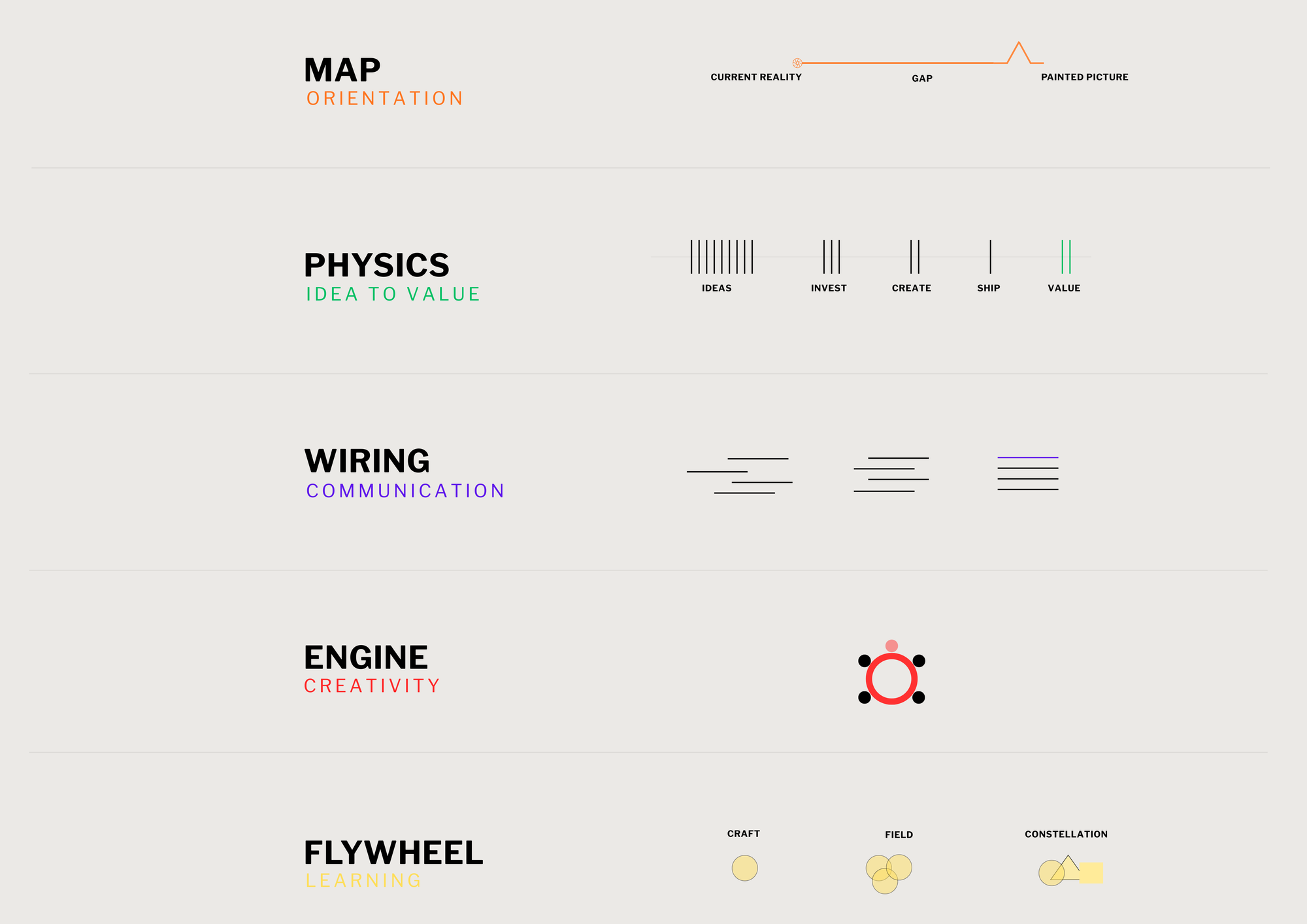
The five layers — how they show up in the room

The map Direction & orientation Where the organisation is going — and whether teams can see it
The physics How ideas move to value The funnel, the cost, the gap — the heart of this session
The wiring Communication & meaning How clarity travels — and where it fragments under pressure
The engine Creativity & climate The conditions that either free or constrain good work
The flywheel Habits & compounding practice What sustains movement after the session ends

The moment that changes the room

There is a point in every session when something shifts.

It usually happens during the cost accumulation exercise — when participants map their current portfolio against the funnel and see, for the first time, where investment is sitting and how much of it is still on the cost side of the ledger. Not because anything has gone wrong. Not because anyone has made bad decisions. But because the work is visible in a way it wasn't before, and what's visible is that a significant proportion of the effort in the room hasn't yet created value — and some of it, if left unchanged, won't.

The second shift comes when the group examines what "value" actually means in their context. Most organisations conflate shipping with value. The product went out. The project closed. The initiative launched. But shipping is a gate, not a destination. What happens after the ship moment — whether the work is used, whether it earns return, whether it builds on itself — is where value actually lives. That distinction, once seen, cannot be unseen.

These are not abstract insights. They are the kind of observation that changes what gets prioritised in the next planning cycle, what gets dropped without guilt, and what gets the attention it has always deserved.


Why this works across mixed leadership groups

The most common concern is whether a single session can hold the range of people in the room.

It can — because the funnel is universal. Every organisation, regardless of sector, size, or structure, moves ideas through some version of investment, activity, and delivery. The physics are the same. What changes is where friction appears, what drives it, and what the right intervention looks like in this context, with these people, at this point in the organisation's story.

The session is tailored before it runs. The pre-work conversation establishes which principles are most live for this group — where alignment is strained, where investment feels disconnected from outcomes, where teams are working hard without a clear line to value. The day then builds around those specifics. The framework stays constant. The application is always particular.

That combination — a coherent shared model applied to real and specific work — is what makes the learning stick past the session itself.


What participants leave with

Participants leave with a shared lens — a common way of describing how work moves in their organisation and where it stalls. Not a set of action items from a workshop, but a way of asking better questions: Is this investment clearly connected to value? Where is cost accumulating? What needs to happen before the next decision gets made?

That shared language is the most durable outcome. It changes how cross-functional conversations run, how prioritisation decisions get made, and how early friction gets named — before it compounds into something harder to address.


What changes for the organisation

In the weeks following, organisations often notice calmer and faster decision-making across functions, clearer prioritisation with less political friction, earlier identification of work that isn't moving toward value, more deliberate investment of time and budget, and improved collaboration between teams who now share the same vocabulary for what they're trying to do.

Work starts to feel different. Less reactive. More oriented toward what actually matters. Not because the problems disappeared — but because the system that produces them is now legible.


Who this is for

Leadership and management teams, cross-functional delivery groups, strategy and transformation programmes, operational leadership, PMO and HR leaders who are close enough to the work to use this as a shared frame.

The common thread is not a role or a level. It's a willingness to look honestly at how the organisation moves — and a position close enough to the work to act on what's seen.

Fit matters more than scale. The workshop has run for small leadership groups of twelve and for cross-organisational programmes of forty. The conversation is always specific to the room.


How the session works

Workshop format

Idea → Value — full-day facilitated session

Duration

1 full day

In-person

Group size

12–40 participants

Multi-team delivery available

Facilitation

Rob Lambert

Creator of the Idea → Value system

Structure

Orientation → principles → exercises → reflection

Built for immediate application


What people say

A senior leader running the session remotely said afterwards that she'd spent three years trying to explain to her board why effort and outcomes felt disconnected — and that the funnel gave her the language to do it in a single conversation.

A cross-functional group who joined a shortened version of the session described the cost accumulation exercise as the clearest thing they'd seen in years: not because the numbers were surprising, but because seeing them laid against the funnel made the implications obvious in a way that spreadsheets never had.

The system has been applied across organisations from one person to sixteen thousand. The pattern that holds across all of them is the same: once teams can see how work moves, they think, see and work differently.


Where this sits in the Idea to Value system

This workshop sits in the Physics layer — the layer concerned with how ideas actually move through an organisation, where effort converts to outcomes, and where cost quietly accumulates between intention and delivery. The Physics layer is where most organisational friction lives, and it's the layer most leaders have never had a shared language for. The five layers of the system — the Map, the Physics, the Wiring, the Engine, and the Flywheel — are all present in the session, but the Physics is the anchor: the core model that makes the other four legible and connected.


A simple starting point

If the description of cost accumulation, disconnected investment, or effort without clear direction sounds familiar — this session is probably a good fit. The starting point is a short conversation, not a proposal. Twenty minutes to establish whether this is the right moment, the right group, and the right framing.


Start the conversation

A twenty-minute call. No pitch, no pressure, no follow-up sequence.

A conversation to understand what's live for your organisation and whether this session is the right fit. Investment and format are discussed in the call — not before.

Leadership teams, transformation programmes, strategy off-sites, and cross-functional groups. If work feels heavier than it should — this is probably a useful conversation to have.

Get in touch →

For participants who want to go deeper after the session — or for leaders preparing before it — the Idea to Value course and field guide cover the full principle system with exercises, video walkthroughs, and the complete framework in a self-paced format.

From the Cultivated library

The Idea to Value System

Course + field guide · self-paced · PDF and video

The complete treatment of how ideas move to value — all the principles, the full funnel, and the five layers of the system. The course is the individual version of what this workshop delivers collectively. Many participants use it as the follow-through that embeds the session's thinking into their own practice.