Some books are to be chewed
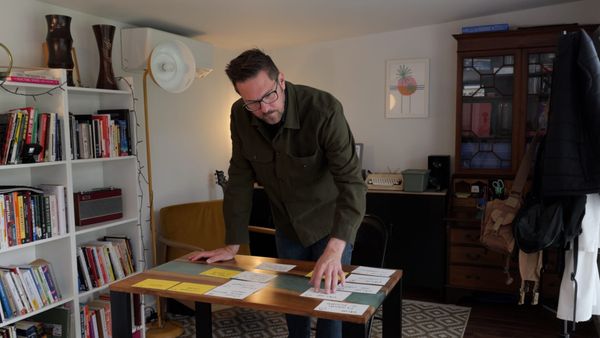
A Winchester bookshop with more books than a life could read. The point was never the reading, or the summary - it's the chewing. My personal knowledge system, in four stages: capture, curate, crunch, contribute.

There's a wonderful bookshop in Winchester, P&G Wells, that has been selling books in this city since 1729. It's behind the Cathedral on college street, a wonderful historic street leading down to the river and the collage walk.
It's a magical bookshop. The floors slope and creak. The shelves reach to the ceiling full of all types of books. However long you have in life, there are more books in that one shop than you could read in the whole of it – and that thought, standing among them one afternoon while I filmed, is where this piece began.
I found myself doing a remarkably humbling calculation. Read a book a week for the rest of a long life, and you might manage a few thousand. This one shop holds more than that. Every reading list, every library, every "hundred books you must read before you die," is a minor accounting error against everything there is to read. And the internet, ever ready with efficiency solution and sensing this dilemma, has popped up to help. Books are now condensed into a five-minute summary, or influencers tell us the hundred "essential" books to make a million pounds, as though the number consumed, and the information alone, is the point.
Here's the idea worth playing with, though. The point was never the reading, not the number, and it was certainly never the summary.
Francis Bacon summed it up four hundred years ago, in a sentence stuck on the commonplace wall.
"Some books are to be tasted, others to be swallowed, and some few to be chewed and digested."
– Francis Bacon
Most of what crosses our path deserves a taste and no more. A little deserves swallowing. And a precious few things – a book, yes, but just as often a talk, an article, a research paper, a remark somebody makes on a train – deserve to be chewed slowly and properly digested, until they've become part of how you think and what you do. That, not the number of books you post to Instagram, is the point, certainly in work. Not knowing a thing. Being able to do it.
At the heart of almost everything I write about here – work, leadership, creativity, communication – sits this very craft: becoming a little wiser over time. Encountering an idea, testing it against the world, and coming away genuinely changed by it. That kind of learning doesn't happen by accident, and it certainly doesn't happen by accumulation, or by reading 100 books a year, nor the summaries. It happens through a bit of deliberate care – through a system, if that word isn't a little off-putting for you.
So the most useful thing I've built over the years isn't a library. It's a way of managing what I learn so that it actually changes how I think and act. It isn't perfect, far from it, and it's never finished; it's a lived thing that changes every so often, iterated over years and still being refined. But it rests on one absolute distinction: knowledge is information in action.
Many of us, if we're honest, are magnificent at storage. The books pile up on the bedside table. The bookmarks take over the browser. Our notes system is packed with great articles and insights. The online courses accumulate. I know the trap from the inside, because I lived in it for years, I pretty much held a degree in that – my digital and physical library growing far faster than my understanding. It's easy though, right, the ease of saving something standing in for the harder work of doing anything with it. The shift, when it finally came for me, was really important: I stopped trying to manage information and started trying to cultivate knowledge. My filing cabinets and storage became a way of thinking.
The system settled, over time, into four specific activities. Not steps as such, but activities that loop and overlap and carry on indefinitely and often cross paths. Capture. Curate. Crunch. Contribute.
Capture is paying attention on purpose. Anything worth thinking about has to be caught before it can be used – a line in a book, a line in a conversation, an idea that arrives on a train platform, the moment in a talk where the speaker really makes you think.
I capture widely but not carelessly – I've made the mistake before of capturing because it's easy. Where you gather from shapes what you become, and there is a great deal of noise on offer across the world right now. So I stay close to a small number of sources with real standards – a few blogs that are always interesting, academic papers that are in my field of study, and books – lots of books, usually second hand, usually older, usually packed with enduring lessons and insights.
It all lands in an inbox, currently part digital notes and part a handwritten notebook. The tool though, matters far less than the landing place that works for you, despite what many will tell you. The ones that have lasted for me are simply the ones that added low friction (easy to capture) and high reward (easy to find). What lands there isn't knowledge yet. It's raw material.
Curate is the first real act of thinking about the topic captured. Every week or so I go back through what I caught and decide what deserves more of my finite human resources of time, energy and attention – and not everything does. I ask three obvious and salient questions: is this still interesting, is this still useful, is it worth carrying forward?
A good deal gets let go, and that isn't waste, it's clarity. Discarding the things that seemed appealing when caught is how you find the genuinely valuable, and the ideas that survive the cull have earned the harder work and investment that comes next.
Curation is also the time to file it correctly, tag it appropriately and index it in whatever way works for you. Filing done with care and attention.
Crunch is the heart of it. It's my word for turning information into understanding and action: reading something slowly a second time rather than quickly once or sitting with a book long enough to digest it. Then placing it beside what you already believe or know, looking for where it confirms or stretches or outright contradicts what you think. Then, the crucial bit, testing it somewhere real – putting the information into action.
Let me bring this to life. I once found an article offering a ten-step method for better meetings. In crunching it, three of the steps were things I already did, so I set them aside. Of the remaining seven, I tried them in an actual meetings. Three made no real difference in practice. One technique was a memorable disaster that nearly ended my credibility, that I rescued by instinct and experience. I have no intention of repeating it. Ever.
That left three genuine improvements – and those three got woven into how I run meetings for good. Ten steps that someone else found useful became three real changes, tested and absorbed. That is crunching, and I don't count anything as learned until it's done exactly that: until an idea about meetings has improved an actual meeting, or a model of leadership has changed how I actually lead, or a delivery theory has actually met reality.
Learning that never reaches behaviour is, in the end, useful but not changing you personally. Crunching applies to your own experience (refining it over time), other people's ideas, theories, methods, books, frameworks, advice. The act of turning a thought or idea into something that changes who you are – something that makes you better at what you seek to do.
Contribute closes the loop on the learning. Once something's been tested and truly absorbed, it can be given away. I do that through my writing, or in a talk or a course, or with a client. But far more often in my daily life: a better conversation, a clearer piece of feedback, a decision made with more clarity and confidence or a way of living a more full life.
Contributing keeps knowledge alive rather than hoarded, and it examines your understanding in a way nothing else quite does, because explaining a thing to someone else exposes, quite rapidly and clearly, every gap in how well you actually grasp it.
This all sounds remarkably tidy but the reality is messier. There are three distinct traps in all of this: collecting instead of learning, mistaking memory and recall for real understanding, and confusing being articulate about something with being any good at it.
I've met people who can talk with dazzling fluency about meetings, leadership, communication, change, work – and run woeful meetings, lead badly, communicate poorly, spend lots of money and create no change, and not genuinely create value in work. Information without crunching produces fluency without competence, and this 4 C system is, above all, a guard against becoming a walking talking hype machine with little substance.
Two habits keep it from falling into a collection of interesting snippets of information.
The first is pruning the system: every system builds up with things that seemed worth keeping and weren't, ideas since outdated and replaced, notes that no longer represent what's important or true – and a regular clear-out keeps it lean enough to actually use. This, by the way, happens in work too, which is why I tend to advocate for someone to own curation there too.
The second is iteration: my tools have changed a dozen times, but the principle beneath them – capture, curate, crunch, contribute – hasn't, and when something stops working I change the mechanism, not the rhythm and principle. I've found it needs to stay simple enough to serve a life rather than become a full time job in itself. Too many tools and you've quietly yourself a second job, likely with expensive annual license costs to boot. Clarity tends to beat complexity.
The wonderful gift of all this is that the more I learn, the more clearly I see how much I never will learn. That sounds disappointing at first but I think it's far from discouraging, because it's absolutely true, and the truth is liberating. A mind that stays curious stays open and adaptable; the moment you feel you've arrived certain you know everything, the more your growth has slowed down. We are always, all of us, in draft form being built through a life.
So a personal knowledge management system isn't really about control over information and clever software to map every connection. It's about care – for how you think, how you grow, and how you might be helpful to other people with what you've come to understand. I've come to the conclusion that learning isn't the preparation for a life. It's life itself, unfolding in many remarkable, curious and interesting ways. A good personal knowledge management system, in the end, is really a way of nudging that life, of steering that life, and helping you share that life in meaningful ways with others.
You'll never read every book in the shop. That is not the point. It's instead, to chew a few of them properly, and grow into who you're trying to become.
Where this sits in the Atlas
Orientation·Idea to Value·Communication·Creativity & Climate·Learning
Creative Soul Projects
There's a video that goes with this piece, on Creative Soul Projects. Same person, same observation — just followed on camera instead of on the page. Explore the channel.