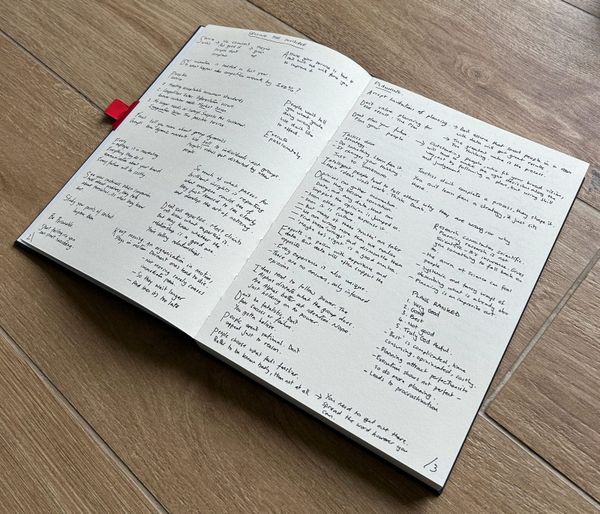
Notes Are for Thinking
Good note-taking is not about recording the past. It is a tool for thinking in the present — shaping attention, learning, and judgment as work unfolds.

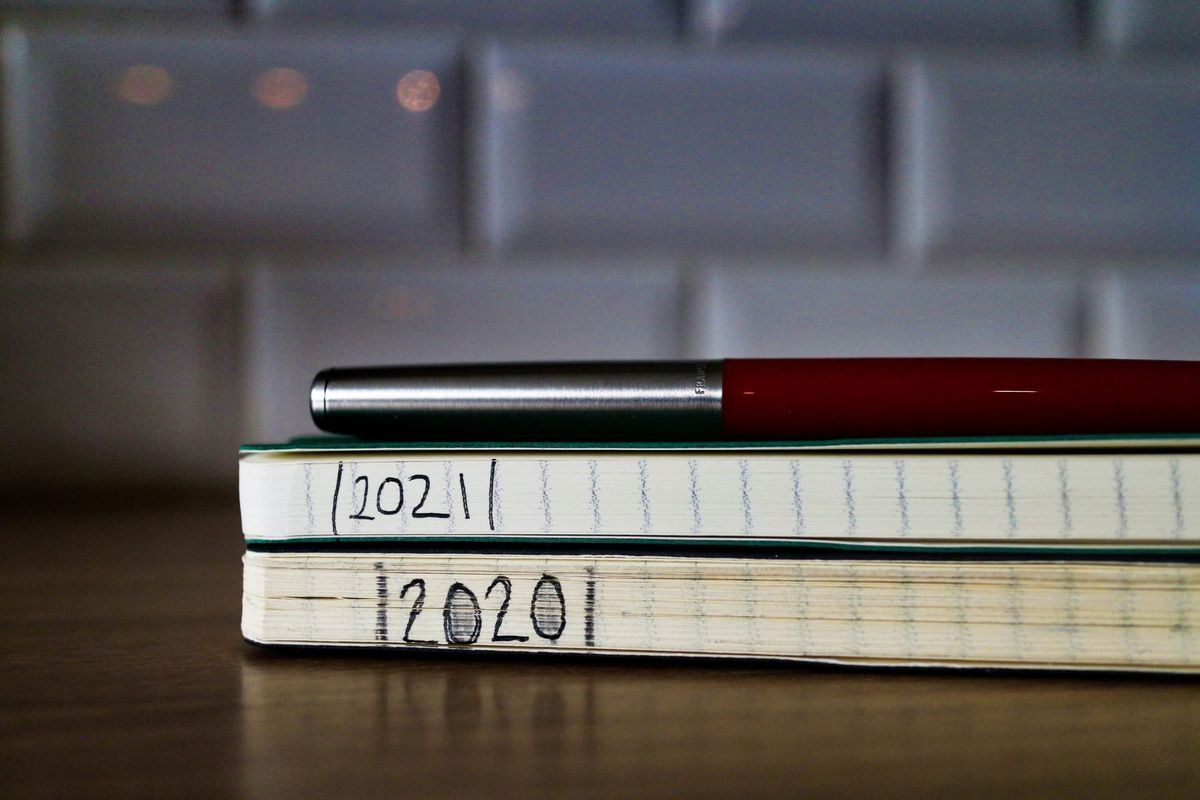
The art of taking good notes
Modern business has developed a curious relationship with note-taking.
We simultaneously expect people to think critically while providing them with very little training on how to capture, organise or interrogate their thoughts.
It is a bit like expecting someone to become a concert pianist after handing them a keyboard and wishing them good luck.
Which is a quiet shame. Because good note-taking does something that very few work habits can claim: it changes the quality of thinking in real time.
Not later. Not in the review. In the moment, as the thinking is happening.
Writing to remember now
There is a debate about digital versus handwritten notes that mostly misses the point. This is not about nostalgia or aesthetics. It is about what happens cognitively when you write by hand.
When you type, capture is almost frictionless. Everything goes in. Which sounds like an advantage until you realise that understanding doesn't live in capture – it lives in interpretation. When everything is transcribed, nothing is processed.
Writing by hand slows things down just enough to force a choice: what actually matters here? That choice is where understanding begins. The hand doesn't just record – it asks your mind to filter. And filtering is thinking.
We write to filter, understand and remember now, not later.
Presence is visible
A notebook does something else that a screen cannot easily do.
It signals attention.
When you close a laptop and pick up a pen, the room notices. You have communicated something without words: that you are here, that what is being said is worth capturing, that you are listening rather than processing email or scrolling social media.
Listening is the greatest compliment we can give someone. A screen creates a barrier that changes how you, and the other people, interact. A notebook gathers it.
Effectiveness beats efficiency
Typing is faster. There is no doubt that there is more friction in writing, but on the other side of all friction, there is a reward. And the rewards for writing by hand can be numerous.
The purpose of notes is not speed – it is clarity. And clarity requires a level of engagement that pure capture often doesn't produce.
Notes are for thinking. Systems are for storage.
Notes help you think, notice, connect ideas, and stay present. Systems help you store, retrieve, search, and act later.
Both matter. But they are different activities, best served by different tools.
The rhythm that works: think on paper, store digitally.
A notebook is a thinking instrument. A knowledge management system is a filing cabinet. The mistake is treating your filing cabinet as the place where thinking happens.
Making notes work over time
Good notes survive the loss of context – written with enough detail that they make sense weeks later, when the emotion and immediacy of the moment have gone. A useful test: are these notes 60-day proof? Will they still be intelligible and useful two months from now, when you have moved on to other things?
You are writing to remember and think today, but also writing for the future you.
Different thoughts need different shapes
There is no single best way to take notes, and looking for one is the wrong instinct.
Different kinds of thinking work best in different forms:
Maps for exploration, when the land is still unclear. Lists for action, when the next steps are known. Diagrams for systems and relationships. Free writing for sense-making, when you need to think out loud on paper.
Notes are instruments. Does this shape help the thinking, or does it get in the way?
A system worth trying
The following is not a prescription – it is an example of one approach that works for me. I leave it here as a form of example, not absolutes.
Using different notebooks for different kinds of thinking creates useful separation. A journal for reflection. A learning notebook for study and ideas. Large pads for breaking down complex problems or drafting long-form work by hand. A weekly planner for focus and rhythm. A small pocket notebook for capturing thoughts on the move.
Each invites a different mode of thought, with real estate to support the thinking. The difference in size and format is deliberate – tools shape behaviour, and the physical object you reach for signals what kind of thinking you are about to do.
You may prefer one notebook for everything. That works too. What matters is intention, not system.
To make notes actionable rather than archival, a lightweight labelling system reduces the effort of processing later. The one that works for me:
A — Action required
I — Idea worth developing
B — Potential content or writing (the "B" is a legacy to my early blogging)
O/F — Observation or feedback (positive or negative)
Scanned quickly at the end of a session or week, these markers surface what needs to move, what needs more thinking and what can stay as a record. It is especially useful in work settings, where written observations support ethical leadership.
Notes protect memory from bias. What we write, we can return to honestly. What we carry in memory alone gets shaped by mood, recency, and what we wanted to be true.
An advantage
Good note-taking does more than capture information. Over time it frees mental space, improves listening, sharpens judgement, builds trust, and creates continuity in learning.
The shift is gradual and hard to attribute to any single moment. You stop reacting. You start noticing. Work becomes slightly calmer, slightly more intentional, slightly more yours.
That is not productivity. That is presence.
And notes, taken seriously, are one of the quietest ways to build it.
At least that's been my experience.
Where this sits in the Atlas
Orientation·Idea to Value·Communication·Creativity & Climate·Learning