A date at the top, and honesty underneath
Journaling on an Iron Age hill fort, wild ponies wandering past. Not a diary of events — a thinking partner, and a leadership one too. On paper over screens, the friction that makes it work, and why an honest map beats a beautiful one.

Journaling as a thinking partner
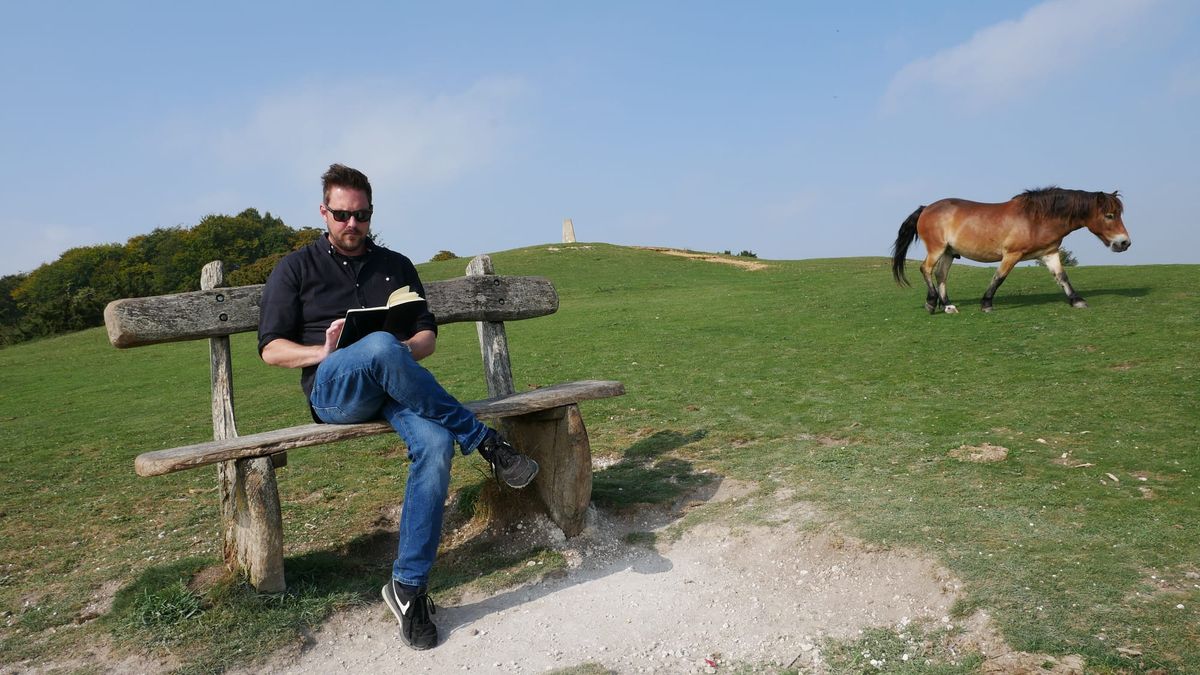
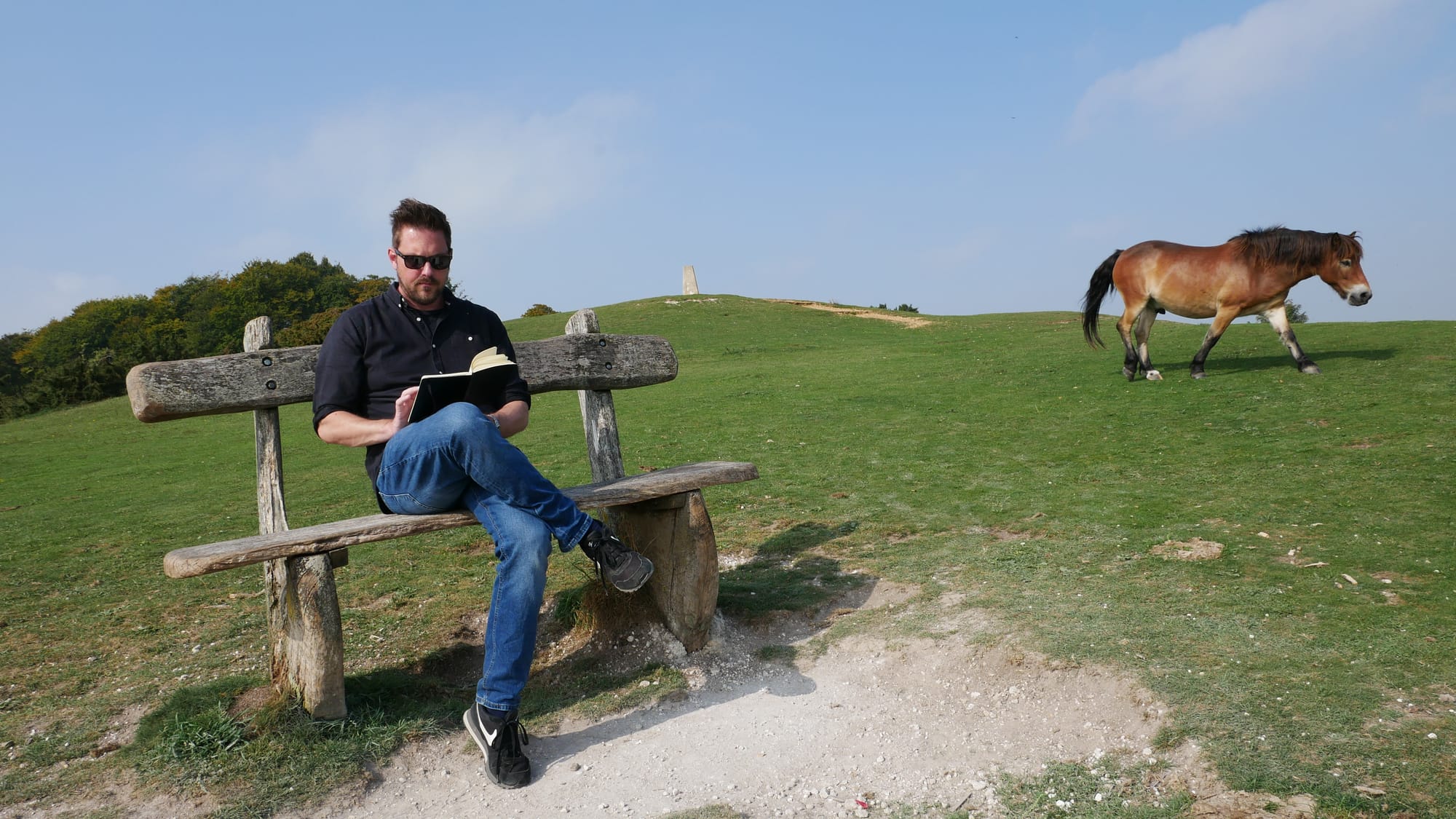
It was, by all accounts, a rather wonderful place to journal. I was at Danebury, an Iron Age hill fort just outside Winchester, its ramparts built around 700BC and lived in for centuries before the Romans ever set foot in Britain. Pretty old, then. The sun was shining, I was writing, and wild ponies were wandering past. I'll be honest – I couldn't have found a more perfect setting to be alone with my thoughts.
Because journaling has been a lifeline for me. Not just the act of putting a few thoughts in a notepad, but a genuine thinking partner – a way to work out who I want to become, to process difficult stretches, and to deal with emotions I used to lug around for days, sometimes months, at a time. Over the years it's become one of the most practical tools I have for thinking clearly and living deliberately.
Let's be honest, though: at first it was a ridiculously tough habit to form. The mere act of sitting down to write was overwhelming, and even when I forced myself into the chair – what was I supposed to write? What's the gold standard for journaling? Was there a correct way to structure it? It's fair to say I was not good at it. I'd start with enthusiasm, keep it up for a few weeks, then not touch the notepad for a month. This went on for years. It was only when I finally committed both brain and body to a specific time – early morning, before the kids woke – that the habit finally stuck.
Now I get up at six, put the kettle on, make a decent pot of tea, and write for ten minutes before anything else is allowed to happen. That small ritual has turned into one of the most powerful activities in my life.
To me, journaling isn't a diary of events. It's a place to think, and to process emotions, on paper. Some days I write about what happened, in a reflective sort of way. Other days about how I feel. Often about who I'm trying to become. Sometimes I'm working through a decision. Sometimes I'm simply getting things off my chest and out onto the page.
There is, I discovered, no single best format. Despite a great deal of rigorous internet research, I found that only by starting – and improving – do you land on the format that works for you. Mine still varies all the time. Some days it's long prose about whatever's on my mind, close to Julia Cameron's morning pages. Some days it's a few notes about the day ahead, or a look back at yesterday, closer to how Austin Kleon keeps his logbooks. Some days it's a single sentence, or a doodle, or a sketch of how I'm feeling. No template. No pretty graphics. Just a date at the top of the page – and honesty underneath it.
Over time, the pages become a private conversation with yourself. And that conversation changes how you show up everywhere else.
There's a remarkably consistent, well-researched science behind all this, too. Expressive writing, the studies suggest, can reduce rumination and depressive symptoms, free up working memory and cognitive capacity, help process anxiety and perceived stress, and even support physical recovery from illness. Researchers at Harvard Business School found that reflection – simply taking the time to think about what you've experienced – measurably improves both learning and performance. But even without the studies, the lived effect for me is simple. When thoughts are trapped in the head, they grow louder. When they reach the page, they become manageable. Writing turns confusion and mental noise into something with shape – words and images on a page – and shape is the beginning of clarity.
In my early years of experimenting, I tried doing it digitally. The reasoning, in my head at least, was that it would be portable and efficient: I could journal anywhere and reach my thoughts anywhere. It was a monumental flop. Yes, the friction was lower – but the reward simply wasn't there. It felt like writing an email rather than reflecting on anything that mattered, and I was only ever a few clicks from the web. The honest truth, for me, is that this practice needs a little friction to slow me down and turn it into a ritual rather than a task – just enough friction that it doesn't cancel out the reward on the other side. Pen and paper is slower than typing, and that slowness is the point: it creates a different quality of presence.
When I went back to a plain notebook and pen, something lit up straight away. No blue light. No notifications. No pull of the latest NBA scores. No temptation to check anything. Just attention and a couple of tactile tools – which, it turns out, is what thinking wants and needs.
There's a real pleasure to paper journals that no digital system quite replicates, as well. Flicking back through old pages – even months or years later – reveals patterns you couldn't see at the time. How a worry that swallowed a whole week turned out not to matter at all. How a view you held with total certainty is now embarrassing wrong headed. How your ambitions and plans and goals shift over the years. A journal becomes a map of your thinking. Not a perfect map – but an honest one. And honest maps are far more useful than beautiful ones.
So what does any of this have to do with work? I don't know about you, but I'm the same person in life as I am at work. Not the same in how I behave, or how I show up, necessarily, but it's still me underneath. So anything that helps me grow as a person, and handle life as it arrives, is going to help at work too. That's one reason journaling has mattered.
But there's another angle worth pulling on. I actually keep two journals. One is personal – for life, reflection, and the longer project of becoming a better version of me. The other stays at work, and is strictly a leadership journal: a place to reflect on how I showed up that day as a manager and a leader. Was I the leader I wanted to be today? Did I hold the standards of behaviour I set for myself and for others? Where did I fall short – and why? What would I do differently tomorrow? Did I act in line with my values, or compromise them under pressure? It's a leadership notebook – also called a catalogue notebook – and it holds two things: reflections backward and planning forward. It is, in the end, professional discipline.
Good leaders are demanding of themselves and generous with others, and a journal helps hold that asymmetry – the high standards kept internal, the generosity pointed outward.
Journaling hasn't made me faster. It isn't a hack, or a shortcut, or a quick win. But it has made me more certain of who I am. It has made me calmer. It has given me a dedicated time and place to be alone with my thoughts, a place to get things out of my head and onto paper. It has brought me clarity.
And clarity changes everything downstream of it – decisions, relationships, leadership, creative work, life. When you know what you actually think, you say it more honestly, and with more conviction. When you've processed an emotion rather than buried it, you respond instead of react. When you've reflected on who you want to become, you make choices more in line with that direction.
It is a practice of attention. And over time, that attention becomes an advantage – not only at work, but in becoming the person your work is built upon.
Where this sits in the Atlas
Orientation·Idea to Value·Communication·Creativity & Climate·Learning
Creative Soul Projects
There's a video that goes with this piece, on Creative Soul Projects. Same person, same observation — just followed on camera instead of on the page. Explore the channel.
Bibliography
Milbury et al. (2014). Randomized Controlled Trial of Expressive Writing for Patients With Renal Cell Carcinoma. Journal of Clinical Oncology, 32(7), pp.663–670.
Gortner, Rude and Pennebaker (2006). Benefits of Expressive Writing in Lowering Rumination and Depressive Symptoms. Behavior Therapy, 37(3), pp.292–303.
Klein and Boals (2001). Expressive writing can increase working memory capacity. Journal of Experimental Psychology: General, 130(3), pp.520–533.
Smyth et al. (2018). Online Positive Affect Journaling in the Improvement of Mental Distress and Well-Being. JMIR Mental Health, 5(4).
Rodriguez (2013). Write to Heal. Scientific American Mind, 24(5).
Scullin et al. (2018). The effects of bedtime writing on difficulty falling asleep. Journal of Experimental Psychology: General, 147(1), pp.139–146.
Baikie and Wilhelm (2005). Emotional and physical health benefits of expressive writing. Advances in Psychiatric Treatment, 11(5), pp.338–346.
Di Stefano, Gino, Pisano and Staats (2014). Learning by Thinking: How Reflection Aids Performance. Harvard Business School.