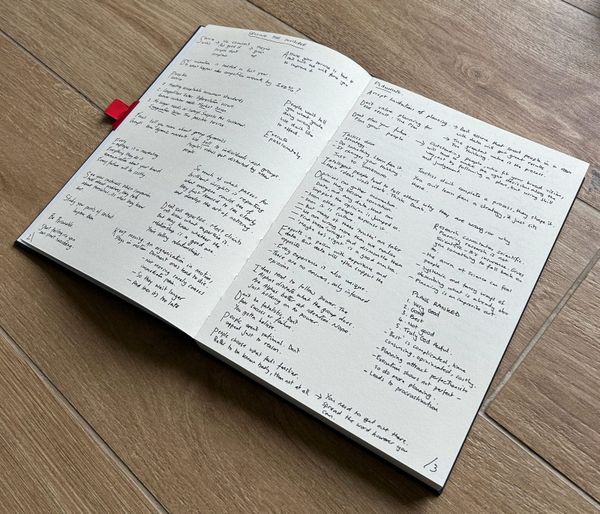
The catalogue notebook — a quiet practice for thinking better over time
A catalogue notebook is neither diary nor to-do list. It is a personal archive of ideas, reflections, and plans — a quiet studio for thinking beyond meetings and frameworks.


A Simple Practice for Capturing Ideas, Reflecting Clearly, and Thinking Better Over Time
My weekends and evenings often disappear down rabbit holes of old notebooks. Sketches from Leonardo. Field notes from Darwin. Fragments from Franklin. Across centuries, across continents, across vastly different fields of work, these books share a common quality. They are neither plans nor diaries — but something in between.
A place where thinking is allowed to be unfinished.
That phrase has stayed with me. Modern work has very few places like that. Calendars demand decisions. Documents demand conclusions. Slack demands a response. Even journalling, taken to far, becomes a structured exercise with prompts and frameworks. The space for thought that is genuinely in motion — not yet decided, not yet useful, not yet anything — has quietly disappeared from most working lives.
The notebooks of Leonardo, Darwin, and Franklin held that space deliberately. They were not productivity systems. They were not even, in any modern sense, journals. They were catalogues of attention.
I keep one. I have for years. This is what it does.
Editor's note — where this sits
An Engine layer essay from the Idea to Value system — on the conditions that allow good thinking to happen, and the practice that gives unfinished thought somewhere to live. It also touches the Flywheel layer: a notebook is a small habit that compounds across years into a record of attention no productivity system could produce.
The Idea to Value system — five layers
The shape of the practice
There is an idea in the Cultivated Notes companion to this piece that captures the practice better than I have managed to in writing:
we reflect backwards, we plan forwards, and we live in the now.
A catalogue notebook holds all three at once. The reflection on what just happened. The half-formed plan for what might come next. The observation made in the moment that has nothing to do with either, but is worth catching before it disappears.
The notebook does not separate them, because in the texture of a working life they do not separate themselves. A meeting reminds you of something a mentor once said, which makes you reconsider a decision you made last week, which suggests an experiment worth trying next month. That entire chain belongs on one page.
Most modern tools force you to choose. Calendars handle the future. Journals handle the past. Note-taking apps handle the present, sort of. The catalogue notebook does none of these things on their own and all of them together.
Living outside the calendar
Much of modern work lives inside calendars — meetings, deadlines, time blocks, follow-ups. The architecture of the working day is built from commitments to other people. There is little space, by design, for noticing, wandering, or reflection. These things are not on the agenda because they struggle to be scheduled.
A catalogue notebook is an antidote. It creates a parallel space — outside calendars, outside deliverables, outside the demands of immediate response — where thought is permitted to stretch. It holds what might matter later. It holds what felt important in the moment but does not yet have a use. It holds what might, eventually, become something more.
The notebook does not compete with the calendar. It runs alongside it. The calendar manages the visible work of the day. The notebook captures everything else — which, over time, often turns out to be where the better work begins.
What it holds
A catalogue notebook is not structured. That is the point.
It accumulates. Half-formed strategies sit beside reflections on a difficult conversation. A sketch of an organisational diagram sits beside a quote from a book read on the train. A list of questions for a coaching session sits beside a drawing of something noticed on a walk. Decisions worth remembering. Observations that have no use yet. Fragments that may, with time, attach to something else.
The lack of structure is what allows the connections to form. A structured notebook — one with sections, prompts, categories — keeps each kind of thought in its own compartment. A catalogue notebook lets them sit next to each other, and that proximity is where the work happens.
Why it works
Writing clarifies. Noticing creates ideas. Recording creates memory.
These are not separate functions, even though we tend to treat them as such. They reinforce each other. The act of writing something down forces you to choose words, which forces you to think more precisely than you would have otherwise. The act of recording trains you to notice in the first place — once you have a place to put observations, you start to make them. And the accumulating record itself, read back weeks or months later, surfaces patterns that were invisible in the moment.
When thoughts sit next to each other on paper — plans beside reflections, quotes beside sketches — patterns emerge that no single thought could have produced on its own. Ideas combine. Perspective deepens. What felt urgent at the time becomes contextual. What felt trivial becomes connected.
The notebook becomes a slow conversation with yourself, conducted across weeks and months and years. Most of what it produces is not the entries themselves, but the relationships between them.
Leaders as creatives
We tend to reserve creativity for artists, designers, filmmakers — people whose work is visibly creative. But leadership is creative work. Strategy is creative work. Culture is creative work. The decisions that shape how an organisation feels, how it moves, what it becomes, are not engineering problems with right answers. They are acts of composition.
A catalogue notebook becomes a quiet studio for that work. A place to think beyond meetings, beyond frameworks, beyond immediate outputs. The leader who keeps one is doing what painters and writers and scientists have always done — giving their thinking somewhere to live before it has to perform.
The leaders I have known who kept notebooks of this kind were almost always better thinkers than their peers. Not because the notebook made them smarter, but because it gave them somewhere to be smart over time, when nothing else in their working life invited it.
A personal archive
Over time, these notebooks become something else again. They become a record of how you thought. What you noticed. What you believed mattered. Which ideas held up and which ones didn't. Where your attention went when nothing was demanding it.
They are maps of a mind at work. A reservoir of what you noticed when most of the world wasn't asking you to notice anything in particular. Read back across years, they tell a story about your own thinking that no productivity system could ever produce — because productivity systems are designed to forget once a task is done, and the catalogue notebook is designed to remember once it is.
Leonardo's notebooks were never published in his lifetime. Darwin's field books were not written for anyone but him. Franklin's fragments were private. Their value, in the end, was never about who would read them. It was about what they made possible for the people who wrote them.
Reflect backwards. Plan forwards. Live in the now.
A notebook is one of the few places where all three can happen on the same page.
From the Cultivated library
Take a Day Off
Book · Digital £9.99 · Print £12.99
A companion argument to this one — on giving the mind the space it needs to do its better work, and why a day deliberately removed from delivery is more valuable than the day it appears to cost.
From £9.99
Read the book →Cultivated Studio
Membership · £5/mo or £50/yr
For practitioners who want to go further than the public library — field notes, extended essays, and over four hours of Idea to Value deep-dive video. The home for thinking practices that compound.
£5 / month
Explore Studio →