The rages were less frequent
Time blocking looks like controlling time. Used well, it's the opposite: a way of seeing where your time actually goes


The time tested art of using your calendar
I used to work with someone who came apart every time a meeting request landed in his inbox. He'd rage. Like proper rage. Things got thrown. Words aired that don't belong in the workplace. He'd jump from his seat and storm around the office. He would announce, to the whole room, that he'd been just about to do some real work, and now the meeting had gone and ruined it. Once he'd calmed down and the office had settled back into something like normal, I leaned over and offered him a single piece of advice: book your working time into your own calendar. He did. The rages grew noticeably less frequent.
We live in remarkable times for this sort of thing. Really we do. The internet offers no end of productivity methods, new ones springing up every day. You could, if you were so inclined – and some people clearly are – spend the whole of your life trialling systems in search of the perfect one, and make lots of money on YouTube by filming it all. But when it comes to work, and maybe to life, the oldest and dullest trick still outperforms most of them: blocking out time in your calendar. For a handful of simple reasons.
Here's the first thing worth playing with, though, because it's where most people get it wrong. On the surface, time blocking looks like an attempt to control time – to file every hour into a neat, labelled box, probably colour coded too. Good luck with that. Time is not remotely interested in being managed, it doesn't respond well, it just keeps going. It doesn't care how you feel, or what's happened, or whether you want some of it back. It's not one to be managed well. Life intervenes. Energy rises and falls. Attention wanders off to look at something shinier and more interesting.
I resisted the whole idea of scheduling for years, having once worked for a manager who wielded his calendar like a weapon – rigid, joyless, every minute accounted for and audited. It took me a while to separate the method from the man.
When I came back to it though, the therapy helping to separate the man from the method, I found something completely unlike the thing I'd been avoiding. Used well, time blocking isn't about control at all. It's about seeing. Not managing time – seeing it.
The moment you put everything you actually intend to do into a calendar – the work, the meetings, the thinking, the family time, the travel, the rest, the exercise, all of it, honestly – something staggeringly helpful happens. Not all of it fits. It can't. And in that not-fitting, a choice you'd been avoiding has to be made – after you've stopped crying and trying to shoehorn in everything you want to get done.
Your real priority shows itself – not the one you'd name if asked by the boss, or our spouse, or your friends, but the one your week actually reflects. That's the first and best thing the tool does: it makes the gap between what you meant to do and what you're really doing impossible to look away from. For some, that may well be why they don't use this approach.
From there, most of the benefits are just honesty and commitments made visible. When the week fills up, you're confronted with the reality that you can't do everything, and something has to move – an awkward moment if we're honest, but a productive one, because it turns a choice you'd otherwise make by instinct into a decision you make on purpose.
A calendar full of real commitments also becomes a legitimate boundary, which is good for the soul and good for the business. Declining a meeting that doesn't matter gets a great deal easier when there's already something in that slot – though this only works if you schedule your actual work, and not merely your meetings and lunch. Leave the work off, and your calendar is simply an open invitation for everyone else's priorities to move in and make themselves at home and trample all over what you're paid to do – create value.
And a week laid out where you can see it reveals patterns that used to stay hidden – in lists, on sticky notes, in your head. You start to notice where the time genuinely goes, where it gets swallowed whole, where you've overcommitted without ever deciding to. A calendar looked at honestly is a mirror – not always a flattering one, sometimes one of those fairground style ones that make you look funny.
Colour it in, or split it across a few calendars on the same view, or use one master calendar – it doesn't matter. Choose your style. But it's wise to ensure it includes all commitments for the week – the value creation work, meetings, personal, family, thinking time, leisure time, gaps to reflect and decompress between important meetings – and you can tell at a glance whether the week is balanced across both work and pillars of life, or whether the time that matters has been hijacked by other people's needs.
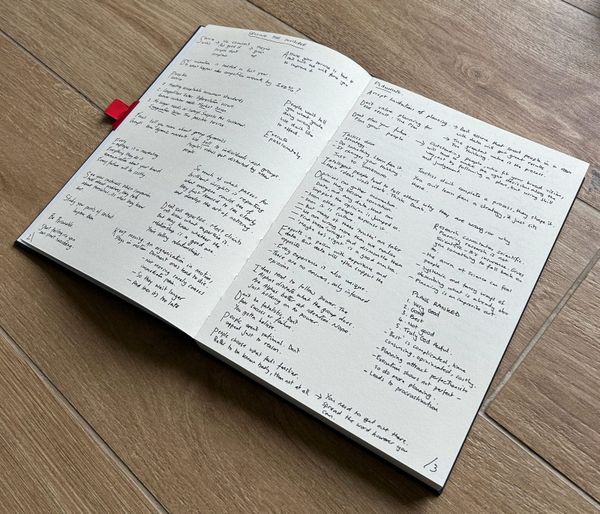
I like to print mine, too, at the start of every day. And mark it up with a pen, because the friction of paper slows me down just enough to actually think about the week rather than merely fill its boxes. That's the reward on the other side of pen and paper friction.
None of which makes it foolproof, nor the perfect system, and it's worth knowing where it lets you down. The biggest blind spot I've found, is that a calendar measures time but says nothing about energy and attention. Some work replenishes you; some empties you out; and a day that looks beautifully organised on the page can be soul destroying in practice if you've ignored which replenishes, and which empties.
I've learned to schedule around my own rhythms too – when I think most clearly, when I'm any use in a conversation, when I simply need to recover, when I do my best person to person work – because the hours really are not equal, nor are the activities we fill them with. We're also, nearly all of us, remarkably hopeless optimists about how long things take, which is why a calendar with no slack in it collapses under its own ambition by about Tuesday morning, maybe sooner. Buffer time isn't waste; it's realism. A plan with no room to breathe is just a plan waiting to unravel. But be careful about those buffer spaces – someone might fill them.
When every single block is labelled something "productive," something has already gone wrong – because family, rest, movement and play aren't luxuries to be slotted in once the work things are done. They are the important things; the foundations the rest of it stands on. So I start the other way round, from what I call my pillars – the non-negotiable personal commitments – and let the work arrange itself around them rather than the reverse. Show me almost anyone's calendar and I'll show you their real priorities, whatever they tell me over coffee and nice biscuits. Of course, we can't all command absolute control over our week, but when the really important things in life – health, family, rest – are crowded by work, there will, there always is, a tax to pay at some time.
And then there's the risk of the tool eating the very time it was meant to protect. The endless rearranging, the constant fiddling, the pursuit of the flawless weekly plan, the perfect colour coded system – all of it misses the point entirely. The calendar is a guide, not a verdict, not an absolute; it exists to support the doing, not to replace it, and if you ever catch yourself spending longer planning your week than living it, something has gone wrong. For the same reason, setting up recurring blocks and never touching them again doesn't hold up beyond the basics. I plan mine lightly each Sunday instead – nudging the pillars around, dropping in whatever has emerged, adjusting for what's changed. Twenty minutes, no more. No two weeks are ever quite the same, and pretending they are just manufactures friction rather than removing it, and makes life a little dull too.
If you want to try it, start simply and easily. List everything you need and want to do this week – work, personal, family, rest – and put all of it into a calendar. Notice what won't fit. Make the choices that follow. Then leave it more or less alone for a month before you change the approach, because the value doesn't arrive in one perfect week, or from the belief you've built the calendar system to rule all calendar systems; it emerges slowly, out of a series of better decisions and improvements over time.
Time blocking won't solve your life. Nothing that fits on a calendar will. But used with a bit of thought, it will show you how you're actually spending it – and once you can see that clearly, better decisions tend to emerge.
My raging colleague never did become a Zen master about his calendar. But he stopped throwing staplers. Some weeks, that's the win.
Where this sits in the Atlas
Orientation·Idea to Value·Communication·Creativity & Climate·Learning
Creative Soul Projects
There's a video that goes with this piece, on Creative Soul Projects. Same person, same observation — just followed on camera instead of on the page. Explore the channel.