
Learning & Practice (Flywheel)
The Skills You Learn on a Market Stall
What trade skills, commercial awareness and practical judgement can teach us about turning ideas into value.
Habits and compounding practice — small actions that build lasting capability over time. Articles in this layer explore learning, resilience, personal development, and the disciplines that compound.

Learning & Practice (Flywheel)
What trade skills, commercial awareness and practical judgement can teach us about turning ideas into value.

The Word at Work
We've made the word craft soft — craft beer, craft fairs, hand-crafted. Underneath sits an older meaning worth recovering: craft meant power. Here's where yours lives at work.

Communication (Wiring)
The CV has survived decades of reinvention around it — and viewed as a communication tool with a purpose, an audience and a context, that survival makes sense. What's missing is something else entirely.
Learning & Practice (Flywheel)
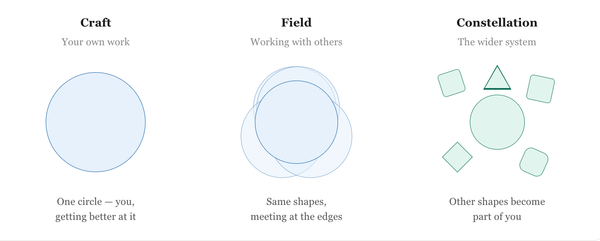
When I first started out, I did the obvious thing. I got good at the work in front of me. It didn't take long to notice that being good wasn't enough.
Idea to Value (Physics)
Progress isn't movement — it's seeing. What stop-motion animation reveals about how your ideas actually become valuable.
Learning & Practice (Flywheel)
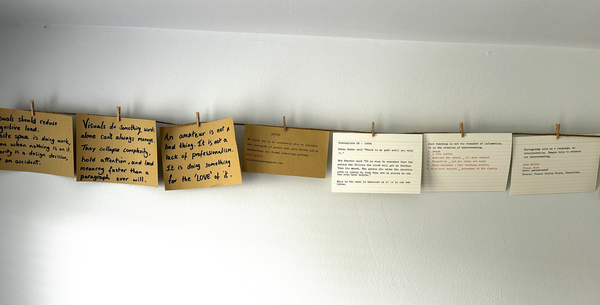
It was some time in the mid to late 80s. A café in Bristol, a man sitting alone, and a twelve-year-old with a new notebook writing his first ever note. Thirty years on, that habit became all of this — and now a good part of it goes public.
Learning & Practice (Flywheel)
Good teaching is not the transfer of information. It is the creation of understanding.

Creativity & Climate (Engine)
We give a great deal of attention to the people we want to be like. The people we'd hate to become are teaching us something too — if we choose to look.
Creativity & Climate (Engine)
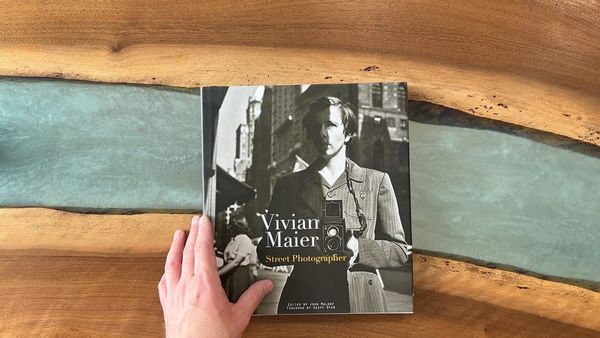
We often use amateur as an insult at work. But the word comes from the Latin for lover — and Vivian Maier's story shows exactly why that matters.
Learning & Practice (Flywheel)
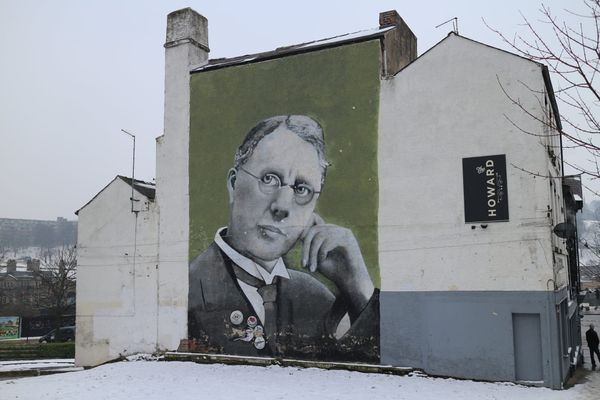
The meeting moved on. Someone named the problem, proposed the solution, and the room agreed. Six months later, it turns out you were right. On developing curiosity as a practice — whether anyone listens or not.

Communication (Wiring)
Communication isn't a presentation skill. It's a daily practice — shaped by habits of attention, vocabulary, and clarity of thought. Two low-barrier practices that quietly compound over time: reading and writing.

Orientation & Direction (Map)
Career advancement follows quieter mechanics than most people expect — patterns of behaviour, systemic contribution, and clarity of intent. A practical exploration of the structural forces that actually move people forward.