The Commonplace Book: Building a Personal Library for Thinking
For many years I have kept a notebook I call my commonplace book. It is not a diary, not a planner, not a system for getting things done. It is a personal library for thinking — a place where ideas wait until they are needed.

How I use my Commonplace Book
For many years I have kept a commonplace book. It houses quotations, ideas, clippings from books, observations, sketches, and insights that caught my attention at some moment and seemed worth keeping. It is not a diary. It is not a journal. It is not a planner. It is not a system for getting things done.
It is a personal library for thinking, based on what I am seeing – a place where observations wait until they are needed, or until they connect with something else entirely.
Over time, it has become one of the most important tools I own.
As part of my ongoing study of where ideas come from, and then what to do with them, I am sharing my own commonplace in public. Showing the thinking, the raw material and the insights that are the foundation of Cultivated.
The commonplace book is not a new invention. Writers, thinkers, and leaders have kept versions of it for centuries.
Marcus Aurelius kept one – which eventually became the Meditations. Montaigne's earliest essays were little more than organised extracts from his. Thomas Jefferson kept one for legal references and another for literary ones. Leonardo da Vinci described his notebook as "a collection without order, drawn from many papers, which I have copied here, hoping to arrange them later each in its place, according to the subjects of which they treat." By the seventeenth century, keeping a commonplace book was formally taught to students at Oxford.
The form is ancient because the need is ever lasting: a place to gather the raw material of thought before you know what you will do with it.
A commonplace book is a system for noticing. Not a system for filing, or retrieving, or managing. A system for paying the kind of attention that makes ideas available when you need them – even if you had no idea at the time that you would.
Mine contains book highlights and quotations, observations from conversations and walks, business ideas in early form, design references, sketches, phrases that made me think, my own crazy ideas, and occasionally drawings my children made that I wanted to keep alongside the thinking, as there is much we can learn from the way children see the world.
There is no strict rule about what belongs. The rule is simple: if it is interesting, useful, or engaging – it belongs. The value is not in the organisation. It is in the accumulation. Over time, patterns emerge from the material. Ideas that seemed unrelated turn out to be the seed that spawns something unique and creative. Observations you barely noticed when you wrote them down become useful years later for reasons you could not have anticipated. This is the serendipity that comes from accumulating observations.
Digital tools are powerful. But a physical notebook and index cards do something different from a screen.
Writing by hand slows thinking just enough for meaning to surface. The friction of forming letters by pen or pencil (or typewriter) forces a choice about what is actually worth writing — a filter that typing at speed tends to skip. When you leaf back through old pages or cards, connections form unexpectedly, wry smiles form, you often see your own seasons of life in front of you. You notice things in proximity that were never intended to be related, and those unintended proximities are often where the most interesting thinking begins.
Screens are designed for retrieval. Paper reveals relationships. That distinction is the reward on the other side of the friction.
I use my notebook mostly as an inbox, and my index cards as the permanent record.
When something strikes me – a quotation, an observation, a half-formed idea – I write it down quickly in the notebook (if I have it with me), without worrying about where it belongs or whether it is worth keeping. Speed of capture matters more than tidiness.
Once a week, I review what I have gathered. Some notes get clarified — I add context I would otherwise forget. Some get expanded into something more developed. Some get discarded, which is fine; they served their purpose by not being forgotten in the moment. Some get marked with a simple symbol to indicate a theme or type – a loose taxonomy that helps me find things without imposing a rigid structure.
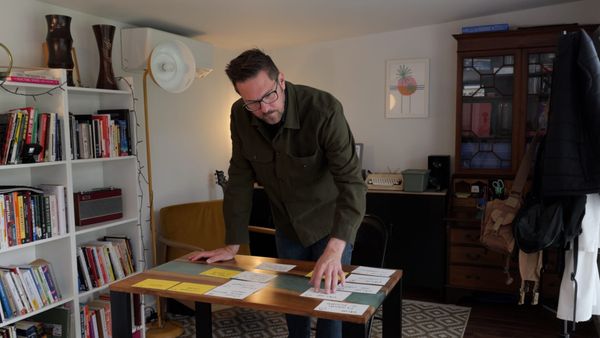
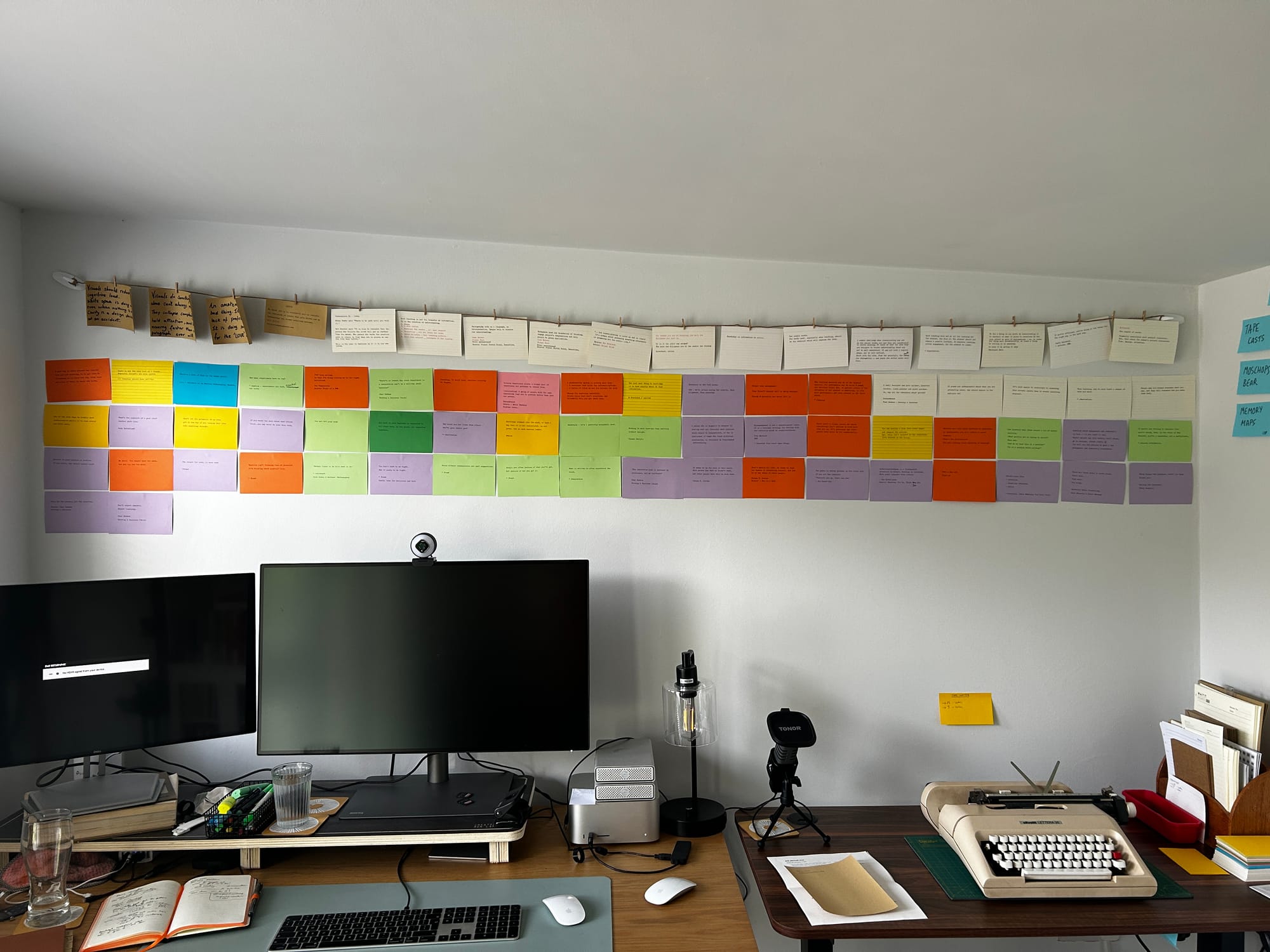
Almost all of them end up on an index card for storage and future use, often typed on my trusty Olivetti Lettera. I have even started putting them up on the studio wall.
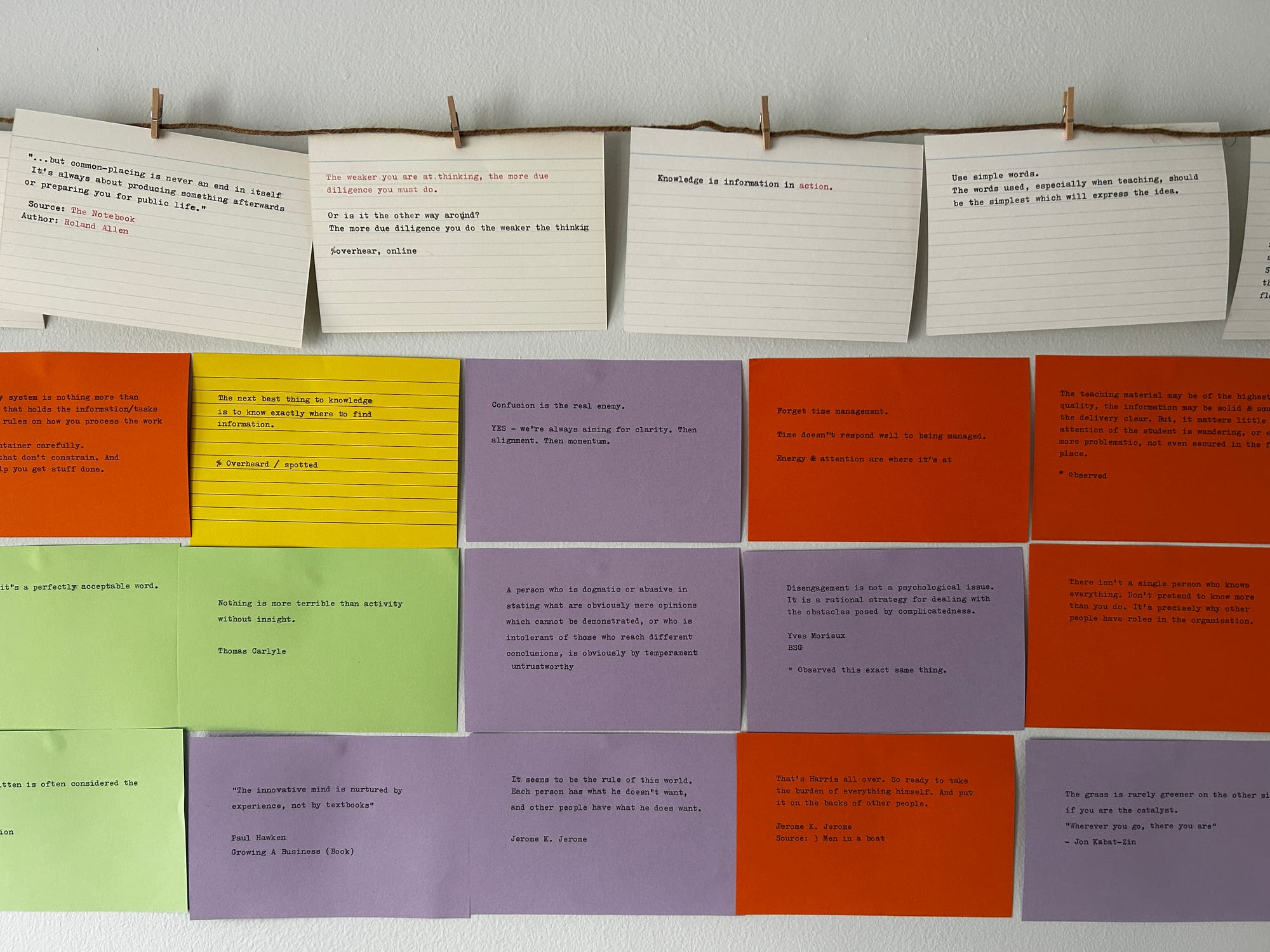
The goal is for the entries to feel like a workbench rather than an archive. Something alive, in use, full of material in various states of readiness.
Alongside the notebook and index cards, I use Apple Notes as a digital companion.
Apple Notes handles fast capture especially for when I don't have my notebook, or the resource is online. Anything I read online, any quick thought on my phone, any audio note I dictate on the move goes there first. It is fast and accessible and good at retrieval. It is also where I store a digitised version of each index card that I share on the public commonplace.
The physical notebook is my preference and is often the most convenient capture system I have at hand. I will try to lean to the notebook where possible, but I'd rather not be precious over the medium when the observation may be fleeting.
When I sit with what is written, I am not searching for something specific. I am thinking — following associations, noticing what has accumulated, letting the pages do the slow work that screens tend to interrupt.
Once a week, I move the best of what has landed onto index cards and Apple Notes — rewriting and typing rather than copying if it's not a direct quote, which is itself a form of processing. Ideas that survive that transition tend to be the ones that actually matter.
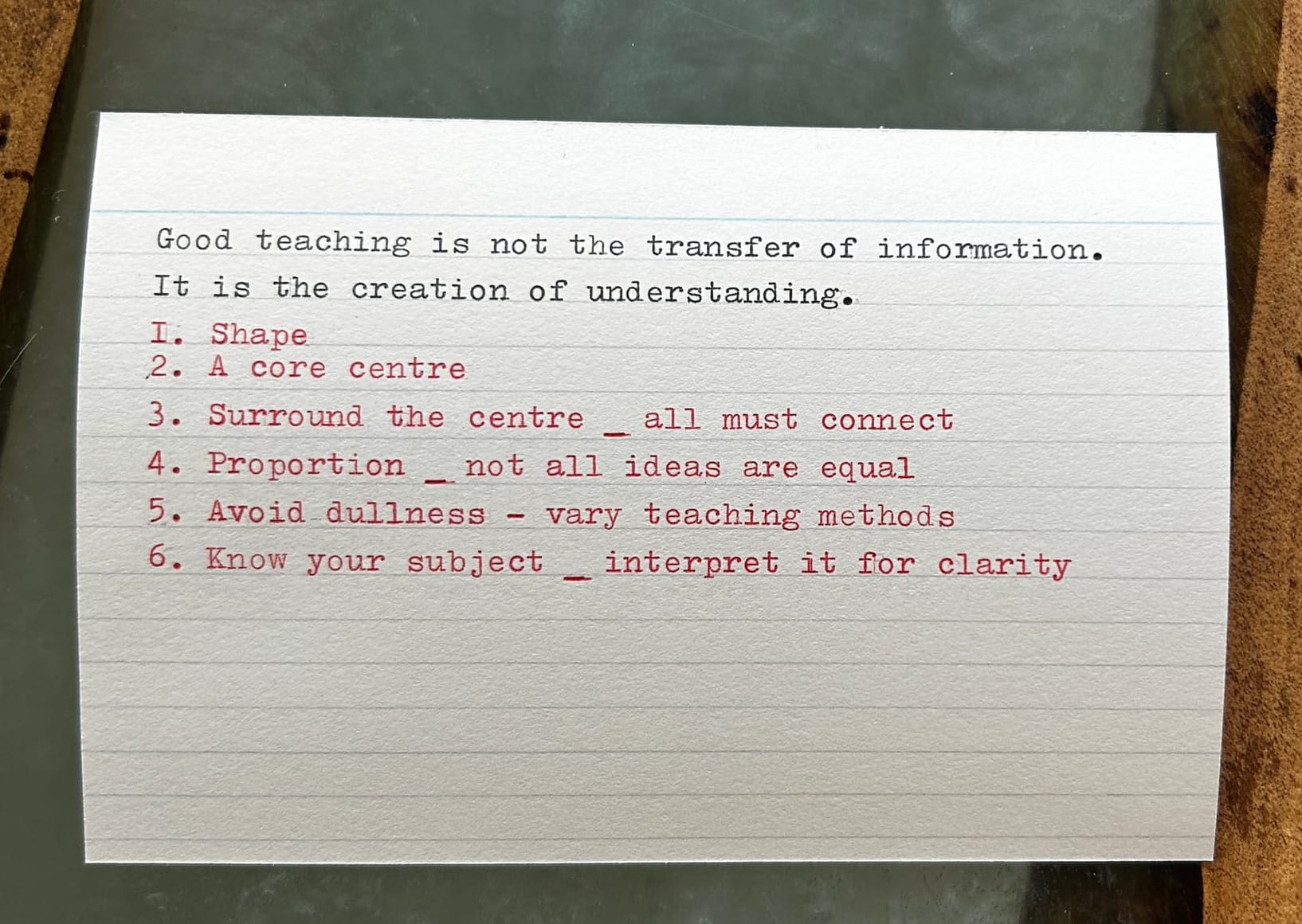
Each medium does what it does best. Paper encourages depth and reveals patterns and a physical record of the collection. Digital enables speed and recall and long term storage. Ideas move between them, and that movement is itself a form of thinking.
The system looks like this.
- Capture (Notebook or Apple Notes)
- Curate (Review, action, decide)
- Crunch (Type or write on index cards, learn, create, improve)
- Contribute (Back into my work, into new essays, into products, or simply share on Instagram)
Note: This 4 C system happens to be the very same system I use for my learning management system too.
A commonplace book is not about efficiency. It is not a system for getting more done or managing information at scale.
It is about cultivation — the slow, non-urgent accumulation of things that matter to you, arranged by interest rather than utility, gathered over years rather than quarters.
Over time, it becomes a map of your curiosity and interests. And from that map, original thinking can grow. You stop staring at blank pages, because you are surrounded by seeds — half-formed ideas, useful fragments, connections waiting to be made — that you have been planting without quite knowing what they would turn into.
In a world that rewards speed, a commonplace book restores something worth protecting: a place to think slowly and see clearly.
And seeing, combined with slow thinking, sustained over time, becomes a life well lived – and not to mention, a competitive advantage for coming up with new ideas.
Where this sits in the Atlas
Orientation·Idea to Value·Communication·Creativity & Climate·Learning
Creative Soul Projects
There's a video that goes with this piece, on Creative Soul Projects. Same person, same observation — just followed on camera instead of on the page. Explore the channel.