Why Methods Don’t Create Value (Learning Does)
There is no single correct way to work. Methods help, but they're not the point. Why feedback and learning matter more than frameworks in turning ideas into value.

Why Scrum, Kanban, and Waterfall don't matter as much as you think — and what does
Somewhere in the archives of most organisations sits a document nobody reads anymore. A framework decision. A methodology selection. A carefully argued case for why this way — Scrum, Kanban, Waterfall, SAFe, lean, stage-gate, Moreorlesssafe — was going to be the answer.
Somewhere else in the same organisation sits a team that has quietly stopped following it.
They didn't rebel. They adapted. They kept the parts that helped, let go of the parts that didn't, and built something that works for their context. The framework is still on the wall. The work moves in a different shape beneath it.
This pattern is everywhere. And it points to something uncomfortable about how we talk about methods — which is that we treat them as if they were the thing that creates value, when in reality they are only the container we happen to be working inside.
The myth of the one correct method
There is a subtle myth in the world of work: that somewhere, behind certification badges and colourful diagrams, there exists one correct way to operate. One framework. One tool. One sacred sequence of steps. And if we could only discover it, everything would fall into place.
Work does not behave like that. People do not behave like that. Context certainly does not.
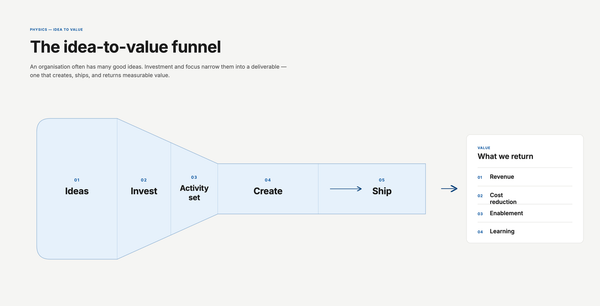
Principles outlive methods. Methods expire. The approaches that felt essential twenty years ago are largely gone. The approaches that feel essential today will be largely gone in another twenty. What persists is the underlying physics — the movement of ideas through investment, activity, and value — not the particular shape of the container you move them through.
This is not an attack on methods. Methods help. Choosing one and committing to it beats arguing about them forever. The point is more specific: a method is a vehicle, not a destination. It holds work and process, it doesn't create value.
The thing most debates actually miss
I have watched organisations spend six months debating whether to adopt a delivery framework. Whole departments forming camps. Training budgets mobilised. Consultants flown in. Vendor pitches, pilot plans, certification schemes, change management programmes. All cost.
Meanwhile, two floors below, a team of five with a whiteboard and a shared document was releasing useful things to customers every week.
The difference was never the method. The team without the framework had something the debating group had forgotten they needed: feedback. Short loops. Frequent signals. Opportunities to learn before the cost became irreversible.
This is the part that gets lost in every methodology debate. The feedback is the mechanism. The method is just what holds the feedback in place. A method without feedback is choreography without consequence — a system performing work rather than doing it. A method with genuine feedback becomes a learning system, almost regardless of which method it is.
What Investment → Activity → Value actually requires
At the centre of the Idea to Value system as a way of seeing, is a thread that has to stay visible for any delivery approach to work.
Investment → Activity → Value.
Can you see the money? Can you see the work? Can you see the outcome? Can you trace the line between them?
When that thread is visible, the specific method becomes secondary. When it isn't — when investment lives in finance spreadsheets, activity lives in a delivery tool, and value is measured by a different team a quarter later — it doesn't matter which framework you chose. The thing you're trying to manage has been broken into three disconnected pieces and filed separately.
I've explored the mechanics of how that thread gets broken — and what to do about it — in the investment-to-value thread piece. The short version: most organisations don't have a delivery problem. They have a visibility problem dressed up as one.
Where methods become identity
The more dangerous mistake is not choosing the wrong method. It's turning the choice into identity.
Teams declare themselves Scrum teams, Kanban teams, Agile teams, Lean teams — and then defend those declarations long after the context has changed. Certifications create allegiances. Consultants create adherents. The original question — is this helping the work move? — quietly disappears underneath the question of whether we're following the method properly.
I once worked with a Scrum Master who wanted to overhaul a process that was working well, because it didn't match the Scrum guide closely enough. There was no evidence of a problem. The team was delivering. The system was clear. His objection was philosophical, not practical. We were failing an orthodoxy we had never signed up to.
That's the trap. When a method becomes an identity, every deviation from it feels like heresy rather than adaptation. Energy that should be going into the work goes into defending the framework against people who aren't using it correctly. Debates stretch for months. Nothing moves. All cost.
The quieter alternative
There are teams succeeding today with entirely different methods. Different containers and rules. Different rituals. Different ways of working. What they share is not uniformity — it's responsiveness. The ability to notice when something isn't working and adjust. The willingness to treat the framework as a starting point rather than a contract.
This is the equine version of being effective. It doesn't photograph well. It doesn't produce the kind of certification wall that looks impressive in a strategy deck. It just works.
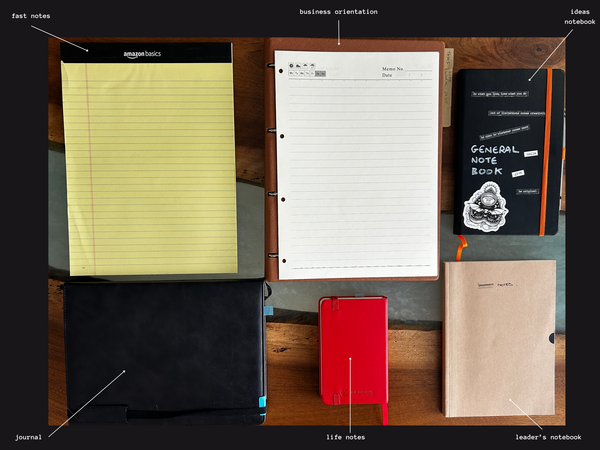
The tools beneath it are almost always more modest than you'd expect. A notebook. A board. A calendar. A digital platform. Each one is simply a container holding work, with a set of rules shaping how it moves. The tool is not the magic. The discipline of making work visible, keeping feedback short, and adjusting as reality reveals itself — that's the magic. The tool is just the place it happens.
Begin with effectiveness, not software
The most common version of this mistake starts with tooling. A team is told to improve delivery, and the first question they ask is which software to buy. The vendor gets booked before the problem is understood.
A better sequence: begin with effectiveness. Then visibility. Then the path from idea to value. Then — only then — the container that holds it all.
Choose tools that support you. Avoid tools that demand obedience. Resist the urge to let the software decide how your work should be shaped. Most of the expensive delivery systems I have seen were installed before anyone had a clear picture of what good delivery actually looked like in that organisation. The software arrived in hope. The hope did not arrive with it.
Value is created by adjustment
The deeper point sits underneath all of this.
Value is not created by following a method. It is created by adjusting — repeatedly, honestly, in response to what the work is actually telling you — as reality reveals itself. The method is one vehicle for that adjustment. Feedback is the fuel. Learning is the outcome.
Without feedback, even the most elegant method becomes a stage show. With feedback, even the simplest setup becomes a learning system. That asymmetry is the whole argument.
So when the next framework debate arrives — and another one always arrives — the question worth asking is not "which method is best?" It is something simpler and harder to answer.
Does this help us see the work?
Does this give us feedback fast enough to learn from it?
Are we using it to improve, or to perform?
And is it helping us take ideas and turn them into something valuable?
The method is not the point. The learning is.
Go deeper
This principle is one of 26 in the full deep dive Idea to Value system. Here's where to continue.
Watch the full Studio session below
4.5 hours of practitioner-level video across all 26 principles — separate from the course, and going significantly deeper. Built for people who want to go deep and apply the system with a rich understanding.
Get the Idea to Value course
The complete field guide and video series — all 26 principles explained clearly, with practical examples and a way of seeing your work you won't be able to unsee. The clearest place to get the full system in one place.