Why You Shouldn’t Compare Teams Using Metrics
Metrics can guide improvement — or distort behaviour. This piece explores why team-level metrics are for learning, not comparison, and how misuse quietly damages outcomes.
Editor’s Note
These sessions explore the Idea → Value system in practice — slower, deeper, and closer to real work. If the essays sketch the outline, these sessions walk the terrain.
How Metrics Support Learning — Not Ranking
Numbers can illuminate.
They can also distort.
In the right hands, a measure is a mirror.
In the wrong hands…
it becomes a lever.
Teams often generate a rich stream of information.
Cycle times.
Throughput.
Velocity.
Rework.
Mood.
Momentum.
These signals are close to the work.
They describe the lived reality of creation.
They are not scorecards.
They are instruments.
And this is where something subtle goes wrong.
When leaders, distant from the work, reach down…
and begin comparing teams by these numbers.
Something shifts.
Work fragments.
Tasks shrink.
Movement is mistaken for progress.
Behaviour bends toward the metric…
instead of toward the value.
The number improves.
The outcome does not.
Every team is different.
Different domain.
Different complexity.
Different history of learning and trust.
To rank them by a single productivity measure…
is to compare things that are not comparable.
This sits inside the Idea to Value.
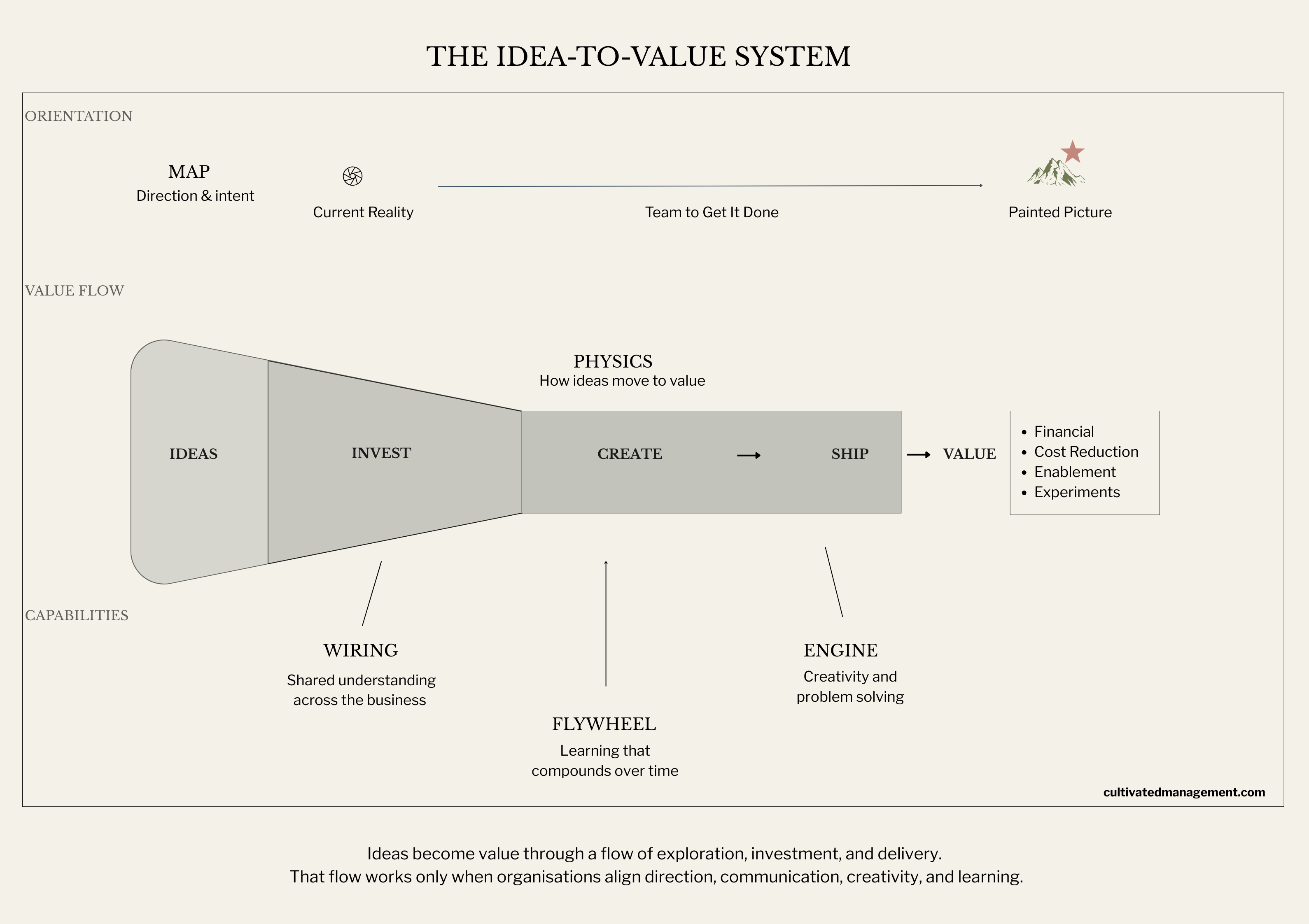
Because metrics are meant to support flow…
not distort it.
At the team level, metrics have one purpose:
Self-improvement.
They are tools for reflection.
Signals that help a team ask:
Where are we stuck?
Where are we repeating ourselves?
Where can we make this smoother?
They are not designed for external judgement.
They are designed for internal learning.
Above the team, other lenses belong.
Milestones.
Financials.
Value realised.
Waypoints.
These are legitimate perspectives for leadership.
They orient the organisation…
without distorting the craft.
But when these layers blur…
something predictable happens.
The organisation starts optimising the report…
instead of the result.
Healthy systems separate the views.
Teams see the mechanics of their work.
Leaders see the trajectory of the enterprise.
Planners see the flow between.
Each lens is valid.
None should replace the others.
Because the purpose of measurement…
is not to accelerate activity.
It is to improve outcomes.
It is provide information to make the business better.
A good metrics or measure helps you make a decision.
And outcomes are not created by numbers.
They are created by people.
Using numbers wisely.
Quietly.
And mostly…
for themselves.
In the full session, we explore how to use team-level metrics effectively,
how to avoid comparison traps,
and how to separate measurement layers without losing visibility.
Go Deeper
This article introduces one part of the Idea → Value system course.
If you want to go further — to see how this works in real organisations, and how to apply it in your own work — there are three ways to continue:
- Watch the full studio deeper session — a rich and detailed walkthrough of this idea in practice (available in the Studio) - below.
- Buy the Idea to Value course complete with field guide - and companion video series.
- Start with the Orientation Session — a 20-minute overview of how ideas move from concept to value
All are designed to help you not just understand the system…
but use it.