You still can't play the drums
There are two ways to learn anything: taking in information, and doing the thing. On why you need both, and why a teacher beside you beats either.

The two ways to learn
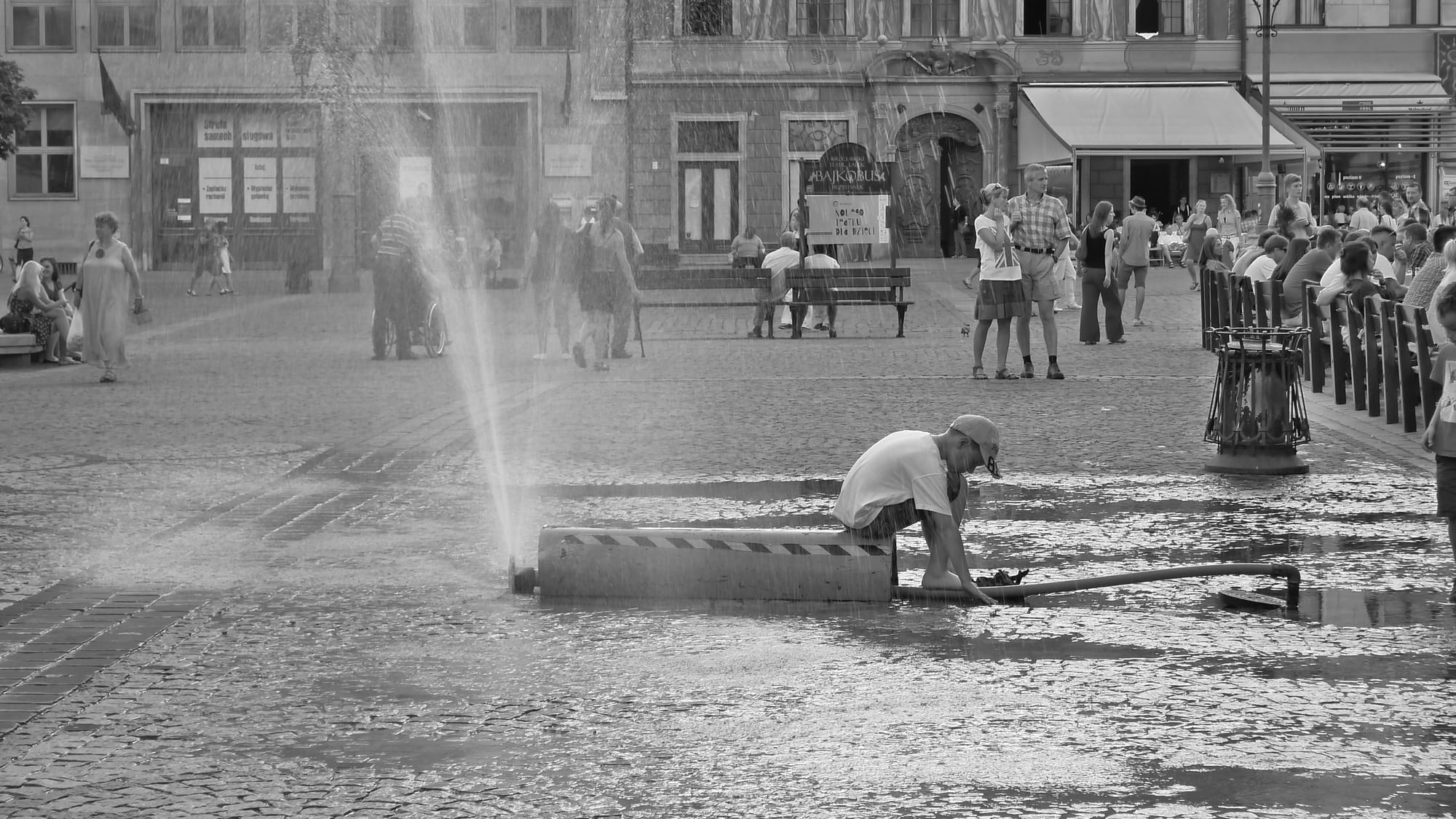
I was in Poland, chilling in the wonderful square in Wroclaw, sipping on a nice local beer, when a couple of guys from England, on the table next to me, leaned over to say hi. We got chatting.
The conversation, as many do with me, turned towards creative expression, in this instance, music. I mentioned I was learning to play the drums and one of the guys launched into a spectacular monologue recounting everything he knows about playing the drums.
He knew the history and the great players; he explained the difference between paradiddle and a flam. With confidence and real authority he brought to life how a shuffle ought to feel. As it happened a band were setting up in the bar. I asked him to play something – out of genuine curiosity. He politely declined. His friend egged him on. He declined again. After an awkward silence, as his moved his finger around the rim of the glass, he admitted he hadn't actually ever really played the drums, he'd just read a lot about it.
There's nothing wrong with knowing a lot – far from it, there's real personal satisfaction in reading and learning about what interests you. But there's a world of difference between knowing something, and doing something. He knew a lot about drumming but could not, in any useful sense, drum.
It's one of the fascinatingly interesting facts about learning anything, and once you've noticed it you start seeing it everywhere. There are people, like Malcolm, who can talk you through landing a passenger jet and have never flown; who can describe professional tennis, stroke by stroke, without ever playing tennis. Knowing about a thing and being able to do it are not the same, and mistaking the first for the second is a common way that learning never quite becomes ability.
Which points at something worth holding onto: there are really two different ways to learn anything at all, and most of us lean far too heavily on one of them.
The first is information acquisition – the taking-in of information. Reading the books, watching the videos, sitting the courses, filling the notebooks; knowing where to find something again and how it sits beside everything else you already know. It's the pursuit of understanding, of knowing about. And it's genuinely valuable, because it develops the language, the models, the patterns and the perspective to make sense of what you're looking at. It's also highly enjoyable. But information on its own has never once made anyone a good drummer. You can read every book ever written on the subject and still be sitting at the kit in complete silence.
The second way is task acquisition – learning by simply doing the thing. The photographer who learns by shooting; the artist who learns by drawing badly and then a little better next time; the drummer who learns.....by drumming; the marketer who learns by marketing something. This is learning grounded in reality, and its oversized gift is that reality answers back. The feedback is often immediate and impossible to argue with – a wrong note is a wrong note. It's the mode I trust most and the one I'd reach for first in work, and life; plenty of the finest drummers alive never read a word about it, they just picked up the sticks and taught themselves, badly at first and then not. If you're curious enough, and honest enough to reflect, you can get remarkably far on doing alone.
Though not quite all the way, which is the catch worth knowing about. Doing without reflection has a pitfall of its own: you practise your mistakes, and grow more confident in them. Experience hardens into one single way instead of softening into improvement and exploration of other approaches. The drummer who never really listens to themselves may just gets faster at playing it wrong.
Which is precisely why the two ways are so much better together than either is apart. Information sharpens the doing; the doing tests the information. You bring an idea into the work and watch which parts survive contact and which collapse the moment reality leans on them, or someone points out why it's not working.
Sometimes you begin with the reading and discover its limits by picking up the sticks; sometimes you begin with the sticks and realise a little theory would really help you get better. Either direction works. It's exactly what the "crunch" phase is in a good knowledge management system is for. That part where something you've read gets tested in the doing, and only then turns into something you genuinely know. Knowledge, after all, is information in action.
Learn a little about drumming, then play; play a while, then read to get better – round and round, and you improve far faster than either on its own would likely take you.
And then there's the thing that, in my experience, beats all of it, the one I'd choose every single time if I could: doing the thing beside someone who is already excellent at it.
Sit at the kit with a real drummer by your side and everything speeds up. The work is real, the feedback is timely and laced with experience, and – this is the crucial part – you can finally see what good actually looks like, in the room, not as a diagram or a video but as something happening right in front of you, by someone excellent at what you want to do, that you can point at and ask about.
They hand you the information exactly when you need it, catch the bad habit before it sets, and nudge you toward the next thing just as you become ready for it. Call it teaching, mentoring, coaching, an apprenticeship, on the job training – the name matters far less than the shape and form of it: a learner, doing the real thing, with someone excellent close enough to help. It's how ability has been passed along for about as long as there have been things worth being good at.
Frankly, none of this is complicated, and that's rather the astonishing beauty of it. The test of whether you've learned something is not about whether you could talk about it in a town square in Poland. It's whether, when the moment arrives, you can actually do it. So read and digest information – read widely and well, because the information really is a gift. But at some point the book has to be set down and the sticks have to come up, and ideally there's someone good sitting beside you when they do. It holds for drumming, for photography, for cooking, for writing, for leadership, for management, for parenting – for very nearly anything a person might want to become better at.
You can know everything there is to know about the drums. You'll only ever learn to play them by playing them.
Where this sits in the Atlas
Orientation·Idea to Value·Communication·Creativity & Climate·Learning
Creative Soul Projects
There's a video that goes with this piece, on Creative Soul Projects. Same person, same observation — just followed on camera instead of on the page. Explore the channel.