In praise of productive procrastination
Creativity isn't a burst of genius that strikes the lucky. It's a rhythm between two modes — open and closed — and a great deal of what looks like brilliance is just someone who's learned to protect it. Here's the full cycle, and how to keep it turning.


The open and closed modes, the cycle they make, and how to keep the ideas arriving
The best idea I had all year turned up while I was washing a saucepan. Well, I say washing it. I was actually scrubbing it furiously after my son had ignored the recipes advice to gently simmer the milk and instead had furiously boiled it – and burned half of it to the bottom.
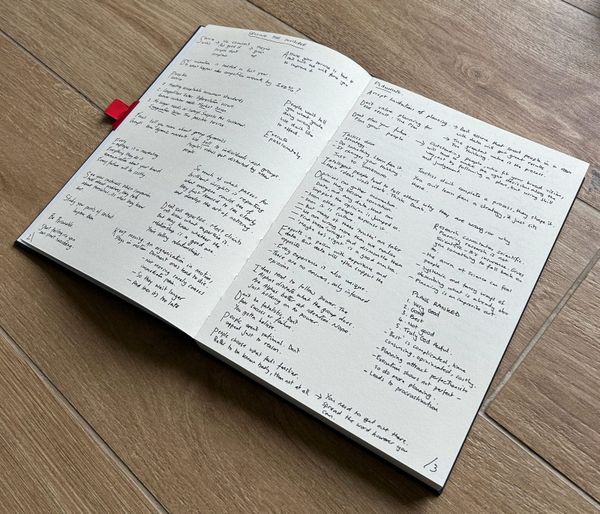
I'd spent the best part of a week chasing the idea at my desk – the nice chair, the second monitor, the document open, the notepads, the A3 paper, the analogue tools, everything a person is supposed to need to think. Nothing came. Then, on a Tuesday evening with my hands in warm water and my mind focussed on saving the pan, the entire shape of the idea arrived at once, uninvited, complete and wanting to become something valuable. I dried my hands quickly and wrote it on the back of an envelope before it could leave. There, complete and ready to be brought to life.
If you make anything for a living, you'll know the feeling, and you'll know how insulting it is: the idea shows up everywhere except the place you built for it. The shower. The walk. The train. The moment just before sleep. 3am. Which is worth playing with, because it's telling us something we often refuse to hear, especially in work – that the desk is only half of the work, and the busy, packed, back-to-back half at that too.
Creativity isn't a burst of genius that strikes the lucky few. It's a rhythm and discipline. And what looks like brilliance is just someone who has learned to protect it.
Two modes, and the movement between them
The clearest way I know to describe this comes from John Cleese, who borrowed it in turn from the psychologist Donald MacKinnon. There are two states we work in.
Closed mode is delivery. Tasks, meetings, email, decisions, output, the satisfying feeling of something crossed off your task list. It's purposeful, action orientated and a little impatient. Most of us live here – all week, all year, and increasingly all decade. It's the normal conditions in many organisations – just get things done.
Open mode is the other one. Curiosity, wonder, noticing, turning an idea over and around, letting the mind wander off, noddling a problem. It's relaxed, playful and unhurried. It's the state you fall into on holiday around day two, when you finally stop resisting the urge to check emails, and start noticing the place around you. It's where possibilities appear, where unrelated ideas find each other, where you see the problem from a side you hadn't tried and where you feel very human indeed.
Here's the idea worth playing with, and the part many people skip straight past: it isn't about picking the right mode. Both are essential. Open mode dreams the thing up; closed mode makes it real. The creativity is in the movement – open to find the idea and expand it, closed to build it, open again to test it and improve it (and to check it's still worth doing), closed again to make the next iteration of it. Open, closed, open, closed. Wonder, action, wonder, action. Notice, work, notice, work.
Einstein reached for his violin to open his mind, then worked with famous stubbornness in closed mode until the idea gave in. Churchill laid bricks – actual bricks, building an actual wall – to reset himself between bouts of intense pressure during the war years. Writers, painters, athletes, engineers: almost any working creative life and you'll find some homemade version of the same alternation, deliberate expansion followed by deliberate focus, over and over.
Modern work does something odd to this though, and not in a good way. It keeps us in permanent closed mode – the calendar full to the edges (a side effect too of remote work where seeing anyone requires booking a meeting), the next thing always starting before the last one finishes, the long hours – and then acts betrayed, bewildered and confused when the ideas stop coming and the same problems are still sitting there a decade later.
Where the ideas actually come from
Before the how-to, one observation, because it changes what you do with the rest.
The people most useful to any piece of creative problem-solving in work are rarely the calm and contented ones. They're the frustrated ones – not the checked-out, but the engaged-and-blocked. The person who cares enough to be annoyed that something doesn't work is the person pointing straight at the problem worth solving. Frustration, pointed in the right direction, is just caring that hasn't been given anywhere to go.
So if you're ever staring at a tangled, long-standing problem and don't know where to begin, begin with the people it irritates most. Go and see them for yourself. The care is the fuel; without someone who genuinely wants the thing to be better, the whole process stalls before it starts.
The creative cycle, in practice
It isn't a sprint, and it can't be crushed into a two-hour innovation session once a quarter and ticked off. It's not a week once a year for "ideation". It's a rhythm you move through – and once you've seen it, you'll recognise it in everything from solving a knotty work problem to writing a book to putting together a photo essay.
1. Care about something. It starts here or it doesn't start. Pick a problem someone actually minds about – ideally you. It's pretty tough to create a solution to something you don't care about. It's hard to create from the heart about a topic that means nothing to you. Care is the starter fuel for creativity.
2. Name the problem properly. Not the vague feeling of it, the actual thing. What's the evidence this is a problem at all? When is it a problem, and when isn't it? How would you know if you'd solved it?
Skip this and you'll generate ideas that feel thrilling and solve the wrong thing entirely. If you want a ready-made set of questions to interrogate a problem with, the Phoenix Checklist – a list originally used by the CIA to pull a problem apart before solving it – is hard to beat. If it works for them, it'll probably work for you this Tuesday.
3. Study it. Einstein's view was that to solve a problem you must first understand it completely. Gather the evidence, the perspectives, the awkward facts. Just don't let studying become a place to hide from starting – there's a point where more research is procrastination wearing a lab coat or suit.
4. Make the space. This is the step everyone agrees with and no one does. Open mode needs an actual gap – a cleared afternoon, a cancelled meeting, a genuine gap in the week. It will not happen in the fifteen minutes between two meetings, no matter how sincerely you'd like it to, or how much you wish it were so.
5. Open mode: ideate — and mind the two blocks of time. Cleese named five conditions for this: space, time, more time, confidence, and humour. The two-times thing sounds like a joke and isn't. When you first sit down to think openly, closed mode prevails – the unanswered email, the thing you forgot, the list, the chores you need to do at home later.
You need a first block of time simply to let all that settle and let your mind cross over from closed to open. Then a second, longer block – usually one to three uninterrupted hours – to actually let ideas emerge, the noticing pay off, the care rise up and ideas collide. Start alone and without judgement (divergent first); bring it together and sharpen later (convergent second). And take the humour seriously: playfulness isn't a bonus here, it's the signal, tool and instrument of creation. If nobody's enjoying it, you've slipped back into closed mode without noticing.
Note: Music is a good way to switch between the modes easily.
6. Then step away. Procrastination, it turns out, is part of the method, not a failing of character or a slight on your personality. This is the most welcome sentence I get to write all year. After all, I hold a masters in procrastination.
Once you've filled your head with the problem, ideas, potential solutions, do something else entirely. Walk. Cook. Sleep. Wash a saucepan. The subconscious keeps working the thing while the conscious mind is busy elsewhere, and this is where the answer usually arrives – on the walk, in the shower, just before sleep, always when you've stopped trying to get the solution.
7. Closed mode: build it. Now the graft. Focus, produce, make the actual thing in full. This is where the idea earns its keep, and it's hard, unglamorous work – no amount of open-mode wonder builds the thing for you, you must sit down and make it so.
8. Test, then round again. Back to open mode: put it in front of reality, get feedback, ask for input from trusted people, see what the work is genuinely becoming rather than what you hoped it would. Then closed again to refine and ship the next version. And on. Open, closed, open, closed – the same rhythm, all the way down.
Holding problems without smothering them
Teams need somewhere for all this to live – a place where a frustration can sit until insights are born, or a half-formed thought can be picked up again next week instead of lost forever.
I once worked with someone who gave me help with exactly this. We built a simple Kanban board – a backlog for the frustrations and problems, a column for each stage of the cycle, and one clear and firm rule: one active problem at a time, so attention wasn't split across six competing ideas. Morale rose. Delivery rose. Enthusiasm rose. People started wanting to bring problems forward instead of hiding them and being personally annoyed by them. And it doubled as a library of insights and solutions, which turned out to be a gift when someone new joined, or when leaders came knocking to see what was happening.
But here's the trap, and it's a subtle one. The board is not the point though. The point is the time and space it's designed to protect – the hours of open-mode thinking and the patch of closed-mode building. It's very easy to fall in love with the tidy columns and let the process become the work, at which point you've built an elaborate way for administering creativity instead of doing any. Keep the visibility; guard the rhythm it was meant to serve.
Protecting the rhythm
Watch how people who create for a living actually operate – writers, musicians, athletes – and you notice something most workplaces have simply forgotten. They don't run flat out, continuously, forever. They alternate: intense focused effort, then real recovery; open exploration, then directed production. The rhythm is built into the craft of what they do, not bolted on when there's time, or injected mid-year as a vanity project.
Most workplaces do the opposite. They ask for full output, at full capacity, all the time, indefinitely – and then act surprised when the ideas dry up, when the problem that's been there for ten years is still there, and when the people with the energy and imagination to fix it find somewhere else to be, or disengage entirely.
That's the real cost, and it's an important one. The work will always be there. The problems will always be there. The people with the appetite to solve them are the thing you can actually lose – and they leave first, because they're the ones who could see it wasn't working and nobody wanted to do anything about it. They are the ones who have the ability, creative expression and willingness to make the work better, if only people would create the space.
Edwin Land, who founded Polaroid, put the responsibility beautifully: the ideal outfit, he said, is made of managers and dreamers, and it falls to the first to protect the second. You don't need a title to act on that. You can protect the dreamer sitting next to you, and – harder, and more important – you can protect the dreamer in yourself, by refusing to spend every hour in closed mode and calling it dedication to the cause. And if your workplace isn't the place to bring your creative intelligence, then a side project or business of your own might be exactly how you take your own ideas and turn them into sustainable work.
Creativity isn't a nice to have we bolt on, and it isn't a quarterly workshop. It's the rhythm by which good work stays alive and gets better and generates value. Protect the space for it – not as a perk, but as a condition of doing anything worth doing – and the ideas keep arriving. Fill every hour with delivery, and you'll get exactly what you've built the week for: everything done, and nothing new.
The saucepan, for what it's worth, is still my most reliable colleague, even if it is a little ruined.
Quick reference — open mode and closed mode
Where this sits in the Atlas
Orientation·Idea to Value·Communication·Creativity & Climate·Learning
Bibliography
Clear, J., 2013. The daily routines of 12 famous writers. jamesclear.com. https://jamesclear.com/daily-routines-writers
Cleese, J., 1991/2017. John Cleese on creativity in management (talk). Drawing on the work of Donald MacKinnon.
The importance of creativity in business, 2022. Harvard Business School Online, Business Insights. https://online.hbs.edu/blog/post/importance-of-creativity-in-business
The Phoenix Checklist. ModelThinkers. https://modelthinkers.com/mental-model/the-phoenix-checklist
The science behind creativity, 2022. American Psychological Association, Monitor on Psychology. https://www.apa.org/monitor/2022/04/cover-science-creativity
30 ways to inspire divergent thinking. Open Colleges. https://www.opencolleges.edu.au/blogs/articles/30-ways-to-inspire-divergent-thinking
What is Kanban? A beginner's guide. Asana. https://asana.com/resources/what-is-kanban