How learning to see is the art of generating ideas (Word at Work)
We use the word idea casually. But it traces back to a Greek verb meaning to see — and that changes how we understand what ideas actually are, and where they come from.


To generate ideas is to see, to pay attention and to notice
The word idea comes from the Greek idein — to see.
Not to invent. Not to create. To see.
That single detail changes almost everything about how we understand what an idea actually is. It was not, in its original conception, an act of bringing something new into the world. It was an act of noticing something that was already there.
This episode of The Word at Work explores the etymology of idea — from its Greek origins through Plato's theory of perfect forms, into the language we use in modern organisations — and what that history reveals about creativity, leadership, and the gap between potential and reality.
The Word at Work — series note
Each episode in this series takes a word we use every day at work and traces it back to its origins. This is episode two. Episode one explored the Japanese concept of mottainai.
What the word reveals
Plato took the everyday Greek word and made it foundational. For him, ideas were not thoughts held in the mind — they were perfect, enduring patterns. The notebook on his desk was an imperfect copy of the ideal notebook. The idea was more real than the object.
That same root gave us the Latin video — I see. The Sanskrit Veda — knowledge. The English wit, wise, wisdom, witness. To see, and to see enough — that is where wisdom sits, if you follow the etymology home.
Later philosophers shifted the meaning toward mental conception. Thought held within the mind. And that is how we use it today: casually, quickly, constantly.
I've got an idea. That's a good idea. Here's an idea worth playing with.
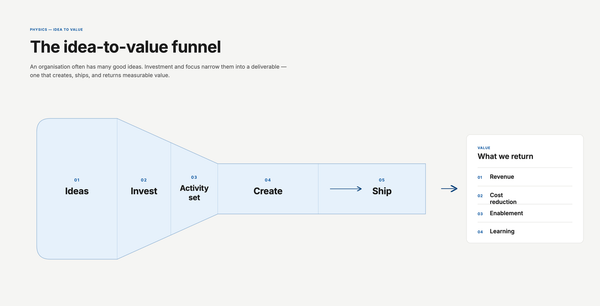
But underneath that casual usage, something deeper is still there. An idea is a possibility glimpsed before it becomes real. In the language of the Idea to Value system, it is the first glimpse of potential value — before the investment, the activity, the creative action, the shipping. Before any of that, there is the moment someone sees something that does not yet exist.
Every product, service, book, video, and organisation begins in that moment.
Four views on ideas
Alfred North Whitehead: Ideas won't keep. Something must be done about them. An idea holds very little value by itself. It only creates value when it finds a path into reality. And if we don't act quickly the idea goes.
Jacob Bronowski: The creative mind is a mind that looks for unexpected likenesses. Creativity, then, is a form of seeing — noticing connections that others have walked past.
Oscar Wilde: An idea that is not dangerous is unworthy of being called an idea at all. Most organisations generate plenty of ideas. Fewer generate genuinely transformative ones. There is a culture of safe thinking in many organisations — ideas that can already be justified, ideas that fit comfortably within existing assumptions, ideas that can be articulated through a spreadsheet. Real ideas can feel uncomfortable, not because they are reckless, but because they challenge what we currently believe is possible.
Antoine de Saint-Exupéry: A pile of rocks ceases to be a rock pile when somebody contemplates it with the idea of a cathedral in mind. Nothing new has been added. The rocks haven't changed. Only the way they are seen. That takes us straight back to the origin of the word.
A closing thought
Perhaps that is why ideas rarely arrive when we demand them. They arrive when we pay attention.
The notebook. The walk. The conversation. The photograph. The question.
These are not tools or techniques for generating ideas. They are ways of seeing.
Because an idea is often not something we create. It is something we notice. And once noticed, the work begins.
About this series
The Word at Work is a regular series on the Cultivated channel. Each episode takes a word we use every day at work and traces it back to its origins — because the history of a word usually reveals something the modern usage has quietly forgotten.