Two Questions to Get Unstuck
When work or life feels stuck, clarity rarely comes from thinking harder. It comes from asking better questions. These two questions restore agency, belief, and momentum.


When You’re Stuck, Ask Two Questions
We all get stuck.
In work.
In projects.
In life.
Sometimes the stuckness is technical
— a problem we cannot solve.
More often, it is psychological
— a fog of overwhelm, ambiguity, or quiet dread that settles in and drains momentum.
In my work, I spend a surprising amount of time helping people get unstuck.
Often, nothing is technically broken.
People simply cannot see a path forward, even though one exists.
When I notice myself stuck, I ask two questions.
What can I do?
Why will this work?
They are simple, but they shift something fundamental.
Editor's note — where this sits
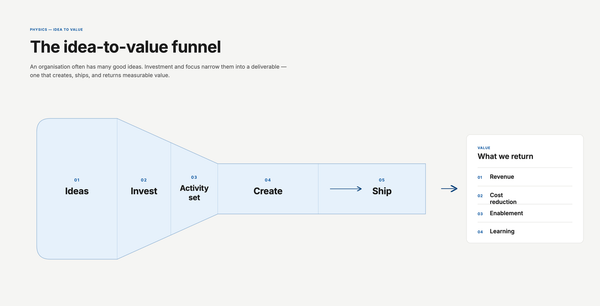
This essay offers two simple questions that restore agency and belief when momentum has stalled — for individuals and for organisations. It sits in the Map layer of the Idea to Value system — the layer concerned with orientation, direction, and finding a path forward when the picture isn't clear. It also connects to the Engine layer: belief and energy are the preconditions for creative action.
The Idea to Value system — five layers
From Reaction to Agency
The first question
— What can I do?
— restores agency.
When we are stuck, it often feels like things are happening to us.
Deadlines, politics, constraints, people, markets, expectations. The sense of control narrows, and with it, our capacity to act.
This question widens the field again.
It pulls attention back to what is within reach, even if that action is small.
You may not be able to solve the whole problem, but you can always do something:
send a message,
gather information,
sketch an option,
clarify a decision,
rest,
step away,
ask for help.
Action is often the antidote to paralysis.
Agency, even partial, breaks the spell of stuckness.
From Doubt to Belief
The second question — Why will this work? — restores belief.
Organisations are remarkably good at rehearsing and practicing failure.
Teams gather around a whiteboard and explain why every idea will not work.
Risk registers swell.
Optimism is quietly mocked.
Negativity bias becomes a form of professionalism.
This question forces a different posture.
It asks you to articulate a theory of success, not just a catalogue of risks.
Why will this work?
What assumptions make it plausible?
What evidence suggests it might succeed?
What could make it succeed more?
This is not blind optimism.
It is deliberate belief
— grounded, thoughtful, and forward-looking.
Belief creates energy.
Energy creates motion.
Motion creates learning.
Clarity as a By-Product of Action
Together, these questions move you from rumination to motion.
What can I do? creates action.
Why will this work? creates coherence.
Clarity rarely arrives before movement.
More often, clarity emerges through movement
— through trying, adjusting, learning, and trying again.
These two questions are a way to begin.
Stuckness in Organisations
What applies to individuals applies to organisations.
Teams stall because no one believes they can move.
Leaders hesitate because they cannot guarantee outcomes.
Committees rehearse uncertainty until momentum evaporates.
In those moments, these questions are leadership tools:
- What can we do right now?
- Why will this work?
They shift conversation from paralysis to possibility,
from critique to construction.
A Quiet Discipline
I return to these questions daily.
In moments of overwhelm, ambiguity, frustration, or fatigue.
They do not solve everything.
They do not remove complexity.
But they restore something essential: a sense that progress is possible.
And often, that is enough to begin.
Clarity Partnership
One-to-one · Single session or sustained
When the two questions aren't enough on their own — a focused thinking partnership for individuals and leaders who want help seeing the path forward. One session or a short sustained engagement.
From £495
Explore →Idea → Value System
Field guide + video · Digital
Understanding how ideas actually move to value helps you see the path when you can't find it. A practical system for seeing where work stalls — and what to do about it.
From £19.99
Explore the system →