Everyone is trying to release value
A product team had twenty million pounds and until year-end to turn it into something people would pay for. Then two other teams' good work landed on top of theirs — and someone had to choose which value moved first.

As many of you may know I like drawing shapes on whiteboards. Especially triangles and funnels – I feel I should expand my shape repertoire a little further.
Anyway, on a bleak Wednesday in London, I was with a group of leaders who were having a rather bleak meeting, and the mood was, well, bleak. That's when I drew three funnels on the whiteboard. Not only did it lighten the mood due to my terrible drawing skills but it helped them see something they knew, but hadn't really surfaced properly.
In the room were the heads of finance, product and HR, along with the regional director and we were trying to untangle a major decision.
The product team had around twenty million pounds and until the end of the year to turn it into something people would pay for — a self-service portal where their customers could check stock, re-order and run their own micro supply chain. Sales and marketing had found the people willing to pay for it. The team was building at full speed, and money was going to come in.
The other two teams were just as busy. An HR team was rolling out a new workforce management system to meet European compliance — a full backlog, funding in place, a clear picture of the end. The finance team was revamping how project investment was managed, retiring the usual merge-hell of spreadsheets for something lighter, with new governance, new reporting and new cycles of review.
Three teams, three sets of good work, all of it moving. What none of them could quite see, from inside their own delivery project, was the other two – and the impact they were potentially having on each other.
Editor's note — where this sits
This one is tactical. Most of what I write here is about how to see your work; this is about what happens when you do — three teams, one decision, and twenty million pounds riding on which kind of value moves first. It sits in the Physics layer of the Idea to Value system — the layer concerned with how ideas move to value: the gap between an idea and its worth, and the cost that gathers while you cross it. The names are changed; the maths is not.
The Idea to Value system — five layers
Everyone is running a funnel
This is what the Idea to Value system is for: not to run the work, but to let you see how it moves.
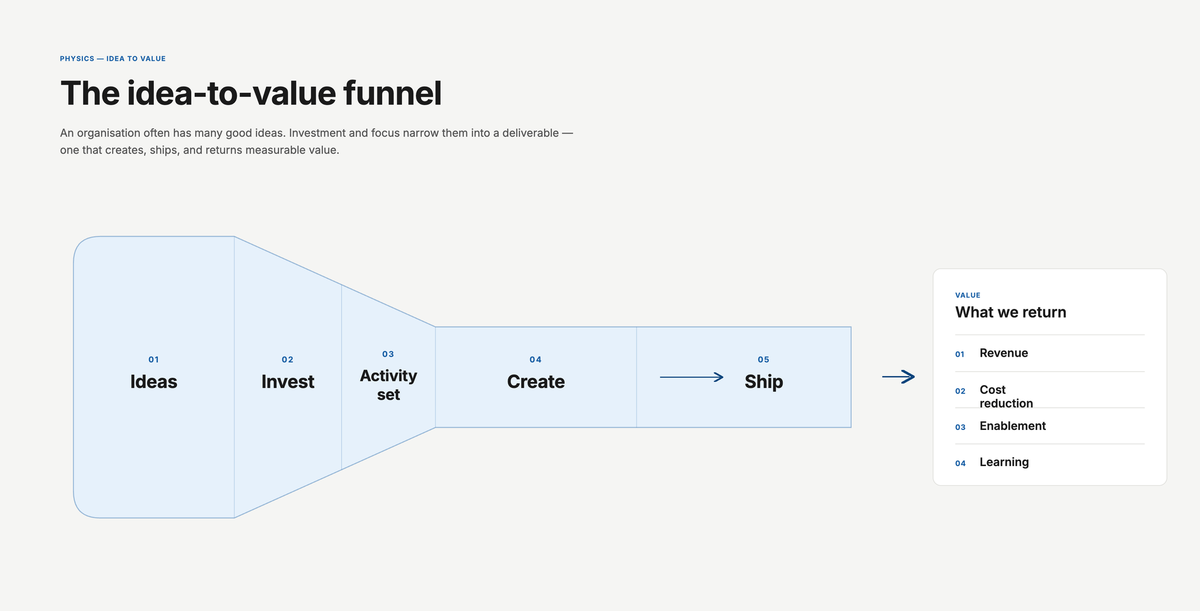
Everyone in an organisation is carrying an idea towards value, and everyone is running some version of the same funnel — the Physics of how an idea changes shape until it becomes something worth having.
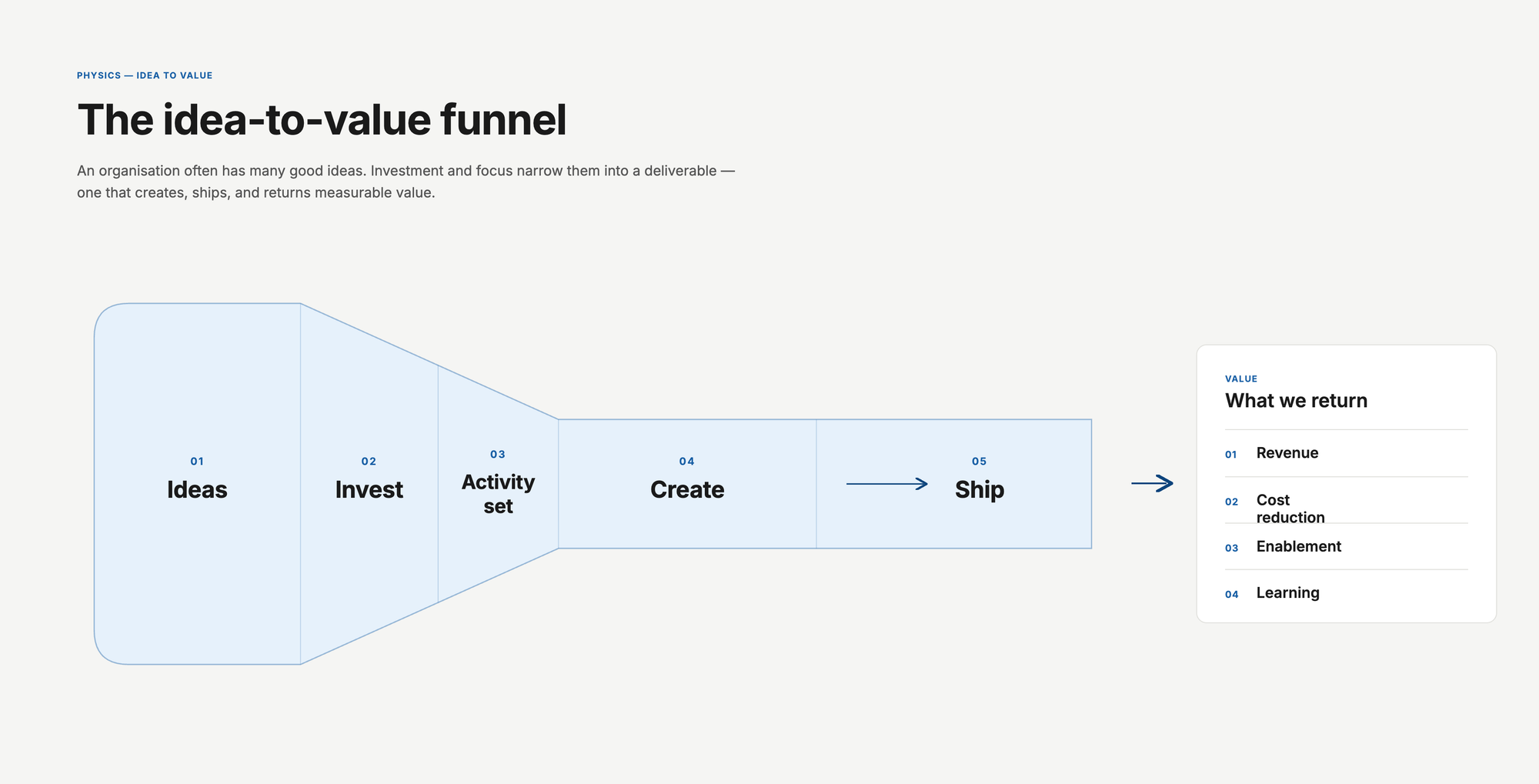
Ideas arrive, and we filter them down using strategy, painted picture, business benefit etc. We invest in the few that survive — and not only money, but people's time, energy and attention, which are every bit as finite.
We build activity sets to hold the idea still long enough to work on it: plans, backlogs, roadmaps, whiteboards, notebooks, sketches, the scrap of paper on the desk. None of it is the work, and none of it is the value — it is a model of the work.
Then we make the thing, the product or service or event or book, and at some point we ship, and at some point the value we were chasing arrives.
Three funnels, three kinds of value
All three teams were chasing their own specific form of value. The HR team was chasing enablement value — the new system kept the business compliant, and made HR people's lives easier as it did, with a little cost reduction on the side in the hours it saved.
The finance team was chasing cost reduction, control and visibility, with a thread of enablement running through it.
Only the product team was chasing financial value (revenue coming in) — the one of the four types (financial, enablement, cost reduction and learning) that points outside the business, money coming in rather than costs going out. The other two, however you frame them, were costs to absorb. That does not make them lesser; a business that isn't compliant cannot earn either. But it is worth being honest about which funnel feeds the others.
When the funnels touch
Midway through the year, the funnels touched. HR and finance were ready to deploy early versions of their work and change the operating rhythm around them — new governance, new reporting, new standards. The knock-on landed on everyone, the product team included.
Nothing dramatic on paper: some training, some meetings, then more meetings, data to migrate, investment frames to re-analyse, reporting standards to debate, tracking tools to rewire so they fed the new report, new time tracking tool, new HR policies to understand, three extra governance routines to attend, all of it to be tested. Small things. Added together, they moved the platform's release from the end of the year to the middle of February.
Not a big deal, plenty of people said.
But everything between a good idea and its value is cost — salaries, buildings, delayed future projects, a sales and marketing plan to re-orchestrate, customers to keep informed, training to reschedule. The cost of building and releasing the platform had gone up, and the value had moved further away. That distance, between the idea and the value it becomes, is the thing we are always trying to make smaller — not to optimise for its own sake, and never at the expense of quality or people, but because a shorter gap is simply a better business.
The choice the leaders faced
So the leaders had a choice. Extend the platform to absorb the HR and finance changes, or hold those changes back and let the platform reach value as planned. Neither of the other systems had a real deadline this year. What would you do?
It helps to remember that the platform was the only one of the three bringing money in — and it is that money that keeps the business alive and lets every other kind of value happen at all. Though a business that cannot stay compliant does not earn for long either.
They chose to hold the HR and finance rollout back for this team only, until the platform shipped. It was a good call. It added no further cost to the platform build, and it let sales and marketing keep their original plan, so money arrived from customers in late December rather than mid-February. The other call would have been defensible too — everyone compliant and tidy, a little more cost and a little later on the money coming in. What you would choose might be different, and that is the point.
Seeing the whole board
None of this decides for you.
Context, cash flow, the market, the priorities coming from above — those still make the final call, and they should. What the seeing does is put HR, finance and the platform team on the same board, in the same conversation and aware of the impact of each across the wider system: not three unrelated programmes, but three flows of value pulling on the same finite money, time, energy and attention.
In this company, everyone already knew the work was connected. What nobody had done was show that every piece of it was a funnel to some kind of value. So, previously, the decisions got made the way they usually do — on the loudest voice, the size of the backlog, a made-up deadline, a feeling about risk. Most of those are reasonable. The loudest voice is not.
Once you can see the funnels, you can weigh them. Until you can, you are guessing loudly. The decision stays yours — but now it is a choice someone made, rather than an accident of who spoke first.
Take this further with Cultivated
The Idea to Value system
Guidebook & self-paced course
The whole funnel, written down. How ideas move to value, what the gap costs, and how to read where your own work is flowing and where it's slowing.
Guidebook £19.99 · Course £29.99
Explore the system →Work with me
Consulting · a few teams a year
Sometimes the funnels need untangling in the room. I work with a small number of teams to make the flow of value visible and get good ideas to value sooner.
By conversation
Start a conversation →