We've likely all experienced something like this. The meeting closes without much discussion. Someone named the problem, someone proposed the solution, and the room agreed — or at least agreed enough to get moving.
You could feel and sense the premature closure to the meeting happening in real time. Something wasn't right. Not with the energy in the room, not with the framing of the problem, not with the confidence behind the answer.
You noticed something. You weren't sure what to do with it.
Six months later, it turns out you were right.
This happens more often than most people talk about. Not because organisations are full of incompetent decision-makers — most aren't — but because the pull toward certainty and fast answers is genuinely strong.
People want resolution. Meetings want output. The person with a clear answer is rewarded with forward motion. The person sitting with a question (or problem, or idea) more fully, noodling something they can't quite name yet, is rewarded with nothing — at least not immediately.
Why developing curiosity as a personal practice matters more than getting the room to slow down
What's worth examining is the difference between two things that can look identical from the outside: a pattern and a prediction.
A prediction says: here's what will happen. It arrives with confidence, it commands a room, and it determines the next action.
A pattern says: here's something I keep noticing. It doesn't have the same weight in a meeting. It isn't resolved enough to be useful — not yet.
But over time, patterns are almost always more valuable than predictions. Reality has a habit of humbling predictions. Patterns, by contrast, tend to compound. The person who has been subtly noticing things builds a picture no single meeting could produce.
Akio Morita, co-founder of Sony, described his chief job as
"...constantly rekindling the curiosity that bureaucracy and formal systems drive out of people."
It's a fascinating framing — not that curiosity needs to be installed, but that it needs to be protected. The conditions around most work are actively hostile to it. Speed is rewarded. Certainty is rewarded. The careful observer who isn't sure yet is not, typically, rewarded.
Which is precisely why, counter-intuitively, it's worth developing as a personal practice — independent of whether it's rewarded, independent of whether the room is interested, independent of whether the organisation slows down enough to hear it.
Curiosity as a practice comes down to four moves, used in sequence, used repeatedly, used quietly:
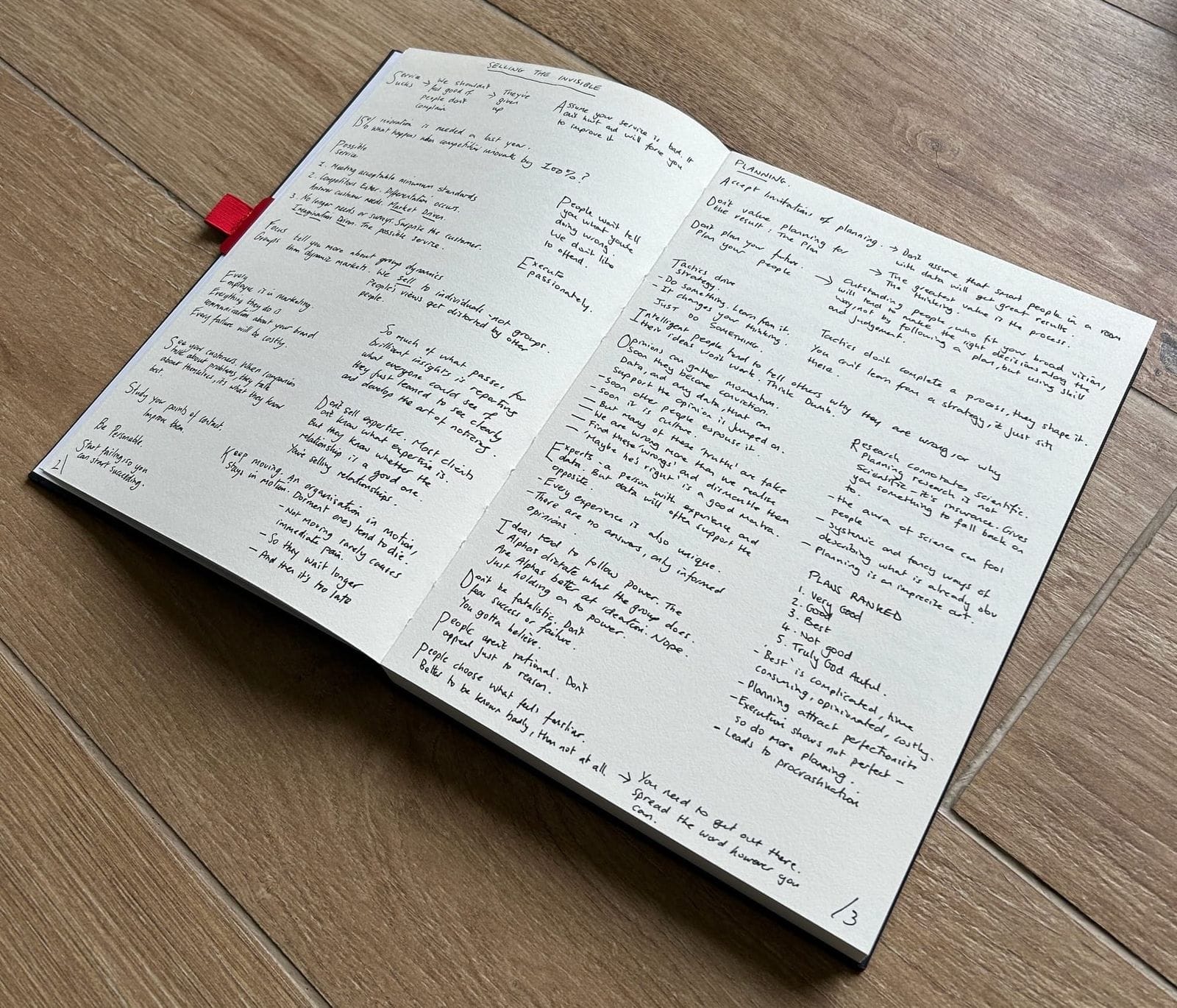
Here's something I've noticed. Not a conclusion. Not a recommendation. An observation, held lightly. Likely captured in your commonplace or notebook or digital system. Just an observation.
Here's a recurring pattern. The same observation, appearing again. In a different meeting, a different project, a different quarter. The pattern starts to feel like something worth paying attention to.
Here's a possible explanation. Not the explanation. A possible one. The curious person doesn't collapse the uncertainty prematurely — that's the move they're trying not to make.
See if it's useful. Test it against reality. Adjust. Notice again.
This isn't a methodology. It's closer to a habit of attention, of noticing, — and like most habits, it gets easier and more natural the longer it's practised.
The person who does this consistently over a year starts to see things that genuinely aren't visible to people who stopped looking. Not because they're smarter, but because they've been paying attention for longer.
There's something worth pointing out about what this practice doesn't require. It doesn't require anyone to listen. It doesn't require the organisation to slow down. It doesn't require a seat at the table, a certain job title, or the kind of authority that gets predictions heard in rooms. The practice belongs entirely to the person doing it. It requires no outward explanation but instead is a significant personal growth activity.
The six-months-later moment — when the pattern you noticed turns out to have been real — isn't about being vindicated. It's about having built something personal. A way of seeing. A track record with yourself of what careful observation produces. That compounds in ways that confidence and fast answers don't.
The goal isn't certainty. It's clearer seeing. And that's available to anyone willing to keep looking.