Nice font. Bad coffee. Change is powered by meaning.
Why clarity comes before control, and how teams actually change.

Clarity is trust towards the future
Updated 31st July 2026
A few years ago, I spent a Tuesday morning with a room full of bright people enthusiastically redesign the very thing that was making them miserable.
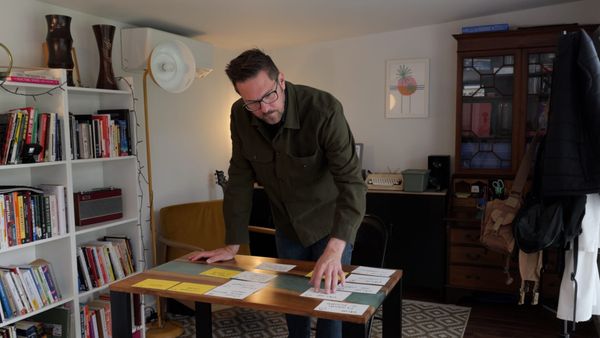
There were printouts. Marker pens. An operating model in several shades of blue. Nice fonts. Bad coffee.
By eleven o'clock, the work had been rearranged quite beautifully. And they understood it no better than when they'd walked in.
I've thought about that morning often since, and never unkindly. They were good people, and the instinct behind the printouts was a generous one – they wanted the work to be better, and doing something felt like the quickest way there. It usually does. The urge to act is one of the most human things about working life, and one of the most promising.
Because the energy in that room was real. It only needed a better view. And that's the positive potential about most teams that are struggling: they're rarely short of effort or goodwill or good ideas. They're usually one clear look away from spending all of those on the right thing. Change doesn't begin with doing. It begins with seeing — and seeing, happily, is a habit any team can grow.
We tend to assume the fix is better people, or more process, or more gates and governance. We go recruiting for talent when the talent is already in the building, adapting with supreme creativity to conditions in the business very few people designed on purpose. We go looking for borrowed frameworks to install, in the belief, and hope, that this might just solve our problems. We add more control, or at the least the illusion of control, through governance, steering committees and better reporting.
But it rarely works because it comes from a place of control, often not a place of true seeing and understanding.
Decisions get made a long way from where they land, and people absorb the gap. The numbers on the wall reward one thing while the work needs another. The measures being used, can often easily be gamed. And if fear prevails in the organisation, the chances are very little truth is being reported either.
None of that is a character flaw, or can be solved with more control. It's a climate — which is actually wonderful news, because a climate is often one of the most changeable thing in any organisation. Warm it up and the same people you already have will show you what they were capable of all along.
This is why I've come to trust clarity over control. Most of us are taught to lead through control – targets, dashboards, a little pressure applied wherever the report reads low – and it has the great advantage of being visible, and seemingly being doing the right thing. You can watch yourself doing it. And, importantly in organisations with high levels of politics, others can see you doing it too.
But the more useful move is almost always to sharpen the lens. When people can genuinely see their work — and how ideas move toward value – how it flows, where it snags, who it's for, what it costs — they begin to steer themselves.
They stop spending their best hours navigating processes and politics so much, and spend them on the work instead, and they bring the whole of themselves to it: the judgement, the taste, the small improvements nobody asked for. Clarity is a quiet form of trust. It treats adults as adults, and adults, given the chance, tend to rise to it.
They rise faster still when they can picture where they're going. People don't move toward spreadsheets, well, maybe some do; they move toward stories and pictures — bright, believable ones of how the work might feel in the future. A team with a credible image of the future has a form of orientation and that changes everything about how effort travels.
So the job of leading isn't only to tidy the present and add more controlling mechanisms. It's to make a better future thinkable – not through slogans, which fool nobody, but through grounded pictures of clearer purpose, smoother work and finer craft. People commit to meaning long before they commit to strategy, and meaning, it turns out, is something you can offer them.
I've started to think "better" is a moral word dressed up as a technical one. We talk about improvement in the language of the machine — output, efficiency, productivity — and underneath it sits something warmer. Work shapes lives. It shapes confidence and curiosity and the mood a person takes home to their family on a wet Thursday evening. To lead a team is to be a custodian of other people's time, energy and attention – those finite resources – whether you fancy the title or not, and to change a team for the better isn't merely to lift its numbers. It's to improve the texture of a great many lives. That's an unusually good thing to get to do with a working life.
And it's mostly done not by fixing people but by tending the conditions they stand in and the climate they work in. Culture isn't the poster in reception; it's the sum of the daily signals. What gets noticed. What gets thanked. What's quietly made easy. People tend to grow to the size of the space you give them, and the leaders I most admire spend their attention widening that space rather than narrowing the people inside it.
There's one ingredient most accounts of this leave out, and I think it's the decisive one: belief. Teams rarely outrun the future they think is available to them; it tends to pull them forward instead. So the most practical thing a leader can hold is a bigger sense of what's possible here — not as a empty pep talk, or a big hairy goal – that's too big and too hairy – but as a steady, daily confidence towards a better future that tends to be contagious. What you believe about has a way of becoming true.
Which brings me back to that Tuesday, and why the printouts were never going to save the morning. They began with the scaffolding around the business. Real change runs the other way. Clarity comes first; from clarity, people find alignment; from alignment, momentum; and from momentum, the value everyone wanted in the first place. It isn't a straight line, and it isn't a programme you announce at the all-hands. It's closer to learning your way toward something – study, try a small thing, watch, adjust – kept up with patience and good humour.
The encouraging part is how ordinary the first step is. Not a restructure. Not a new model on the whiteboard. Just a team beginning to see – the system they're in, the work they're really doing, the future they could make. When people can see, they begin to move. And when they move together, the good work finally begins.
And with that good work, maybe we can buy some better coffee.
Where this sits in the Atlas
Orientation·Idea to Value·Communication·Creativity & Climate·Learning