There Is No Perfect Notebook
There's no perfect notebook — only the right container, with the right rules, for how long a note needs to live. Here's the method, and the six on my desk.

Paper, to many of us, is still relevant. In fact, I'd go further: for a lot of people it's still essential.
Through the work here on Cultivated, my ongoing exploration of the mediums of thought over on Creative Soul Projects — including the legendary wallpaper method — and of course the Stationery Freaks podcast, I get asked the same question more than any other.
"What's the perfect notebook?"
It's an easy answer. There isn't one.
But there is a method I've used over and over to find the right notebook for the right purpose, and I'll share it here. A hint before we start: the same method works for any artefact you use in work and life, whether it's paper or a screen.
It comes down to friction.
We seem obsessed, as a society, with removing it. To make everything easy, everything seamless, the whole of life somehow friction-free. But to weigh the friction on its own is to miss the other half of the equation. Reward.
On the other side of friction lives a reward — a framing I've borrowed from the excellent work of Richard Hammond, not the Top Gear one. And it's the half most people forget. Paper is friction, no question. It's usually easier to reach for a computer, to use AI, to let automation do it. Typing costs less than writing by hand, or setting something down on a typewriter. But friction isn't the enemy we've made it. It's a price. And on the other side of the price is something we wanted.
Editor's note — where this sits
This piece uses a shelf of notebooks to carry a single idea: every tool is a container with rules, and those rules are a friction we pay for a reward. It sits in the Engine layer of the Idea to Value system — the layer concerned with creativity, climate, and the conditions that let good work happen. It also touches the Wiring layer, because a notebook is finally a form of communication: a way of holding meaning still long enough for an idea to travel without leaking away.
The Idea to Value system — five layers
Container and Rules
So here's the frame I'll carry through the rest of this article, and it's simpler than it sounds.
Every notebook is a container. Nothing more. What makes one different from the next isn't just the cover or the paper — it's the rules you give it. Write only in the mornings. Keep it neat. One idea to a page. Never tear anything out. Bullet journal. Those rules are the friction. Each one asks something of you, and that asking is the cost.
But you don't pay a cost for nothing. On the other side of the rules is the reward — the thing the friction was actually protecting. Neatness you can return to. Thoughts that don't blur into one another. A record you can still trust a year from now.
So how do you know how much friction is worth paying? That's the last piece, and it's the one most people skip. Fidelity. Not how neat the note is — that's a rule — but how long it needs to live.
Some notes are scrap: thought out loud, useful for an hour, gone by tonight. Others are records, meant to outlast the week, the project, sometimes us. A note you'll bin tonight deserves almost no friction. A note you'll keep for years earns a good deal of it. Get the fidelity wrong and you either fuss over scrap that was always going in the bin, or you lose something that mattered because you trusted it to a page you never meant to keep.
That's the whole lens. A container. The rules you give it, which are the friction. The reward waiting on the other side. And fidelity — how long the note must live — which tells you how much friction the job is worth.
Now, plenty of people in the stationery world buy a notebook because it looks right. It feels right. It's beautiful, or the paper is just so. I do it. My co-host Helen does it. Everyone we've ever interviewed does it. And then — here's the thing — we leave those notebooks on the shelf until the right project, or the right reason, finally comes along. Which is exactly the point. The question was never which notebook is best. It's which container, with which rules, for a note — or a series of work — that needs to live how long.
Because underneath all of it, a notebook is a form of communication. It holds an idea still long enough for it to move — from your head to the page, from today to next month, from a rough thought to something real — without the meaning leaking out on the way. That's what we're really doing when we choose a tool: deciding how to carry meaning safely as it travels toward value.
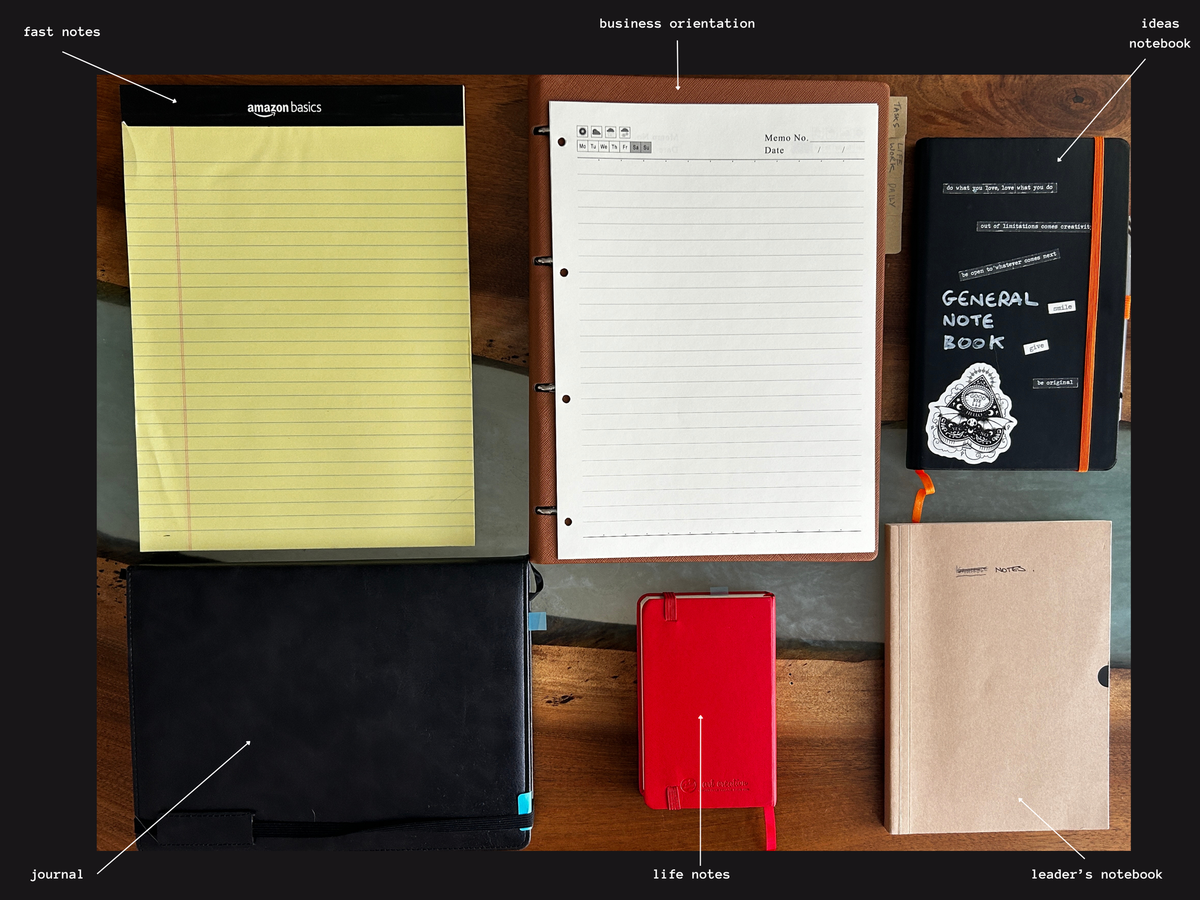
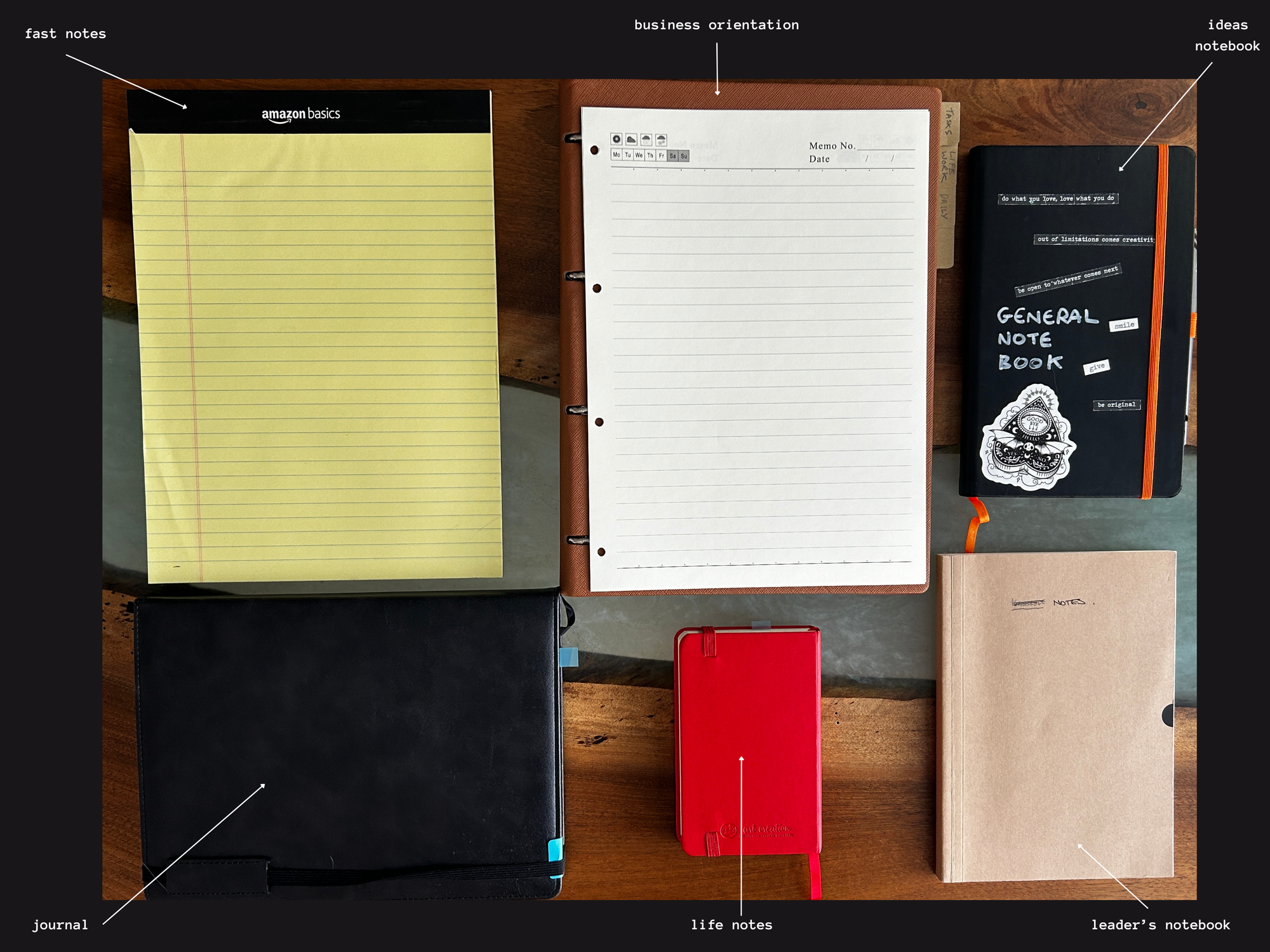
So here are the notebooks on my desk. Six containers, six sets of rules, with fidelity to match. I share them not for you to copy, nor as a suggestion of what your perfect notebook might be, but to show how this thinking lands on the right notebook for the right reasons. Not the perfect one. A good one for the task at hand.
The Yellow Legal Pad
I use yellow legal pads — and only ever yellow (there's a rule hiding in plain sight) — for fast notes. Notes that need little neatness and won't survive for long. It's my go-to for most meetings, video calls, sales calls, talk-scoping sessions, idea sessions with other creatives, content outlines, and doodles about systems. These notes, especially meeting notes, then get synthesised and processed into other places.
Fidelity. Short-term and transient, often covered in tea rings. Disposable paper for quick capture.
Rules.
- Always yellow — white ones just don't appeal to me.
- Cornell method for meetings.
- Pencil or gel pen only; ink pens don't sit well on yellow paper.
- One always within reach — around the studio, or in a bag for meetings. It needn't be the same pad; I have them everywhere.
- As cheap as possible.
- Side-bound or top-bound, never hard-covered.
- Anything worth keeping gets transcribed or recaptured elsewhere that night.
Rewards. There's always something to hand, and the colour and the space do the rest — clearer thinking, faster capture, real concentration, and no worry about ruining a page I was always going to recycle. The A4 size gives enough real estate to think out loud, the yellow helps me focus, and because they are on the cheaper side, I don't mind making a mess of them.
The A4 Ring Binder
I use an A4 hard-shell ring binder, with A4 inserts, for my own business and life — the operating model, the mission, the daily working files, the goals, the project pages.
I ran on digital tools for years: Apple Notes, Todoist, Evernote, Trello — you name it. Each had its limitations, which meant information, decisions, activity and insight ended up scattered across a dozen systems. Digital tools are also endless by nature. There are no edges, so every thought, idea and half-formed insight lands somewhere in the pile, and the signal disappears into the noise.
A ring binder has edges. I still use digital alongside it, mind. My painted picture for the business — values, goals, roadmaps — lives in Apple Notes so I can update it quickly and carry it anywhere in the world. But I print it and keep it in the binder for daily reading. It doesn't change often; when it does, I update the digital version, reprint, and swap the page.
The daily notes are typed on a typewriter: my top three things for the day, reminders of appointments, and a log of the day written on the reverse each evening. A routine to set the day ahead and account for the one just gone.
Fidelity. Long-term. This is a record of my days — not a journal, they're different things, but a record that accumulates across the weeks and years. Will I keep them forever? I doubt it. But for now, they should survive.
Rules.
- Apple Notes is the canonical source of business operations; printed only when something changes.
- Daily notes always on the typewriter.
- Project pages updated by hand, with my Sailor pen.
- Always to hand, in the studio and the house.
- Never leaves home or studio.
- Read daily.
Rewards. Edges and boundaries, so everything has to earn its place. One organised home for everything, attention pulled away from screens, and the slowing-down that makes sure my finite time, energy and attention go to the right things. It's also simply a pleasure to use.
The Ideas Notebook
The ideas notebook is a cheap A5/B6 with a hard cover. It's purely for ideas that might need to survive longer than a day — unlike the legal pad — but not forever.
I carry it everywhere practical, between the studio and the house, and open it whenever I know I'll have time to sit and think. When I take one of my boys to football, we arrive forty-five minutes to an hour early for them to warm up and for me to get cold in the car. That's when this one comes out.
Its power is in how varied and disparate the contents are. Going back through it is a small act of serendipity — sometimes the first capture sparks a new connection, sometimes a thread only shows itself on the second reading.
Fidelity. Long enough to last the life of the notebook, which might be three months, six, or a year. The hard cover protects it. I keep every one of these. Do I mean them to last forever? I don't think so — but a container like this could, if I wanted it to.
Rules.
- Anything goes: pen, pencil, doodles, words, stickers, diagrams.
- Anything processed elsewhere — an observation turned into a post, a task moved into another system — gets a line through it.
- Always the same key I've always used: A for action, I for idea, P for post.
- Always with me, where practical.
Rewards. A time-series catalogue of my thinking, captured quickly and screen-free, with enough room for a good idea to stretch out — and the mashing-together of threads that simply wouldn't be visible in any other medium.
The Leader's Notebook
Now it gets interesting. This is a beautiful notebook from Mark+Fold. Cultivated isn't affiliated with them, but they're a close friend of the Stationery Freaks show — so it felt right to be clear about that.
It's the one brand and notebook I'd happily recommend for almost any use in this essay — except the disposable kind. The Mark+Fold Everyday is exceptional, and I use it as my Leader's Notebook. There's already an essay on what a Leader's Notebook is, so I won't go deep here — but in short, it's a reflect-backwards, plan-forwards notebook, purely from a work perspective, for when I'm leading teams or working directly with a leader or manager. It's the professional log of actions, decisions, one-to-ones, plans, problems and opportunities. (As an aside, I use a second Everyday as my learning notebook.)
Fidelity. As long as possible — at least until that season of work is complete. This notebook needs a long life. One of the most overlooked aspects of good leadership, management and consulting is keeping robust, clear, professional notes, especially around people. A notebook can be used in a legal case, should evidence ever be needed. It should be a solid, honest, fact-based record — which doesn't mean personal reflection can't sit alongside it. Keeping professional notes is a form of business ethics, and this is that notebook.
Rules.
- The same key system I always use.
- Capital letters throughout, where reasonable, for clarity.
- As neutral as it can be.
- Behavioural observations about people only — never opinion, judgement, or personal traits.
- Dates, times, people, decisions — everything catalogued carefully for reference, and for anything that might later be required.
Rewards. A clear, accurate, honest record of what is happening, what happened, and what needs to happen — and the quiet comfort of knowing you're leading in a traceable, ethical way.
The Life Notebook
The container is a small A6 from T.K Maxx. It was a gift from my middle son — a true investment in the potential he sees in me, and I want to honour that as best I can.
So it holds a written copy of my painted picture: goals, ambitions, and anything to do with living for my life's task and living a good life. It carries a few inspirational quotes too. It doesn't get used often, but when there's a real breakthrough in how I want to live, this is usually the book the thought starts in.
The friction is baked in: small pages, limited space, and the fact that it was a gift — which means I don't want to squander it or fill it with nonsense.
Fidelity. Small pages, hard cover — designed to last a lifetime.
Rules.
- Pen only, for longevity.
- Life planning and insight only.
- Treat it with respect; honour what's inside.
Rewards. An emotional connection that keeps me honest and grounded, small enough to carry, easy to spot by its colour, and just enough space to think about how to live.
The Journal
The journal is a beast — a cheap A5 from Amazon with over 500 pages. Crucially, it's undated. I journal often, but not daily, and the undated pages mean I can write as little or as much as I like, as often as I like, without dated pages nagging at me. It's lovely to write on, with plenty of room.
Fidelity. Still working this one out. It's built to live a long time — but do I want it to? I know someone who burns his journals at the end of each year. I don't, but I understand why he does. This isn't meant as a lifelong record (much as we're grateful for the ones that survived — Marcus Aurelius among them). It's for working through the now: noodling a problem, reflecting on behaviour, thoughts, performance.
Rules.
- Journal thoughts only. The ring binder handles the factual daily reflection — what got done, what happened, what's next, money in. The journal is the other side of that: the feelings, the highs and lows, the struggles, the things my mind won't leave alone. It's not dark reading — just an accumulation of human thought from someone trying to do something really difficult: make a living from ideas.
- Date every entry.
- When noodling a problem, don't let too much negativity creep in — find a way through it.
Rewards. A safe space no one else is meant to read — a way of processing what's happening rather than capturing it for posterity. A clearer mind, emotions aired and ideally dealt with, a route through problems, and time away from a screen.
So, the perfect notebook
Back to the question I'm always asked. What's the perfect notebook?
There still isn't one. There's only the right container, with the right rules, for a note that needs to live a certain length of time. The yellow pad would be a poor place to keep a legal record in the way I use it. A Mark+Fold Everyday may be wasted on a shopping list you'll bin by lunchtime. Neither is better than the other. They're built for different lengths of life, and they earn their keep by matching the job in front of them.
And this is the part that reaches past stationery. Every tool you use is a container with rules. A spreadsheet, a group chat, a voice note, an email, an AI that drafts in seconds. Each one asks something of you — or asks nothing at all.
The ones that ask nothing are the ones to watch, because friction removed is usually reward removed along with it. The question is never whether a tool is easy. It's what you're trying to carry, how far it has to travel, and how long it needs to survive once it arrives.
Get that right and the tool all but disappears. The idea moves, the meaning stays with it, and the work becomes what it was always meant to be.
So don't go looking for the perfect notebook. Look at the job, then choose the friction worth paying.
Cultivated Studio
The argument is here. The working tools are in Studio.
Studio is the ongoing, behind-the-scenes layer of Cultivated — field notes, extended essays, frameworks, and over four hours of Idea to Value deep-dive video. It doesn't extend every article with a matching framework. It extends the thinking across the whole system, for practitioners who want to go further than the public library. If this essay opened something, Studio is where the wider architecture lives.
Explore Cultivated Studio →