Cornell Note-Taking Method: Boring but effective
I discovered the Cornell Note-Taking Method over a decade ago and promptly ignored it. It sounded dull and academic. Then I tried it properly. I have not really stopped since.

The Cornell Note-Taking Method: Why It Still Works (and How to Use It)
For a long time I ignored the Cornell Note-Taking Method. It sounded dull. Academic. Slightly bureaucratic. Not at all aligned with the dynamic, free-flowing person I believed I was.
Then one day I tried it properly. I gave it space to work. I haven't really stopped using it since.
What surprised me was not how tidy the notes looked, but how much clearer my thinking became. The method didn't just organise information – it created space for interpretation. And that turned out to be exactly what I needed.
What the Cornell method actually is
The Cornell Note-Taking Method was developed at Cornell University in the 1950s by Walter Pauk. The idea is straightforward: rather than using an entire page as a single stream of notes, you divide it deliberately into three distinct areas.
The larger section – two thirds of the page – captures what is happening in real time: discussion, information, decisions, explanations, thoughts. You write here continuously, without interrupting your attention.
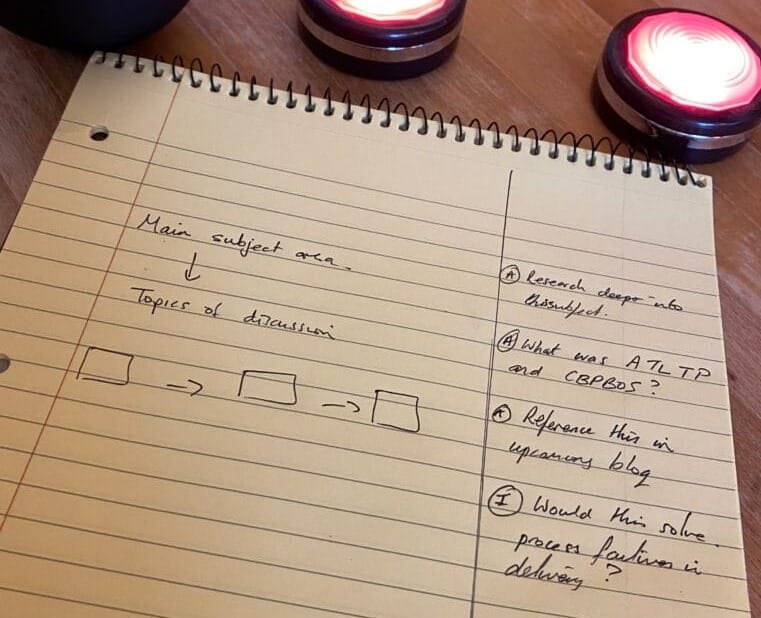
The narrower column is reserved for something else entirely: questions, actions, reflections, connections, and emerging ideas. You return to this column after the meeting or session – or when something particularly important surfaces that you want to flag immediately.
At the bottom of the page sits a summary section, this is the part of the Cornell system I don't actually use. The summary is designed for a brief distillation of the most important point or insight from the whole page. This is written last, after reviewing everything above it.
That is the entire system. Three zones. One page.
Many note-taking systems treat everything captured or noted down as equal. Ideas, facts, decisions, and reactions all flow into the same stream, competing for attention. Over time, meaning gets buried beneath volume and it becomes harder to see the really important parts. You end up with pages of notes that capture what happened without helping you understand what it meant or what to do about it.
The Cornell method introduces a deliberate asymmetry. Information lives in one place. Sense-making lives in another. And that's precisely why, even though it may seem boring, it's actually very effective.
This separation matters because it mirrors how thinking works. We first absorb, then react. We listen, then comprehend. We capture, then decide what to do with what we have captured. The page structure makes that sequence explicit rather than hoping it happens naturally.
I don't use this method for everything. It's not the solution to all note-taking problems. It's just one system in a broad use of paper and pens. But it's maybe worth walking through how the Cornell system makes my thinking, and then, my effectiveness better.
Meetings are the most logical place for this system. Let's be honest though, many meetings are wasteful, so the system won't stop that, but at least you can have some fun in the margins. Capture the flow of the conversation in the main section; stick tensions, actions, questions and insights in the narrow column.
Sometimes I use it for learning notes, a lot depends on the subject, the context and what notebook I have lying around, but the Cornell system can help significantly here. The sheer act of deciding what belongs in the margin forces genuine engagement in the subject. You are no longer transcribing everything you read or hear, you're interpreting and synthesising the information – and this, in some respects, is learning happening.
Now, drafting presentations is where this comes alive. In Zero to Keynote I suggest that one of the best ways to never forget your talk, is to write the talk out in long-hand. It works, it's what I do and I use a somewhat modified version of Cornell to do it. The narrower section is even narrower, giving more space to the main talk, and leaving a little margin for notes on movement, emphasis and the other cues that make a good presentation.
The Cornell method doesn't endure because it is clever or efficient. It endures because it respects the difference between information and thought – and gives each its own space.
Information arrives first. Thought follows. The method makes that sequence visible on the page and protects the space that thought needs to emerge. In a world full of note-taking apps, AI transcription, and digital capture tools, that physical act of structuring your attention is more valuable, not less.
The best note-taking system is the one that changes how you think, not just what you store. Cornell does that.
And don't worry about looking boring. Trust me, it's worth it. Because you will become more effective.
Creative Soul Projects
There's a video that goes with this piece, on Creative Soul Projects. Same person, same observation — just followed on camera instead of on the page. Explore the channel.
Where this sits in the Atlas
Orientation·Idea to Value·Communication·Creativity & Climate·Learning