The cabinet of unfinished things
A garden in January looks dead. It isn't. Nor is the unfinished idea you can't quite let go of. On wintering — and why the ideas that keep coming back are usually the ones worth listening to.


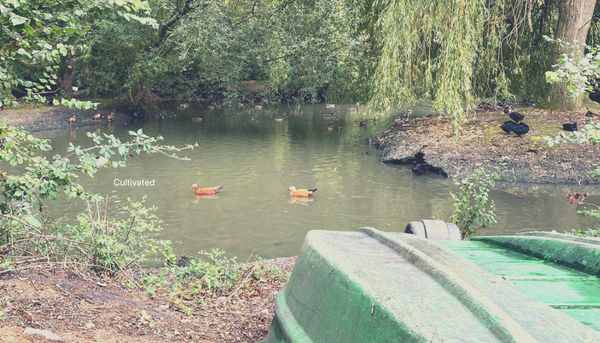
Many gardens in January looks like they're waste land. Well, to be fair, our garden right now always looks like that. The beds are bare, the roses are brown sticks, the trees have few leaves, the whole thing feels abandoned.
And yet the experienced gardener walks past it entirely unbothered, because they know exactly what's going on down there in the cold and the dark and the rain. Bulbs are doing their slow forming and growing. Roots are spreading where we can't see them. Bugs and insects are busy channelling through the soil.
We can't see it all happening. The apparent deadness is the work of a garden in winter. If we get impatient and we rush it, and we start to dig it up in February to check on it, or force it under a lamp to prove what it's doing, you get something weaker than if you'd just left it alone to be cold for a while and do its thing.
I've come to think a great many ideas need precisely this, and almost never get it.
For years I've kept a sort of cabinet – a digital one and paper version, though it may as well be a drawer – where the unfinished things go. Half-written articles. Scraps. Observations caught in meetings, between meetings and after meetings that felt worth keeping but not yet worth finishing. Ideas on trains, overheard conversations that might become an article, or a book. All of them refusing to fit neatly somewhere, or be forced into a framework or onto a slide.
This is, of course, my commonplace system. But, in most of working life there's nowhere for a thing like that to live – a place for observations and half-formed ideas to stay. We're not good at unfinished. There's a constant, low pressure to tidy a thought quickly, to get it presentable, to move from idea to outcome before lunch. Or to stick it on an ideas backlog – that, ironically, often requests ideas be fully formed – that gets ignored, or archived, as more commercially viable options come in.
So the half-formed ones tend to meet one of two deaths: rushed into something shallow, or deleted for not yet earning their keep.
The cabinet is simply a refusal to do either – a place where an idea is allowed to be cold for a while without being asked to justify itself, or prove its worth. Nothing gets optimised. Nothing gets forced into being something valuable. It just sits there, apparently lacking any life, doing little at all – or so it would seem. And that, it turns out, is the whole point. (Katherine May has a lovely word for this season of rest and dormancy — wintering — and it fits an idea every bit as well as it fits a person.)
Here's the part productivity culture can't quite accept: whether an idea is easy to articulate and work on tells you almost nothing about whether it's any good.
Some of the best ideas simply take longer than a quarter, or don't fit neatly into a budget cycle, or can't be easily defined for the good ideas board. The signal worth watching was never whether an idea is describable – it's whether it keeps coming back.
When I go through the cabinet, without urgency, or a demand for something special, curiosity where the pressure may have been, the striking thing is never how much is in there. It's that a few ideas are still actually kind of warm. Months on, unresolved, ignored, and stubbornly not dead. The idea still speaks, it still murmurs something. It still wants to be explored. That persistence is the tell. An idea you keep returning to, that survives being neglected for a season, is usually trying to tell you something.
And when I finally sat with a decade of these fragments – hunting for what had lasted rather than what I could archive away – the same few things kept surfacing on their own, without my arranging them, or forcing them, or asking for them to explain their value. That most problems at work are human long before they're technical: not ability, but relationship, honesty, the courage to say the truthful thing, in rooms where saying it costs you something. That clarity was never a document but a shared, felt sense of what matters and what doesn't. And that good work grows out of a decent climate far more than a tight grip. The notes kept circling back to atmosphere, to whether it felt safe to speak, to question, to slow down, to care, long before I had a phrase for any of it or a container to house them in.
I hadn't imposed those themes. They'd survived the winter, which is a different and far more trustworthy thing.
Most of us have a cabinet, whether we'd call it that or not – the notes app full of half-thoughts and observations, the questions we never quite answered, the ideas still waiting for their time to shine. It's worth keeping, and worth not tidying too soon also. Unfinished doesn't mean failed, useless and irrelevant. Usually it just means alive, and cold, and not ready yet – which, in a garden, is the most ordinary thing in the world, and nothing whatsoever to panic about.
If something keeps coming back after you've ignored it for a season, that isn't a loose end. It's a bulb. It's potential waiting to grow.
This cabinet is where Meditations on Management eventually came from — a free collection of short reflections on the real work of managing. Free to read or download.
Where this sits in the Atlas
Orientation·Idea to Value·Communication·Creativity & Climate·Learning