The conditions behind great creative work
For creativity to emerge it typically needs a different question: how do we discover what might be possible? That requires different conditions. Less friction. More trust. More room for work that can't yet prove its value in a spreadsheet.


As many of you may know I am a huge fan of hiphop. I know – you can tell right?
I was, of course, intrigued by Drake's return.
Not the music itself – although it's very good. Not the culture wars around it. Just the fact of it: after a year of relative quiet, he comes back with three albums and more than four hours of output, attached to a marketing campaign that actually worked.
Everyone was talking about the volume. The sheer creative mass of it. The audacity.
That's not what interested me.
What I kept turning over was the question underneath: what were the conditions that made all of that possible? Not the output — the system behind the output. The studio. The collaborators. The workflow. The time protected. The environment built not for one-off bursts of inspiration, but for sustained, compounding creative work.
Visible output is always the final expression of a much larger system. We rarely get to see the system.
Does the environment support creative work?
Most organisations aren't short of ideas. That's worth saying plainly and honestly, because it cuts against the usual diagnosis.
There are backlogs. Roadmaps. Transformation strategies. Customer feedback gathering dust in CRM systems. Employee suggestions filed in idea platforms and forgotten. The inventory exists. It almost always exists. We're rarely short of good ideas in the workplace.
The problem is that the inventory isn't alive.
A musician can return to an unfinished lyric from three years ago and pick up exactly where they left off. A writer can open an old notebook and find something that's been quietly maturing. The idea hasn't died — it's been waiting for the right conditions to develop. There's the serendipity of mashing ideas together. The re-awakening of ideas when investigated at a later date.
Most organisational ideas don't get that chance. They get captured, stored, labelled, and left. A digital graveyard of possibility that everyone acknowledges and no one tends.
The difference isn't whether ideas exist. The difference is whether the environment allows ideas to develop.
Cultivation of conditions
Cultivation is the right word here — and not just because it's the name of my business.
Cultivation is different from collection. Collection is accumulation. Cultivation is creating the conditions for something to grow.
A garden doesn't succeed because someone owns a lot of seeds. It succeeds because the environment supports growth — the soil, the light, the time, the tending, the environment. Ideas work the same way. They need space, attention, experimentation, conversation – the right climate. Somewhere to develop before they're asked to justify themselves.
Most organisations are very good at focusing on the systems for delivery. How do we track work? How do we manage projects? How do we measure progress? How to do align finances?
These are all legitimate activities, and the systems that answer them cleanly matter greatly. But they're designed around execution and delivery. They answer: how do we complete what we already know needs doing?
Creative systems answer a different question: how do we discover what might be possible? That requires different conditions. Less friction. More trust. More room for work that can't yet prove its value in a spreadsheet.
Removal of activities is essential
There's a pattern worth looking at here. When an organisation decides it needs more innovation, the instinct is to add activities. A workshop. A brainstorm. An idea portal. An innovation programme or sprint. The assumption is that if you bring people together and ask them to be creative, creativity will happen.
But creativity doesn't happen this way. Creative people (of which we all are) build habitats.
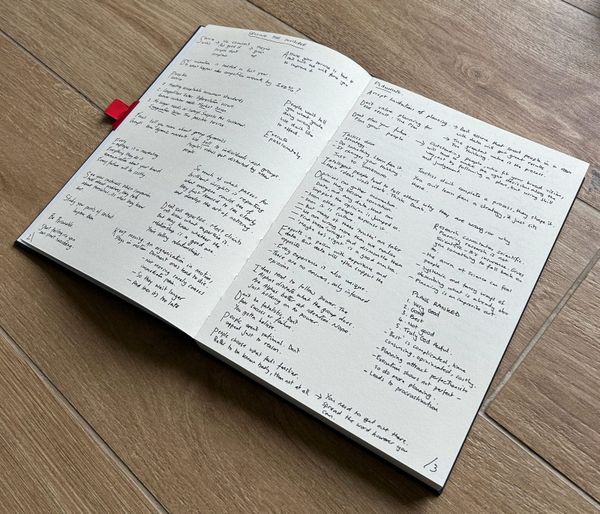
A studio is a habitat. A notebook is a habitat. A research lab is a habitat. The best teams become habitats where thinking is architected — places where ideas aren't just generated but they are allowed to mature. Where unfinished thinking isn't failure; it's the normal state of things.
And there's something about simplicity worth pointing out also. As organisations grow, complexity accumulates almost automatically. More processes. More approvals. More systems. More meetings that exist to discuss the last set of meetings. It's a form of self sabotage to be honest. But the most productive creative environments tend to move in the opposite direction. They simplify.
The best writers simplify their tools, workspaces and routines. The best leaders simplify communication and make important decisions about their priorities (and yours too). Complexity belongs around the work of taking a good idea and turning it into value. The path through it should be clear, simple and obvious.
Conditions & Climate
This is what I find most useful to ask when I look at organisations that do creative work well — or at individuals who produce work that seems to keep coming.
Not: what did they do?
But: what conditions allowed that to happen?
Behaviour is an outcome of environment. A forest doesn't focus on producing leaves and trees. It creates conditions in which leaves and trees emerge. The leaves and trees are a consequence of everything underneath.
The better question for organisations isn't how do we get more output. It's: how do we create the conditions where good work has somewhere to grow?
That's a harder question. It requires looking at what you're actually building — not just the products and the projects, but the environment itself. The office. The habits. The room for things that can't yet prove their worth on a spreadsheet.
Most organisations never get there, because it doesn't feel urgent enough to prioritise. Until the person who was doing the work quietly leaves, and you realise the conditions left with them.
At the end of the day maybe we shouldn't be asking :
“How do we get more output?”
But:
“How do we create conditions where creative output becomes inevitable?”
Meeting Notes — weekly
This post was originally sent by email
Meeting Notes arrives each Sunday — one or two thoughts in the margins of that week's writing, plus occasional observations from real work. Free. You'll also receive a short orientation to the work, including a free essay not found on the site, along with a free Public Speaking checklist.