A 1944 sabotage manual that looks suspiciously like modern work
In 1944, the OSS published a manual on how to quietly sabotage organisations. Eighty years later, many of its tactics have become standard corporate practice. Read it and you'll recognise your own workplace.

We are sabotaging our own workplaces
I have a tendency to wander down rabbit holes on Friday evenings. Newsletters, obscure resources, random PDFs — curiosity tends to pull me in.
Last Friday was no different.
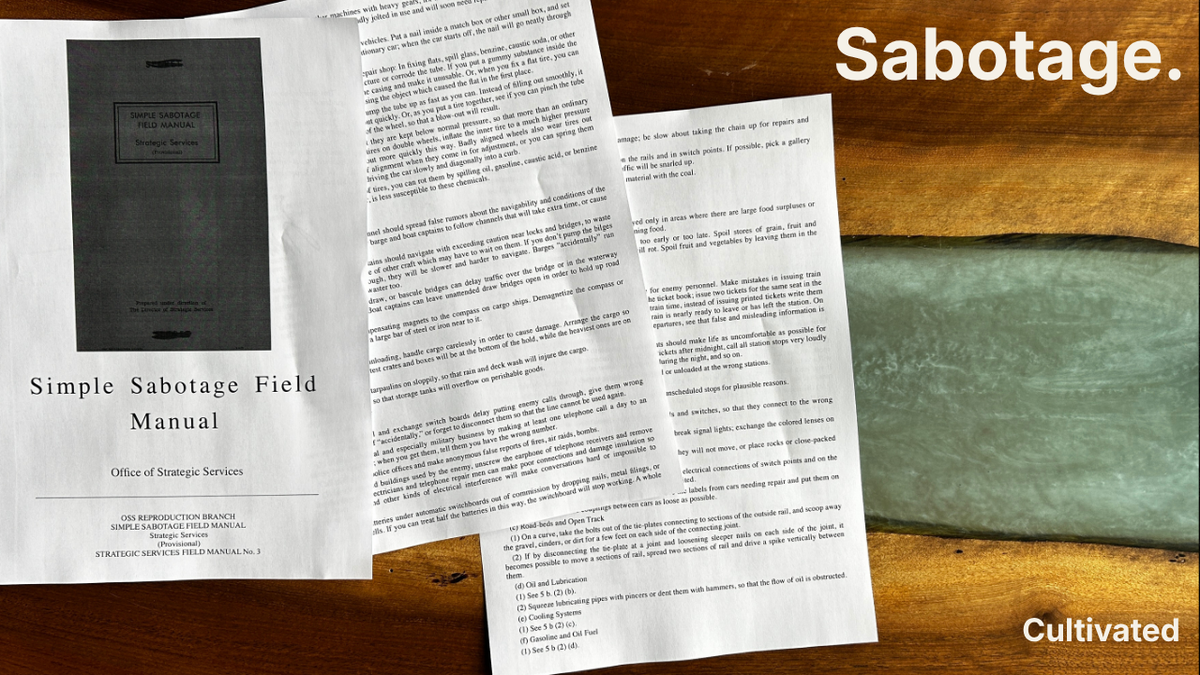
Somewhere between scrolling and half-hearted productivity, I stumbled across something remarkable: The Simple Sabotage Field Manual, published by the Office of Strategic Services (later to become the CIA) in 1944 and declassified in 2008.
It is, quite literally, a guide to quietly sabotaging organisations.
And as I read it, I couldn’t help but think: this reads like a modern corporate ways-of-working handbook.
Not because organisations are malicious.
But because many everyday practices — well-intentioned — produce the same outcomes as deliberate sabotage.
Reading this list reminded me that the best way to decrease an organisations ability to generate value and create unnecessary cost, is to create an increasing gap between the ideas they have, and the value they generate from them. My work has always been focused on the opposite - reducing that gap.
As you read this, think about your own organisation.
How many of these behaviours feel familiar?
Editor's note — where this sits
This essay uses the 1944 OSS Simple Sabotage Field Manual as a mirror — showing how ordinary organisational practices produce the same outcomes as deliberate sabotage. It sits in the Physics layer of the Idea to Value system — the layer where ideas either move toward value or quietly stall. It also connects to the Map layer: organisations that mistake activity for progress lose sight of where they're actually going.
The Idea to Value system — five layers
OSS Simple Sabotage Field Manual, 1944
Eleven tactics for sabotaging an organisation — and how they show up today
Use channels. Never shortcuts.
"Insist on doing everything through channels. Never permit shortcuts to be taken."
Talk endlessly
"Make speeches. Talk as frequently as possible and at great length."
Refer everything to committees
"Refer all matters to committees… make the committees as large as possible."
Haggle over words
"Haggle over precise wordings of communications."
Keep reopening decisions
"Refer back to matters decided upon at the last meeting."
Advocate caution at all costs
"Urge your fellow-conferees to avoid haste."
Insist on perfection in low-value work
"Insist on perfect work in relatively unimportant products."
Reward mediocrity
"Be pleasant to inefficient workers; give them undeserved promotions."
Demand written orders
"Demand written orders."
Ask endless questions
"Ask endless questions."
Ensure multiple approvals
"See that three people have to approve everything where one would do."
Use Channels. Never Shortcuts.
“Insist on doing everything through ‘channels.’ Never permit shortcuts to be taken.”
The bureaucracy trap.
RACIs, RAPIDs, operating models, decision frameworks — until nobody can actually decide anything.
One person technically has the “D”, but cannot use it because someone senior might disagree.
Decision-making becomes drama.
Talk Endlessly
“Make speeches. Talk as frequently as possible and at great length.”
Communication masquerading as productivity.
Meetings, updates, town halls, decks — activity everywhere, clarity nowhere.
Talking is not communication.
Sometimes, it’s sabotage with a human voice.
Refer Everything to Committees
“Refer all matters to committees… make the committees as large as possible.”
Committees are where good ideas go to be neutralised.
The larger the group, the safer everyone feels
— and the slower everything moves.
Haggle Over Words
“Haggle over precise wordings of communications.”
Minor edits. Endless opinions. Death by comments.
Precision matters — but perfectionism on trivialities kills momentum.
Keep Reopening Decisions
“Refer back to matters decided upon at the last meeting.”
Re-litigation as a management style.
Nothing ever finishes.
Everything is provisional.
Progress becomes optional.
Advocate Caution at All Costs
“Urge your fellow-conferees to avoid haste.”
Risk avoidance framed as professionalism.
Speed framed as recklessness.
Slow becomes virtuous.
Competitors rarely agree.
Insist on Perfection in Low-Value Work
“Insist on perfect work in relatively unimportant products.”
Perfection is noble — when it matters.
When applied everywhere, it becomes a sophisticated way to avoid shipping.
Reward Mediocrity
“Be pleasant to inefficient workers; give them undeserved promotions.”
Few things sabotage morale faster.
High performers notice.
They either disengage — or leave.
Demand Written Orders
“Demand written orders.”
No initiative. No judgement. No responsibility.
Work becomes a permission economy.
Ask Endless Questions
“Ask endless questions.”
Questions create clarity — until they create paralysis.
Some people specialise in freezing organisations with endless questions.
Ensure Multiple Approvals
“See that three people have to approve everything where one would do.”
Three approvals, zero progress.
Governance as a brake pedal.
We Are Doing This to Ourselves
What struck me most is how normal these sabotage tactics feel.
None are malicious. Most are framed as best practice.
Caution. Inclusion. Governance. Thoroughness.
All reasonable in isolation.
Catastrophic in aggregate.
Old Tactics. Modern Consequences
Organisations that institutionalise these behaviours tend to:
- Overvalue process over outcome
- Reward activity over impact
- Mistake caution for competence
- Believe slowness equals safety
In reality, they risk slowing themselves out of relevance.
Sabotage Without Intent
The most unsettling lesson is this:
You don’t need malicious actors to sabotage an organisation.
You just need enough well-meaning people following poorly designed systems.
What To Do Instead
Notice where work slows for no strategic reason. Challenge committees, approvals, perfectionism, and pseudo-roles when there seems to be no logical reason for them existing.
The question worth asking is simple: is this process here because it adds value — or because nobody has had the courage to remove it?
Every organisation ships value or ships sabotage. Most do both.
A Cultivated View
The 1944 sabotage manual is not a historical curiosity.
It is a mirror.
It shows how easily organisations drift from purpose into performance acting and going through the motions.
How easily good intentions become friction.
And how business agility is not about frameworks — it is about removing invisible brakes.
At the heart of Cultivated's work is shrinking the gap between having a good idea and generating the value from it, whilst enriching the workplace. Almost everything in the sabotage field guide was about increasing that gap and diluting the culture of the organisation.
Once you see sabotage patterns, you cannot un-see them.
And once you see them, you can begin addressing them.
Releasing Business Agility
Half-day seminar · In-person or virtual
A half-day experiential seminar that makes the invisible brakes visible — through a facilitated game that puts teams inside the dynamics that slow their real work down. For leaders who want to release what the sabotage tactics are suppressing.
Enquire
Explore the seminar →Idea → Value System
Field guide + video · Digital
A practical system for seeing where work stalls between idea and value — and how to intervene before cost accumulates. The antidote to accidental sabotage, applied deliberately.
From £19.99
Explore the system →