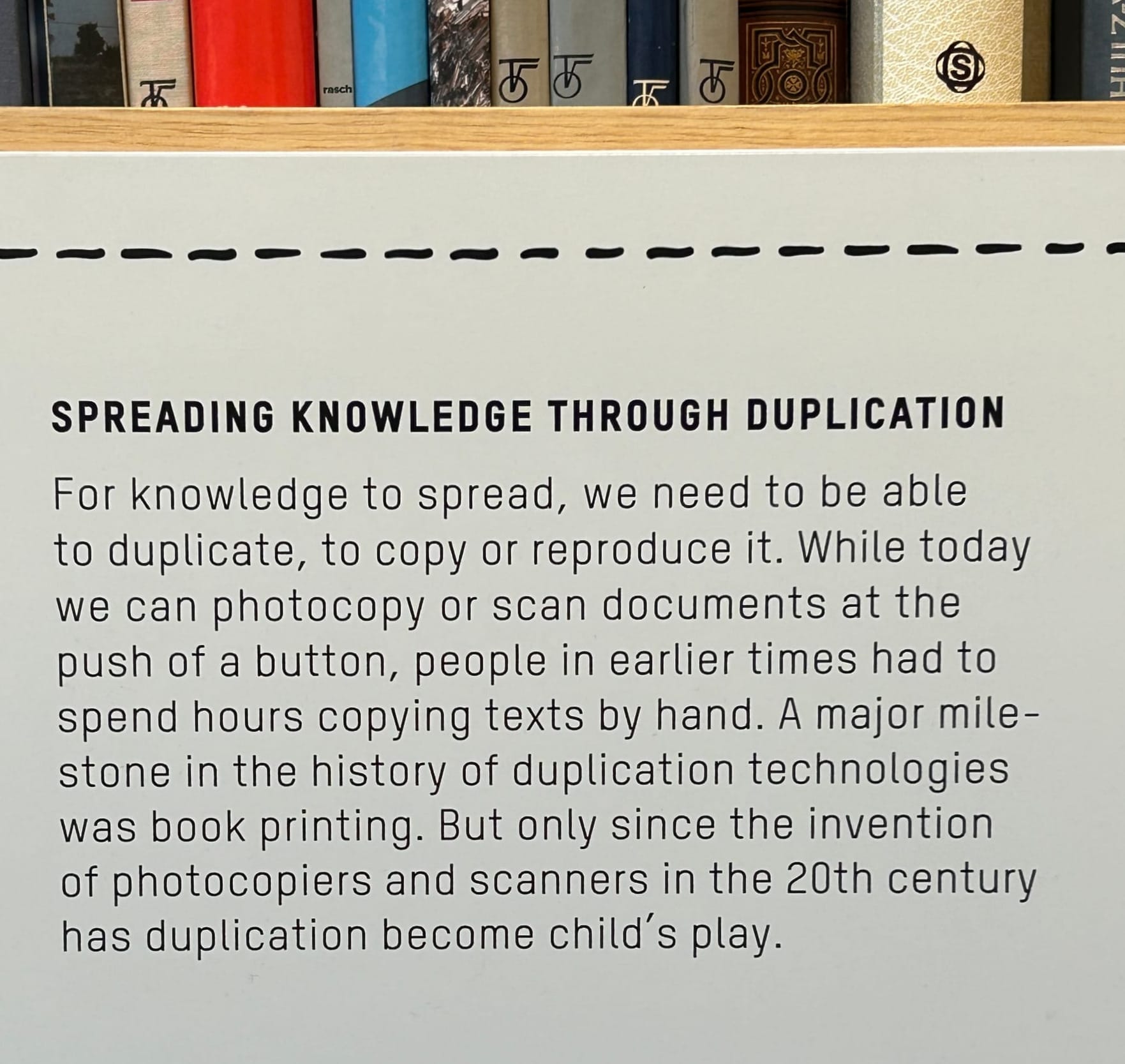
I was wandering the Technology Museum in Berlin with my camera, doing the thing I always do in museums – collecting things of interest for the commonplace book, photographing the display panels, items, objects and even the way museums are signposted.
In a particularly fascinating section on communication I was drawn to one about the spread of information.
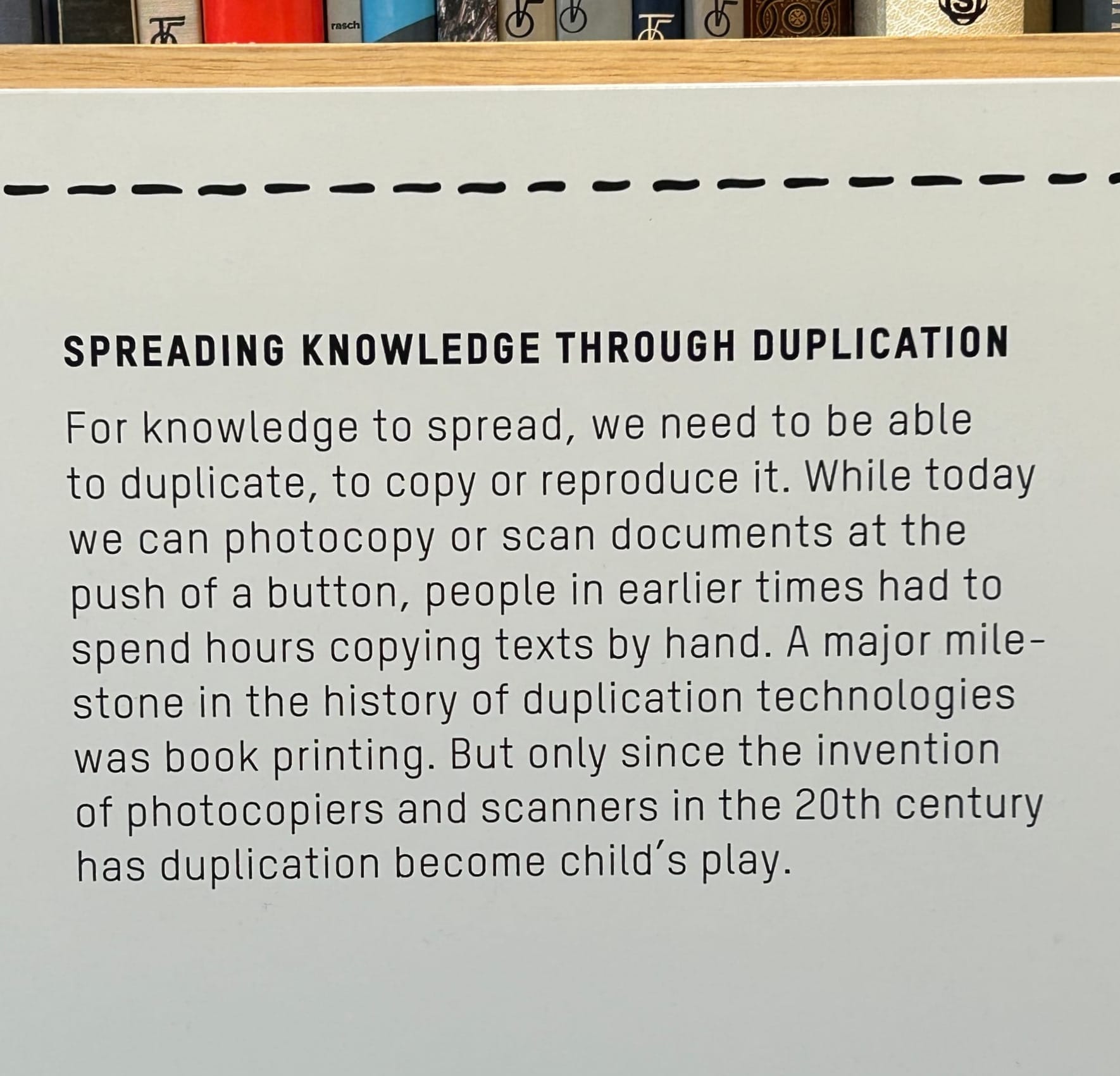
SPREADING KNOWLEDGE THROUGH DUPLICATION.
For knowledge to spread, it said, we have to be able to copy it. For most of history that meant someone gathering under the candlelight, hunched over a desk copying a text out by hand, for hours, days, weeks, months and years. Then came printing. Then, in the twentieth century, the photocopier and the scanner, and duplication became – in the panel's own wonderful phrase – child's play.
I took a photograph of it and then stood there longer than probably warranted, and certainly longer than my family had patience for, because it seemed to me to be describing a deeply consequential idea in the whole history of power, and suggesting it was just a note about photocopiers.
Because here's the thing that panel text was maybe too polite to say out loud. For most of human history, whoever could copy and distribute knowledge held the power.
The monasteries that controlled the copying of manuscripts controlled what a civilisation was allowed to know. Gutenberg's press didn't merely make Bibles cheaper – it shattered a monopoly, and the Reformation spawned out on the back of it, pamphlet by pamphlet. Every leap in our ability to duplicate and distribute – the press, the newspaper, the photocopier, the internet, the phone in your pocket – didn't just spread knowledge. It moved power around.
Distribution is power. Not power as status or a title, but power in its most practical, original form: the ability to shape what people understand, and therefore what they do.
Which is why politicians buy newspapers. Why organisations pour fortunes into media and messaging and narrative and PR. Why entire professions exist for no reason other than to shape what gets seen, heard and remembered. Control what is published, when it appears, how often it's repeated, and where it lives – and you shape how reality itself is understood. The future doesn't belong to those who can think about it – it belongs to those who can communicate about it.
For a giddy few years, social media looked as though it had handed that power to everyone. Suddenly anyone could publish, broadcast, mobilise; the gatekeepers seemed to have lost the gate. And something genuinely did shift. For a while. But the deeper truth still held firm, and it's the one worth pinning above the desk: the real power never left the people who own the platform. The algorithm decides your reach. The policy decides your visibility. The infrastructure decides what survives and what disappears.
You can publish all you like – but you're publishing on rented land, and the landlord can change the terms, or evict you, or take away things from you, whenever it suits. Which is a remarkably important distinction for anyone with something to say – a writer, a maker, a founder, you – because there is a world of difference between a channel you own and a channel you merely borrow. Build your whole house on someone else's platform and, at some point, you may not have an audience at all. You have a lease.
And the same structure, if we look hard enough, runs inside every organisation, just without an algorithm to make it obvious. Power at work has never sat only with the job titles. It sits with whoever decides what gets written down. Whoever controls the agenda and shapes what lands in the update. Whoever gets to tell the story of what's going well and what isn't and where it's all heading. Whoever repeats a message often enough that it hardens into accepted truth, even if it's totally made up.
I've seen people with no title and no direct reports run whole departments, simply because they understood that if they controlled the channel – what got recorded, what got circulated, what became the official version of events – they had power. None of it is necessarily sinister. It's just how clarity and alignment actually happen across a lot of people at once. When the wiring is clear and honest, alignment forms. When it's fragmented or absent, confusion rushes into the gap, along with a few conspiracy theories too – and confusion is never neutral. It writes its own story, and usually the story it writes corrodes trust and slows everything down.
There's a little lesson from journalism that belongs here too, because it's really about which channel wins: what gets written down becomes the truth. The spoken update loses traction. The all-hands blurs within a week. The corridor conversation mutates as it travels from desk to desk. But the written thing endures – it can be pointed at, quoted, challenged, built upon, and shared easily. It becomes the shared artefact that decisions cohere around and that accountability hangs off. Which is why the most effective people and teams write things down, not out of love of bureaucracy but because the durable channel is the one that shapes what everyone believes tomorrow. If something important only ever got said aloud, it's safest to assume it hasn't really been communicated at all.
The systems thinker Donella Meadows once mapped the places where you can step into a system and change it, places to intervene as she called it, and ranked them by how much they actually move. About half way through the list – above delays etc – sits the flow of information. I personally reckon it should sit higher with more impact. Communication, after all, is what all of us do, all day – it also happens to be how we keep the meaning of an idea alive as we turn it into value. Then again, she was the expert.
When information doesn't reach people, they can't do their jobs effectively: they escalate to approval boards that would be unnecessary if they simply knew what was going on; they duplicate work because nobody told them someone else already had it; they make perfectly logical local decisions that turn out to be globally disastrous, because they couldn't see the whole. When information flows cleanly, the opposite unfolds – people make good calls close to the ground, understand the direction, and act without escalating everything.
Clarity produces alignment, and alignment produces momentum. Which is why getting information to flow well is not soft, supportive nicety and a fluffy skill to bolt on. It's a high-impact things anyone can do to a system, because it's structural – it decides whether the whole thing can function at all. It is the wiring.
All of which cuts both ways, and I would be remiss not to mention the other use of power. The same command of distribution that spreads clarity can just as easily spread lies, manufacture a false consensus, and corrode trust one carefully worded message at a time. Whoever owns the wiring can mislead through it exactly as easily as illuminate. But turned to good ends, it becomes one of the load bearing and powerful forces for better work there is: it connects people to meaning, it reduces the friction that slows a good idea on its way from someone's head into something real, and it narrates a believable future clearly enough that people actually choose to walk toward it. The future doesn't simply arrive. It gets communicated into being – one artefact, one repeated message, one deliberately chosen channel at a time.
Which brings me back to that unassuming card in the Berlin museum, the one nearly everyone walks past on the way to the steam engines. It was telling the whole story in four sentences and calling it a note about photocopiers: knowledge became power the moment someone worked out how to copy it and get it to travel.
That was true of the monastery and the printing press, and it's just as true of your newsletter, your notebook, and the platform you're currently deciding whether to trust with your life's work. The oldest lever of power has never really changed. It is not the having of the knowledge. It was the owning of the wiring it travels through. And the people who understand that don't tend to shout any louder than everyone else. They just think very carefully about the wiring.
Where this sits in the Atlas
Orientation·Idea to Value·Communication·Creativity & Climate·Learning