The three ways ideas change (or don't)
Progress isn't movement — it's seeing. What stop-motion animation reveals about how your ideas actually become valuable.

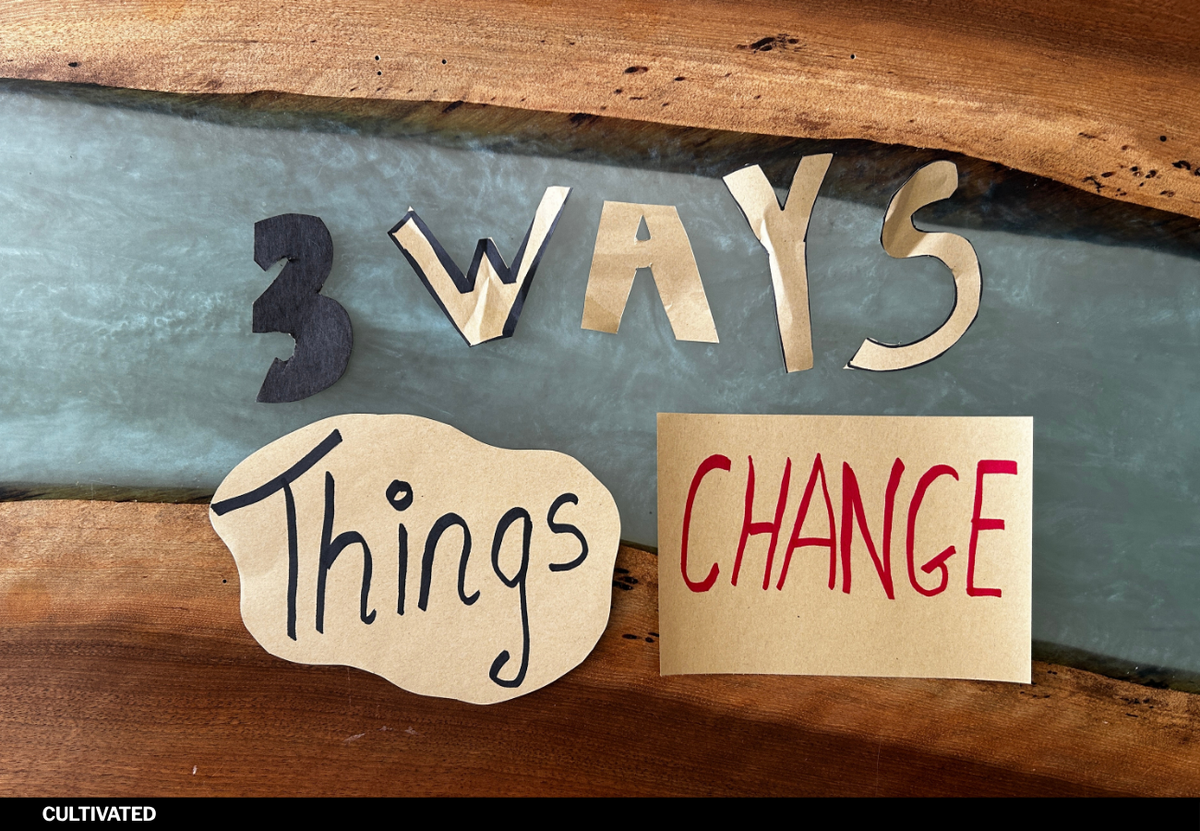
I'm no expert in stop-motion animation, but it is a passion of mine, and there's a remarkable lesson from stop motion in how ideas move, change and morph as they become value.
I have all of my old videos from around 1996/1997 digitised now – backed up off 8mm and VHS – and they still make me smile when I watch them. It's interesting because throughout the many hundreds of films, there are one or two stop-motion films. Films made not from something moving within the continuous shot, but by taking a sequence of photos whilst the subject within the frame is moved, changed or modified between the shots.
I was doing stop motion 30 years ago, and I still do it today.
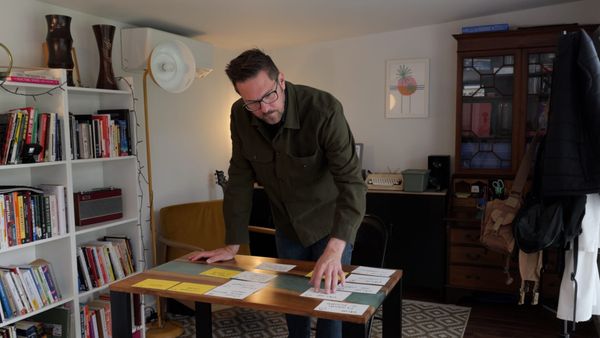
There's a small camera clamped to a stand above my resin river desk here in the studio. Beneath it, a figure made of wire and clay, no taller than my thumb. I move its arm a millimetre and take a photograph. I move it again and take another. An hour (or several) passes like this, and on the screen the figure raises a cup to its mouth and drinks.
Here is the thing though. Nothing on the desk moves within a single shot like it would in a video.
Movement is actually an illusion. It's built from a long series of small decisions, and every one of them is made by looking, seeing and deciding what to do next, in order to create the moving image in the final video. You study what's in front of you. You change something. You capture it. Then you look again.
The craft isn't movement. The craft is seeing.
If you spend long enough doing stop motion you notice something else. There are only three fundamental ways a thing in front of the camera changes.
The first is displacement. The object stays the same and changes position. The figure walks forward. The letter moves across the desk. Nothing about the thing itself is different — only where it sits.
The second is deformation. The object changes shape. The pile of paper becomes letters or the clay stretches, bends, swells, thins. It's still recognisably itself, but its form is becoming something else.
The third is replacement. You take one thing away and put another in its place. The first object is gone. Something new stands where it stood.
These run underneath animation. But if we sit with these three techniques for a while – they start to describe something much larger. They describe how your own ideas become something valuable. They describe how ideas move, change, morph and ultimately become value.
And they show why seeing — really seeing — is among the most useful things you can learn to do at work.
The pull to deliver too soon
An idea rarely arrives finished. It turns up as a hunch. A frustration. A question that won't leave you alone. A sense that something here could be better. A vision of potential. A new product or service you sense will make an impact.
And almost as soon as it arrives, you feel the usual pull that happens in workplaces.
People get to work naming it and defining it for approvals. They start to derive absolute returns the idea will generate, often plucked out of thin air. People start convincing everyone this idea needs to be worked on and that is will revolutionise the business. And then it becomes a plan. Say it aloud in a meeting at 9am and if people like it, it has tasks, milestones and roadmaps by the afternoon. There's a date now. There's a deliverable. You're moving.
It feels like progress. Often it's the opposite — because the idea may not yet know what it is. It's still finding its shape, and you've started moving it forward as though its shape were already settled.
This is how good people produce beautifully delivered disappointments. It's how teams deliver software people don't use. It's how companies run launches that drive no sales. Not through weak execution; the execution is usually excellent. Through defining too early what the thing was meant to become – and worse of all, locking in that definition even when the idea is screaming to be something different.
The problem was never effort. It was seeing.
Helpful key
Deformation is a search for shape
The earliest stage of most work worth doing is deformation. You're not moving the idea forward to the end. You're finding out what it is.
Writers call it drafting. Designers call it prototyping. Founders call it testing. Scientists call it experimenting. Different words, one activity — exploring the idea and seeing if it needs to change shape.
It asks a different question of you.
Not "how do we deliver this?"
but "what is this becoming?" or "what potential is really here?"
You can't answer that by thinking harder. You answer it by making something. The rough sketch. The awkward first conversation. The prototype that doesn't work as expected. The insight from the team building it that the implementation isn't really feasible as it stands. The first customer who tells you the truth. The feedback from the sales team who tell you they won't be able to sell it.
Making something shows you what thinking harder can't. Every attempt creates learning, and every piece of feedback reveals a little more of the shape. The value isn't in the activity. It's in learning to see what the activity is telling you.
Displacement asks for confidence
There comes a point when the shape settles. The unknowns shrink. The ambiguity lessens. The evidence starts pointing the same way, again and again.
Keep reshaping past that point and you only add confusion, cost and delays. So the work changes. The question is no longer what the idea is supposed to be. The question is how to turn the idea into something that can be put out into the world.
Delivery. Consistency. The discipline of finishing. This is where plans and process earn their place — not because planning creates value, but because it carries a valuable thing to the people who need it.
Displacement matters. The only mistake is starting it too soon. The risk here though, is that we stop looking. We stop seeing. We stop gathering feedback. Early confirmation about what the idea was supposed to be may yield further learning that warrants change.
Replacement is evidence you were paying attention
The hardest change is replacement. Sometimes what comes back isn't a refinement. It's a tough verdict on the idea. The idea was wrong. Or the ground shifted under it. Or something better appeared while you weren't looking. Or the market has moved on. Or the value the idea would create is not enough to justify the investment costs.
Sometimes that same feedback arrives midway through implementation of the idea, sometimes near the end, often though, with enough exploration of the idea, it arrives near the start.
Sadly, many companies press on anyway — not because the evidence supports it, but because letting go feels like failure. Because politically it will look like weakness, or a waste of money, or like you don't know what you're doing. Or because there is false hope it will be ok in the end, even if the data and insights tells a different story.
It isn't failure though. Replacement is one of the clearest signs that you've been paying attention. Feedback exists to sharpen your judgement and decision making. Sometimes better judgement means deeper commitment in the idea. Sometimes it means pulling the plug and moving on to something else, replacing this work with something else.
Choosing the second isn't losing your nerve. It's seeing what's actually there, and acting on it.
As an aside – I did some idea to value workshops with a company. The attendees (none of whom were leaders....) said that almost all of the current projects needed to be replaced. The company had insight and feedback showing that there was little-to-no value at the end of each one. Yet, the plug was never pulled. Just deliver the project was the message. The costs were felt. Commercial value was faltering. The push to do more with less as costs are too high, was communicated.
It's very common for many of the reasons laid out above.
How do you know which one you're in?
So far this is a most pleasing way to describe change. It becomes useful when you can tell which kind of change a piece of work actually needs right now.
That's a question of seeing, not method. And it needs a lens. Seeing needs an instrument.
The instrument is value. Every idea is on its way to becoming something worth a person's time, money, or attention — or it isn't. Every idea moves to something valuable, or it doesn't.
Cost sits between the idea and the value it generates. In the hours, the pay, the office costs, the investments, the operational costs, the delays, the meetings – in the time, energy and attention of the people in the business.
The whole journey from idea to value is the work of carrying something across that gap.
Hold that up to the work and the three modes stop being abstract.
While you still can't see, measure or envision the value clearly — while you couldn't yet say, in one plain sentence, what this is for and who it serves and whether the value is worth more than the costs — you're in deformation. Keep reshaping. Keep testing. Keep learning. Keep experimenting.
Once the value comes into focus — once you can see what it's for clearly enough to deliver it and you can see the potential — you move to displacement. Now finishing is the work. Getting it out into the world is the goal. Always ensuring on-going seeing is happening.
And when you look honestly and the value isn't there — when no amount of reshaping brings it into view — that's replacement. Set it down. Begin again, wiser and more informed.
This is what the Idea to Value system is, underneath. Not a method to install. Not a framework. A way of seeing, looking and noticing.
What value is there in this idea?
Is the value still there?
Was it worth doing?
The temptation to borrow someone else's eyes
There's an easier path, and it's always on offer. Reach for the framework that worked somewhere else. Adopt the process the successful company swears by. Bring in the methodology that has certification schemes to prove it works. Let a methodology decide for you which mode you're in, so you don't have to look. Let someone else's seeing guide your decisions.
It feels responsible. It rarely is. A borrowed conclusion saves you the trouble of seeing — and the trouble of seeing is the whole job. The frameworks worth anything don't tell you what you're looking at. They make you better at looking, at seeing, at noticing, and provide ways to act on what you see.
Learning to look at your own work
Stop motion is: Move, look, respond. Move, look, respond.
You can learn to do the same with your own work.
It's a skill, and like any skill it sharpens with attention. Most of us were trained to do the opposite — to commit early, to look decisive, to keep the thing moving so it resembles progress, to keep going, to report progress, to build plans, to descope risks and deliver the plan – even if the value is not actually there.
Seeing asks you to slow down at exactly the moment everyone wants speed, codify and create reporting standards. To hold an idea up and ask, plainly, what it's for. To see what problems it solves, or what opportunities it opens up. To notice when it's still becoming something, and resist the urge to shape it too quickly. To notice when it's ready, and stop fiddling. To notice when it's wrong, and have the honesty to say so.
The consultant who catches the pattern nobody else clocked. The colleague who sees a problem a quarter before it lands. The maker who senses what a half-finished idea is trying to be. None of them are working from more certainty than many other people. They're working from clearer sight.
So the next time a piece of work sits in front of you and you feel that familiar pull to push it forward, try the animator's pause instead. Look at what's actually there. Ask what it's for. Then choose the next frame on purpose.
Sometimes the right move is to keep going. Sometimes it's to keep reshaping. Sometimes it's to lift the figure off the desk and start again.
It was never about forcing movement. It was always about seeing clearly enough to choose the next frame well.
From the Cultivated library — related reading
The Idea to Value system
Guidebook & online course
The system behind this article, in full. The value lens built into five layers — a way of seeing how any idea moves to value, and of knowing which mode your work is in right now.
From £19.99
Explore the system →From Idea to Sustainable Work
The Solo Creator Guide · PDF
For the individual putting this to work on their own — moving your own ideas from first hunch to something that lasts, without deciding too early what they must become.
£5.99
Get the guide →