The three areas of learning — and the one very few people invest in
When I first started out, I did the obvious thing. I got good at the work in front of me. It didn't take long to notice that being good wasn't enough.

For the first ten years of my working life, I did what I thought you were supposed to do. I got good.
Writing, then publishing, then technology. I read the books, put in the hours, and became genuinely skilled at the thing in front of me – the work I was doing. And it worked, right up until the day I realised it didn't. Being good at my craft got me a seat at the table. It did almost nothing to help me once I was there.
Editor's note — where this sits
This piece sits in the Flywheel layer of the Idea to Value system — the learning that compounds over a career. It sets out the three areas that learning falls into — craft, field, and constellation — and argues that the third, the one almost nobody invests in, is often the one that matters most.
The Idea to Value system — five layers
Making Impact
Because the table had other people at it. And the work that mattered — the work that actually turned an idea into something real — happened in the space between us, not inside my own head. Being excellent on my own was suddenly the least interesting thing about me. What I needed was to work well with people who thought nothing like I did, to make the conditions around a team better, to amplify a room rather than just contribute to it. None of that was craft. My craft had run out of road.
Then it happened a second time. Even working well with good people, I kept hitting walls that none of us had built and none of us could move. Systems. Constraints. Rules that made no sense from where I sat, and perfect sense from somewhere I'd never stood. So I went looking for that somewhere. I started reading about the commercial realities of a business, about how behaviour ripples through a system, and then — with no real plan — about everything.
Psycho-geography. The Roman army. Marketing. Wild Camping. The history of note-taking, PR. All of it running alongside my on-going study of how humans communicate. It built, slowly, into a wide and patchy map of the forces that actually govern how people behave, contribute and interact at work.
That was the shift that mattered most.
It moved me from someone who did the work, to someone who could help others do it, to someone who could change the shape of the thing they were all working inside. It isn't a path everyone wants. But it's where the real leverage on a career lives, and I walked it later than I wished I had.
And walking it taught me something uncomfortable about how we train people.
Most workplace learning keeps you exactly where you started. It makes you better at your craft, some of it helps you work better with other people too. In our workplaces we call it development.
That's not nothing. And it's a fabulous resource to have.
But look at what it subtly refuses to touch. The courses are plentiful. The completion rates are healthy. The dashboards are green. The "are we training our people" metrics look good. And behaviour, mostly, doesn't move – business results often don't get better – because the training was built to be measured, scaled and tracked, not always to change the person going through it.
We have never had more access to learning: management systems, libraries, endless content, all a click away. Yet there's a steady drumbeat of research [1] suggesting that technology-led learning in schools underperforms a knowledgeable person in a room teaching, and I've seen nothing to convince me the workplace is different. Also, much of what we're taught at work is never put to use where it counts — inside the work itself, with feedback, with someone observing and adjusting. So it evaporates. Expensive, well-intentioned, and gone by the following month.
Here's what I think is missing. Not more learning. The right spread of it — across three areas.
These are the three areas I use with clients when we build a learning plan, and the three I leaned on myself. I only saw them clearly by looking backwards, at my own growth and at the corporate training I'd owned, and finally spotting the pattern. (Throughout, the cultivated view holds: all real learning is self-directed. Nobody develops you. You develop.)
Craft
Craft is getting better at the work you've chosen to do. And that will likely change as your career does.
It's your contribution — the thing that's yours to make. Coding, selling, marketing, writing, finance. You do the work, something takes shape, value becomes possible. Nearly everyone starts here, and for most of us it never really ends. There's always another level to the craft.
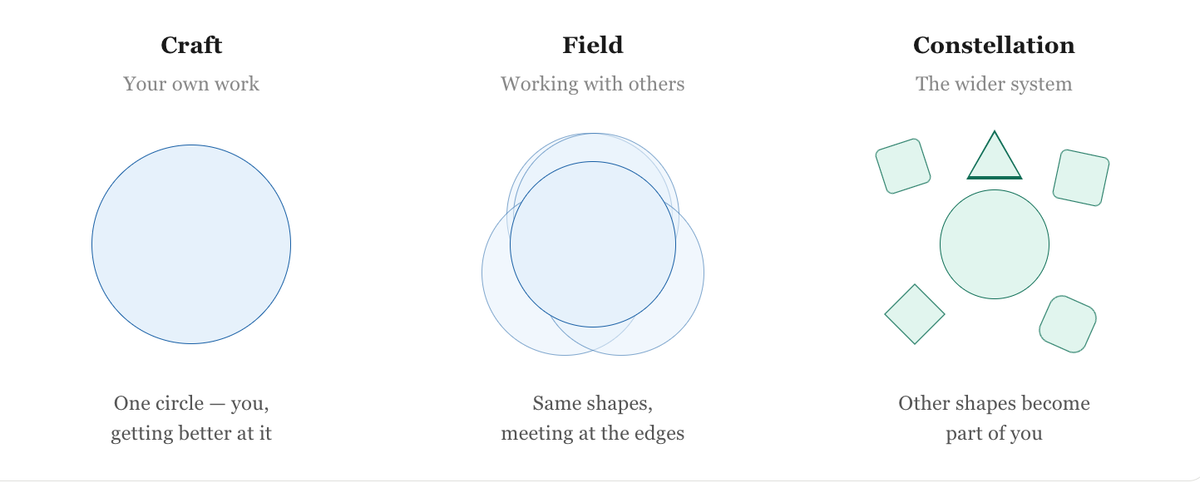
But here's the trap. Craft feels like the whole job, because it's the part you can see most clearly. And organisations reinforce that — they hire you for it, manage against it, promote you on it, and hand you training that deepens it. So you can spend a whole career getting better and better at a thing, and slowly less and less impactful. Because being the finest version of a single circle is still only ever one circle.
The work needs you to meet other people.
Field
Field is what happens when your circle meets everyone else's.
It's less about your skill and more about the edges — where your work touches the work of people who do something different, and value only appears if those edges fit. This is needed, much needed, as this is how different disciplines come together to take an idea and turn it into something tangible, something real, something of value.
Learning to work well with others is the goal of field learning. Learning to see what they bring, and why it matters, and work well with others. Learning where your contribution sits inside a system far larger than your part of it.
There's no prize for being the best coder in a building you can't function inside. If you can't work with people, can't recognise the value in a discipline that isn't yours, can't move through the culture without friction — your craft never gets deployed to it's fullest potential. Field learning is what carries your craft into the business and lets it do something towards the value being derived.
I've used the word value a lot already. That's deliberate, because in my experience most people never connect their work to it. They don't see the pressure behind a decision. They don't know why a constraint exists, or why a rule has to hold, or how the machine they're part of actually runs. Many fight against it because they feel it constrains them, without truly looking at it from a different perspective.
Which is the third area. The one hardly anyone invests in — and the one I've come to believe matters most.
Constellations
Constellation is everything that surrounds your craft and your field. And it's the one that changes what you're made of.
Craft and field are both circles — you, and other people like you, doing their work together. Constellation is different in kind. It's the triangle and the square and the shape you don't have a name for: employment law, economics, behavioural science, regulation, marketing, PR, biology, physics, sociology, communication science, mechanical engineering, history, the way money actually moves through a company. Learn a little of it and you stop being a single circle. You become something more complex, and harder to replace.
You could study it for a lifetime and never finish. Partly because it's vast and never ending in scope, and partly because it keeps changing shape as you do. What you reach for is driven by what genuinely interests you, the plan you have for your career and life, how much you want to change things, and what your role demands. It isn't sharpening your craft. It isn't deploying that craft alongside others. It's understanding the systems and topics that surround and govern the work — and, if we're honest, the life you wish to lead.
Here's what it looks like in practice.
I once worked with someone at the very top of his leadership game. Somewhere along the way I'd helped him see that his organisation is organic (there's a clue in the word organisation) — always moving, adapting, refusing to sit still – and not always in ways we expect. So he decided to study biology, and started bringing its lessons back into how he ran his company. He was also hiring hard at the time, so I nudged him toward UK employment law — the protected characteristics in particular. He read it, and stopped cold. He'd been letting his managers run interviews with no training at all (you could argue someone from HR should have made this a very clear policy – it baffles me why this is not standard practice).
Two subjects, neither of them his direct craft, both of which changed how he worked and what his business risked. That's constellation. It rarely announces itself as relevant, and it's usually the thing that turns out to matter.
None of the three areas is dispensable, and the balance shifts with the season you're in. But the aim is to hold all three in tension, not to master one and neglect the rest.
The same is true if you run learning for other people. Craft makes them better at the job. Field helps them work well while doing it. And the one I'd fight for — the cultivated bias, I'll own it — is constellation. The subjects that look, at first glance, to have nothing to do with the role, and end up shaping the career and the business more than anything on the training plan.
It's why I'd teach every employee the basics of business finance and employment law before almost anything else. Not because it's on their job description. Because it's the shape they're missing. Then help them to discover genuine topics that interest them – and weave this into the workplace learning agenda. Not sporadic subjects for the joy of it (although that is helpful), but subjects that can be connected back to how ideas move through the value.
Teach people to see the whole system, and something changes that a craft course never touches. I'd say that, of course. But I've watched it happen too many times to pretend otherwise.
After all, one person with a different perspective on work can change an entire business.
From the Cultivated library — related
Workshop Mastery
Guide · PDF download
If you design or run learning, this is the practical guide to building training that shifts behaviour — not training built to be measured. The three fields, put to work in a room.
£14.99
See Workshop Mastery →A talk or keynote
In person · Anywhere
The fastest way to give a room a constellation view — ideas from well outside their world, tied straight back to the work they do every day. Where most of the work begins.
Enquire
See talks →