The Ministry of Detail
Rory Sutherland has a rare gift for saying uncomfortable truths with warmth and humour. One observation landed hard: creativity is scarce in organisations not because people lack imagination, but because systems quietly discourage it.


Why creativity is suppressed by systems, not by lack of imagination
I was recently watching Rory Sutherland speak about creativity.
He has a rare gift for saying uncomfortable truths with warmth and humour.
One observation landed hard: creativity is scarce in organisations not because people lack imagination, but because systems quietly discourage it.
Creativity is uncertain.
It resists forecasts.
It doesn't fit neatly into a spreadsheet.
And so it is quietly filtered out.
Editor's note — where this sits
This essay sits in the Engine layer of the Idea to Value system — the creative conditions required for ideas to form and thrive. It asks why organisations so reliably suppress the creativity they need, and where genuine creative work actually lives. The Physics layer runs underneath: the permission structures, budget gravity, and risk filters that determine which ideas ever move at all.
The Idea to Value system — five layers
Risk, Money, and the Shape of Permission
In business, permission follows predictability.
Large budgets attract governance, committees, and justification rituals.
Small experiments attract indifference
—or quiet freedom.
Sutherland’s slide made this visible.
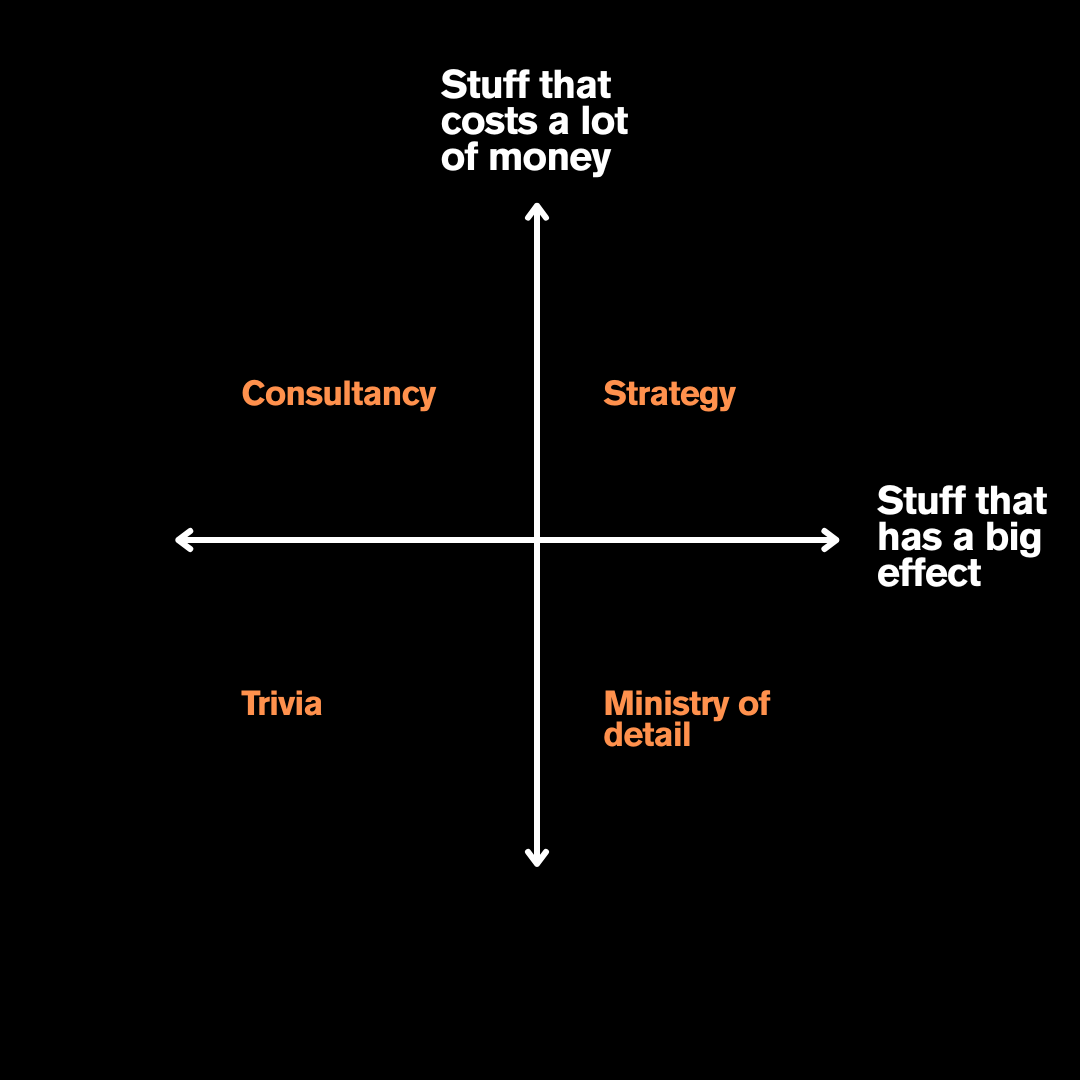
High-cost initiatives often produce modest effects. (Consultancy)
High-cost strategies can produce big returns (Strategy)
Low-cost trivialities produce nothing. (Trivia)
But somewhere in the corner is a strange, underfunded territory: small interventions with disproportionate impact. (Ministry of Detail)
He called this territory the Ministry of Detail.
It is where overlooked problems meet attentive minds.
Where constraints sharpen perception.
Where someone notices what everyone else has normalised.
Where Creativity Actually Lives
Creativity rarely emerges from the centre of power.
It emerges from the edges.
From people who see friction because they feel it.
From individuals who cannot afford grand solutions and therefore invent precise ones.
From teams operating under constraint, not abundance.
Constraint is not the enemy of creativity.
Constraint is its native climate.
The Myth of Big Programmes
Organisations often equate innovation with scale.
Transformation programmes.
Strategic initiatives.
Multi-year roadmaps.
These structures are good at coordination.
They are terrible at delivering genuine improvements - and many fail too.
They struggle with the small, strange, sideways ideas that change behaviour rather than organisational architecture.
The irony is that creativity often dies when funded.
Money attracts measurement.
Measurement attracts risk aversion.
Risk aversion suffocates imagination.
Attention as Strategy
The Ministry of Detail is not about budget.
It is about attention. It is about noticing.
Someone notices the web page form that makes customers quit.
The wording that changes behaviour.
The meeting structure that drains energy.
The tiny process step that causes cascading delay.
These are not headline strategies.
They are acts of care.
And yet they often create more value than million-pound initiatives.
Creativity is the engine of the business, and care is the fuel.
Teams Built for Constraint
This is why I prefer building teams under constraint.
Not because constraint is noble.
But because constraint clarifies.
With limited resources, teams stop performing innovation and start practicing it.
They test.
They adjust.
They notice.
They do not wait for permission to think.
Creativity Without Spectacle
Creativity in organisations is often theatrical.
Innovation sprints.
Hackathons.
Design sprints branded with flashy optimism.
These have their place.
But most meaningful creativity is quiet, unbranded, and inconvenient.
It lives in marginal gains, reframing, and noticing.
It is less window dressing, more craft. And it happens in the work itself.
The Quiet Leverage of Detail
The Ministry of Detail is where leverage hides.
A pricing tweak.
A wording change.
A behavioural nudge.
A process removal.
More intelligence and quality into the product or service.
Small changes, large effects.
This is creativity as systems thinking, not brainstorming.
Why This Matters
Organisations do not fail from lack of ideas.
They fail from lack of attention.
They look for innovation in big budgets and miss it in small behaviours.
They seek disruption and ignore friction.
They fund spectacle and starve craft.
The Ministry of Detail is where organisations rediscover their ability to change.
Not through grand programmes.
But through noticing.
Creativity, Reframed
Creativity is not wild ideation.
It is disciplined noticing under constraint.
With a rhythm.
It is the courage to care about small things.
It is the humility to adjust rather than overhaul.
It is the quiet work of seeing what others have stopped seeing.
Most organisations do not need more innovation budgets.
They need more attention.
The Ministry of Detail is already in the building.
It is waiting for permission to matter.
From the Cultivated library
Idea to Value Guidebook
Field guide · Digital PDF
The practical guide to moving ideas through organisations — including the creative conditions that determine whether good ideas survive long enough to become something worth having.
£19.99
Get the guidebook →Workshops & Keynotes
In-person or virtual · Bespoke
If this argument resonates for your organisation — the suppression of creativity, the myth of big programmes, the leverage hiding in detail — this is the conversation to have in the room.
Enquire
Start the conversation →