The 5:15 Report
As teams grow, it becomes harder to stay connected to the reality of work. The 5:15 report is a lightweight sense-making loop—five prompts that compress progress, improvement, and mood into a readable signal.


A small communication loop that surfaces what dashboards cannot
As teams grow, leaders lose touch with the texture of the work. Not the headline numbers — those keep arriving — but the daily reality underneath them. What is actually changing. What people are carefully carrying. Where momentum is gathering and where it is leaking away.
Dashboards show activity. Meetings show acting. Neither reliably shows how the work is moving, or how the people doing it are holding up.
Years ago I picked up a small practice that addresses this directly. It is not a tool. It is not a piece of software. It is a single weekly habit, and I have used it across multiple organisations, in teams of five and teams of fifty. The 5:15 report.
Editor's note — where this sits
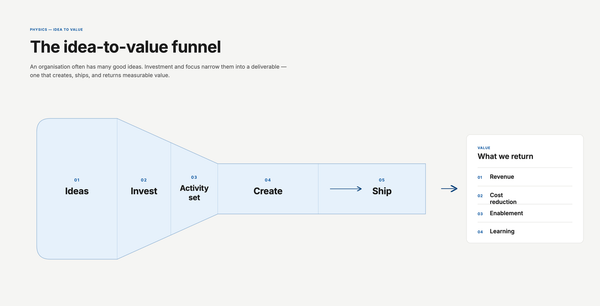
A Wiring layer essay from the Idea to Value system — on how a small weekly communication loop carries progress, intention, and sentiment between people who would otherwise lose contact with each other's reality. Lightweight by design. Compounding by nature.
The Idea to Value system — five layers
A lightweight loop, not a status report
The name is pragmatic. It should take about fifteen minutes to write, and five minutes to read. Anything longer is a status report. Anything shorter is a tick-box. The point is the rhythm, not the document.
A status report tracks delivery. A performance review tracks the person. The 5:15 does neither. It is a small weekly loop in which the writer makes sense of their own week before passing a compressed version of that sense-making upward. The artefact matters less than the act of writing it.
Five prompts
Each person, each week, answers five short questions:
- Did you do what you said you would do?
- What did you improve this week?
- What personal improvement will you make next week?
- What are your key objectives for next week?
- What is the mood of the team?
Together, those answers form a compressed map of the week — progress against intention, evidence of learning, and a read on how the work is being experienced.
Five minutes of reading per person gives a leader something dashboards never will: a coherent picture of what is actually happening, in the words of the people inside it.
Accountability without surveillance
The first question is the heart of the report. Did you do what you said you would do — and if not, why?
The phrasing matters. The question is not "did you complete your tasks." It is "did intention become reality." That is a different question. It places the weight on the commitment, not the activity. It invites honesty about why something didn't happen — capacity, dependency, judgement, distraction — without requiring a defence.
Accountability built this way creates trust rather than fear. The act of writing what you said you would do, and what you actually did, is its own quiet correction. Most weeks, people self-correct before a manager has to.
Improvement as a habit
One small improvement per week, compounded across a team, across a year, is more than most transformation programmes deliver. Stopping low-value work counts. Reducing friction counts. Removing one bad meeting counts.
The discipline is in the noticing. The prompt forces a weekly question that most people would otherwise skip: what did I make better, and what will I make better next? Improvement that lives in routine eventually stops being a project and starts being a property of the team.
Personal systems matter
Work creates tension. People need to develop themselves alongside the work, not separately from it. The fourth prompt — what personal improvement will you make next week — names this directly.
It is small on purpose. A leader is not asking for a development plan. They are asking the person to spend a moment each week noticing one thing they want to be better at, and committing to it in writing. Over time, this prompt produces a record of someone's own growth that no performance system will capture.
Mood as signal
Mood is not a soft metric. It is a signal, and a precise one. When a team's mood shifts before its delivery does, mood is the telemetry. Read carefully across a few weeks of reports, mood reveals systemic problems long before any dashboard will — fatigue, misalignment, conflict, drift.
Most leaders learn about these things too late, in exit interviews and resignation conversations. The 5:15 makes them visible while there is still time to do something about them.
Sense-making at scale
The 5:15 is not a management tool. It is a communication system. It compresses reflection, intention, and sentiment into a readable signal that travels between people who would otherwise lose contact with each other's reality.
It helps leaders be surprised less often. It helps people feel seen without being scrutinised. And it does so with no software, no platform, and no consultant — which is probably why it endures.
A subtle pattern
It is simple. It is not branded. It does not require a roll-out. A team can adopt it on a Friday afternoon and have something useful to read by the following Friday.
What it does, slowly, is build a body of small weekly evidence about how the work is unfolding. Read across months, that body of evidence is one of the most honest pictures of an organisation a leader will ever have access to. Read across years, it becomes something rarer still — a written record of how a team learned to think about itself.
Cultivated Studio
The argument is here. The working tools are in Studio.
Studio is the ongoing, behind-the-scenes layer of Cultivated — field notes, extended essays, frameworks, and over four hours of Idea to Value deep-dive video. It doesn't extend every article with a matching framework. It extends the thinking across the whole system, for practitioners who want to go further than the public library. If this essay opened something, Studio is where the wider architecture lives.
Explore Cultivated Studio →