Teach, don't read the slides
People hand a workshop teacher the things they can't get back — time, energy, attention. On why running one is teaching, not facilitating, and the craft that difference demands.

A workshop is for teaching
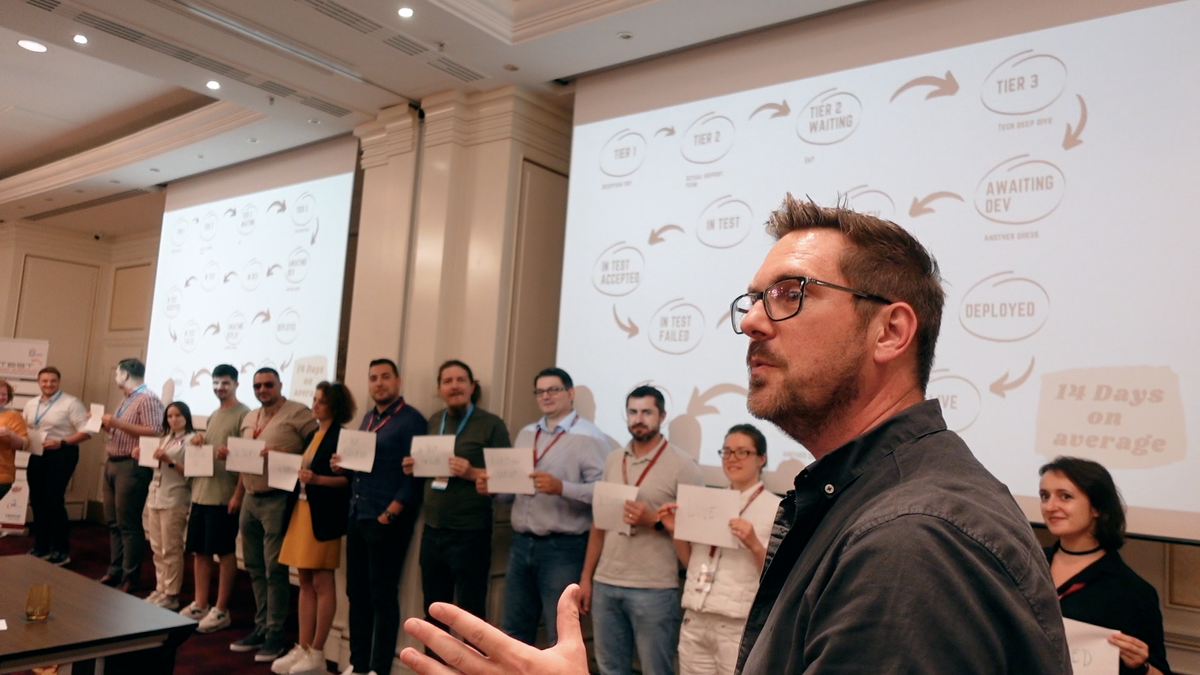
I'm in Berlin, about to teach a workshop on communication skills. I'm tired, I'm drinking coffee. I'm doodling on flipcharts. It's a little before nine, and people are arriving in various states of mood and attention. It is a conference after all.
A couple are down the front already, notebooks open, pens poised, keen, eager to get started. A few are hovering by the coffee, wondering whether they've made a terrible mistake with their choice for the day. Many genuinely chose to be here. At least one is here because somebody in HR decided it would be a good use of a Thursday.
And for the next few hours, every one of them is going to place an extraordinary amount of trust in a stranger. Me.
They've handed over the only things they can't get back – their time, their energy, their attention – and in return they'd like something useful. It's a trade to be taken seriously indeed. Which is why I've always been bewildered that so many people entrusted with a room like this feel it's entirely normal to read their presentations slides aloud for three hours.
I think we can do better than that. In fact, I know we can.
Here's the distinction I've come to hold quite firmly: we don't facilitate workshops. We teach them. Facilitation is a genuine skill – it means creating the conditions for a conversation to happen, steering occasionally, teasing out quiet voices and staying out of the way for a lot of it.
Teaching is a different thing. It means taking responsibility for what people actually leave the room able to do. One arranges a powerful discussion. The other is on the hook for the actual learning. Teaching a craft, and like any craft it rewards the person who treats it seriously.
So it begins, always, with a question: where are these people now, and where should they be by the time they leave? Teaching is movement – guided, structured, deliberate movement from here to somewhere more capable. That takes more than knowing your subject. It takes design: what has to happen, in what order, and where to spend the room's finite resources (time, energy and attention) so the outcome happens; learning.
I plan these sessions carefully, and I practise them intently. But the plan was never the point; the learning, in the minds of the students, is. A lesson plan exists to protect the handful of teaching ideas that truly matter and to hold the conditions in which they can land – not to be read out like a train timetable while the actual room falls asleep. Prepare it with care. Then stay awake enough to abandon bits of it the moment the learning asks you to.
The good sessions are also, always, bounded – and this is the one that feels back-to-front, because we tend to assume generosity means handing people everything we know. It doesn't. A workshop with no limits on size or scope isn't generous; it's a person showing you the full breadth of what they know, at the direct expense of what you came to learn.
Cover everything and you teach nothing – the material goes up, the depth goes down, and the attention leaves the building around one hour in. Expertise isn't teaching everyone everything you know. It's teaching the right things, at the right depth, for the actual people in front of you, and holding that in mind even when someone in row three would dearly love you to go broader. Telling people, ideally in advance, what a session is, and isn't – the level, the scope – isn't just small print on the agenda. It's a kindness. Vagueness wastes everyone's afternoon.
And a fair amount of the teaching is done before I've said a word, by the room itself. The light, the layout, the sight-lines, the temperature, whether the chairs face the thing they're meant to face, whether people can be comfortable whilst learning. Turning up early to sort all that out isn't care-taking; it's part of the teaching, because a person squinting past a pillar or slowly overheating in an airless room has already had a slice of their attention taken before we've begun. The same goes online, where an untested link or a cluttered screen does the taxing instead. The environment is never neutral. It's always teaching something – the only question is whether it's teaching what you'd have chosen.
You'll never get the balance between lecture and interactivity perfectly right, by the way, and it's freeing to stop trying. Some want more discussion, some more frameworks, some more information; some find the pace brisk, others sluggish. Chase everyone's approval and you produce the one thing nobody needs – a session bland enough to offend no one and useful enough to help no one. The sin you genuinely can't afford isn't seriousness, or rigour, or a high bar. It's dullness.
Learning needs energy and attention, and the sense that something worth staying awake for is happening. And energy doesn't mean bounding about like Mr Tumble – it means presence, interest and care: enough to notice the moment attention dips, and doing something about it before the room's gone, and the learning with it. Mostly it means believing that what you're teaching matters, which people can read on you whether you meant them to or not.
The place it can quickly come apart is with instructions. Every exercise is a test of whether you can say a clear thing clearly. Give a vague brief for a practical activity and you'll watch the learning drop while twenty people attempt to reverse-engineer what you actually wanted. Clear instructions make room for learning. Muddled ones eat it and a little trust in you at the same time. Which is why I write mine out and test them beforehand, rather than trusting that something clear in my own head will arrive clear in someone else's. It rarely does.
And then, of course, something goes wrong. It always does. The monitor dies. Someone asks the question that warrants digging into, scuttling the plan also. New people arrive, the fire alarm goes off, you miss a quiet ask for help. People arrive tired, or sceptical, or fuming about something at work that they take out on you.
None of that is the teaching going wrong; it is the teaching. The first time the plan falls apart on you, it's frightening. By the tenth, it's simply the job – a moment for judgement rather than panic, met with a small repertoire of moves you only know because you were caught out before and learned your way through.
The word running underneath all of this is teaching, and I use it on purpose. Because when those people handed over their Thursday, they weren't asking to be facilitated, or talked too, or entertained, or amused – although those last two do help teaching land. They were trusting a stranger to have something worth saying, the skill to say it well, and the care to want them to leave more capable than when they arrived.
That trust deserves a real learning experience – prepared properly, delivered with life in it, and built around their learning rather than my cleverness. Oh yes, and without dullness.
It's a craft, in other words, and it's worth treating as one. The person who lingered by the coffee, unsure they'd made the right call, deserves to walk out at four o'clock absolutely certain that they had. Get that right often enough and it turns out to be the best possible use of a Thursday – theirs, and mine.
There's a video that goes with this piece, on Creative Soul Projects. Same person, same observation — just followed on camera instead of on the page.
Where this sits in the Atlas
Orientation·Idea to Value·Communication·Creativity & Climate·Learning