Words carry meaning into other people's minds
The way you speak shapes whether people understand, engage, and remember what you teach.
In workshops, business sessions, and conferences, clarity is everything.
Word choice, tone, pace, and expression determine whether ideas land or dissolve into background noise.
Teaching is communication. Facts, enthusiasm, and meaning travel through your voice. If your communication is unclear, your teaching will be too.
Communication extends beyond words.
Posture, facial expression, tone, appearance and presence all signal meaning.
Even silence communicates something.
Editor's note — where this sits
The wiringA practical reference from the Wiring layer of the Idea to Value system — drawn from Workshop Mastery, for anyone who teaches, facilitates, or presents and wants their ideas to travel clearly.
Words Matter
Words carry ideas from your mind into other people’s minds
— and they do not land equally for everyone.
Use simple language, define jargon, use one term for one idea, and structure sentences clearly.
Then practise. Speak aloud. Record yourself. Listen back. Notice unclear phrasing, filler words, and awkward delivery. Improve one thing at a time.
The Elements of Speech
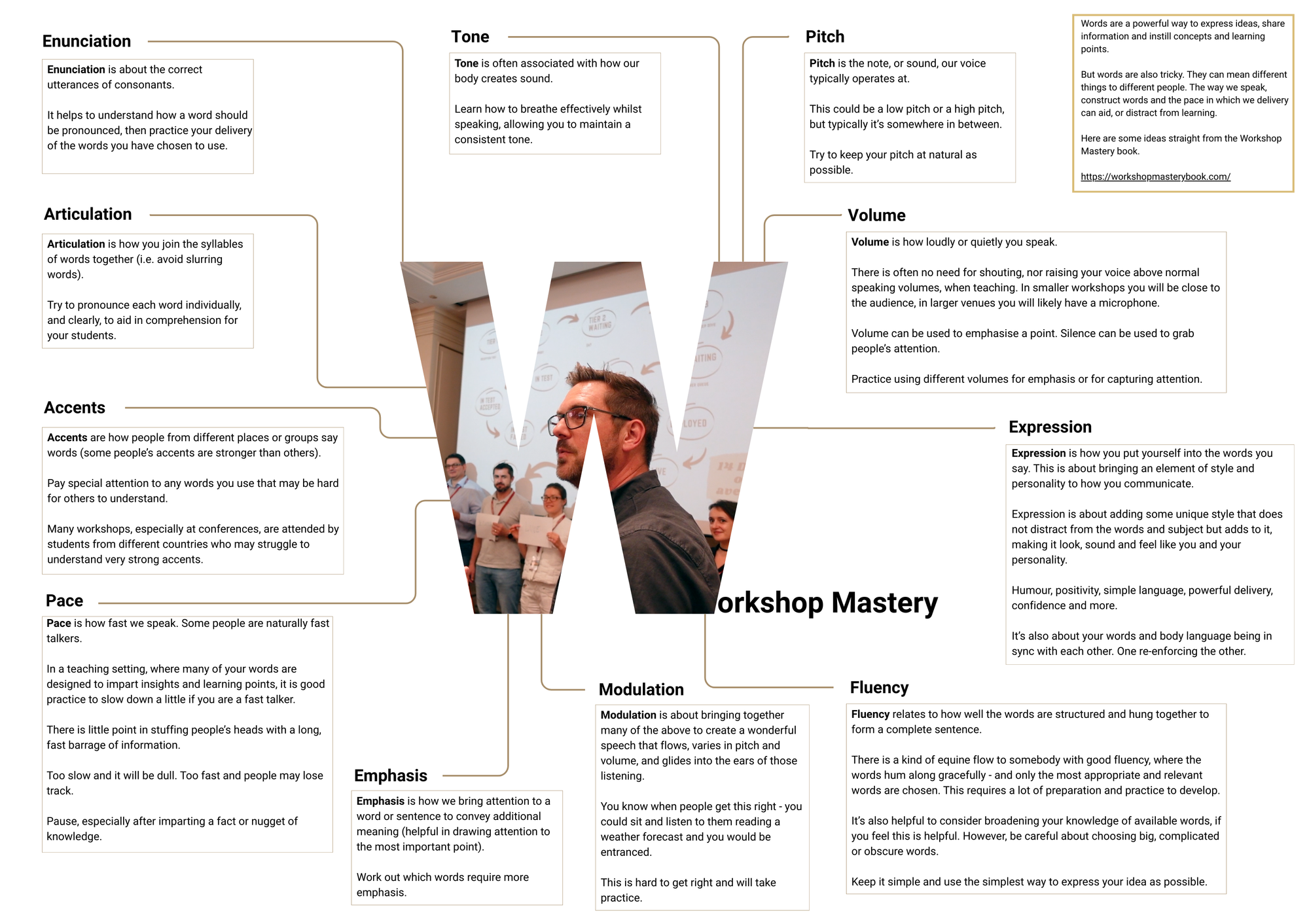
Quick reference — elements of speech
The wiringThe elements of speech at a glance
Each element shapes whether your ideas land clearly or dissolve into background noise.
Note: View, print or download the image at the end of this post for a good reference guide to this content
Enunciation
Clear pronunciation of consonants. Learn how words are spoken and practise them.
Articulation
How syllables connect. Avoid blurring words together — each syllable should land.
Accent
Accents vary. In international settings, be mindful of words that may be harder to follow.
Emphasis
Highlight key words and phrases to signal importance. Not everything deserves equal weight.
Tone
Shaped by breathing and vocal control. Aim for steady, relaxed delivery rather than performance.
Pitch
Your natural vocal range. Keep it natural — strain signals nerves and distracts from content.
Volume
Use normal speaking volume, adjusting for emphasis. Silence, used well, can carry more than words.
Pace
Slow down for clarity. Pause after key points. Avoid flooding people with information before it lands.
Fluency
Smooth, logical flow of words. Requires preparation — fluency is earned, not improvised.
Modulation
Variation in pitch, volume, and rhythm. Monotone loses rooms. Variation sustains attention.
Expression
Personality, humour, warmth, and confidence — aligned with body language. This is how care travels.
Find Your Style
No two teachers sound the same. That is a strength.
Learn the fundamentals, then experiment. Presence, clarity, and personality make learning engaging. People learn more when they feel energy, intention, and care.
From the Cultivated library
Workshop Mastery
Book · Digital PDF
The fuller craft behind this piece — designing and facilitating learning that actually changes behaviour, from structure and pacing to presence and the discipline of teaching well.
£14.99
Get the book →Communication Superpower
Workbook · Digital PDF
Communication as a deliberate personal capability — how to adapt tone, style, and clarity across any audience, context, or room. The system beneath the speech.
£21.99
Get the workbook →