How Reading and Writing Make You a Better Communicator
Communication isn't a presentation skill. It's a daily practice — shaped by habits of attention, vocabulary, and clarity of thought. Two low-barrier practices that quietly compound over time: reading and writing.

Reading widens the palette. Writing sharpens the brush
Most people think communication is a performance skill — something you develop in presentation training or practise in meetings. In reality, it is a daily habit shaped by attention, vocabulary, and the clarity of your own thinking.
Two low-barrier practices quietly strengthen communication over time — and neither of them happens in a training room.
Editor's note — where this sits
This essay explores reading and writing as compounding communication practices — habits that quietly strengthen the range and clarity of expression over time. It sits in the Wiring layer of the Idea to Value system, where meaning moves between people and communication either builds or erodes clarity. It is also firmly Flywheel work — both practices compound slowly, invisibly, and permanently.
The Idea to Value system — five layers
You can watch the note below, or read on to explore this idea.
Reading — expanding the range of expression
When we read, we encounter more than vocabulary. We encounter expression — somebody's thinking translated into words.
Different authors use different rhythms, structures, and vocabularies to convey meaning. Exposure to varied styles expands the range of words and sentence patterns available to us when we speak or write. Not about sounding complex, or copying others — about having sufficient linguistic tools to match the nuance of an idea.
Diversity of material matters more than category. Fiction, essays, design, philosophy, biography — each reveals a different way of assembling meaning. The benefit is cumulative rather than immediate. Vocabulary grows gradually. Phrasing becomes more natural. Clarity becomes easier to access.
Readers are not just effective communicators because they consume more information. They are effective because they have observed more ways to express it.
Writing — slowing the mind
Writing performs a different function. Where reading expands input, writing refines output.
To write is to slow down. To think. The act of forming sentences forces thought to become clearer and more deliberate. Ambiguity becomes visible on the page. Weak phrasing reveals itself. Ideas either hold together or fall apart under their own weight.
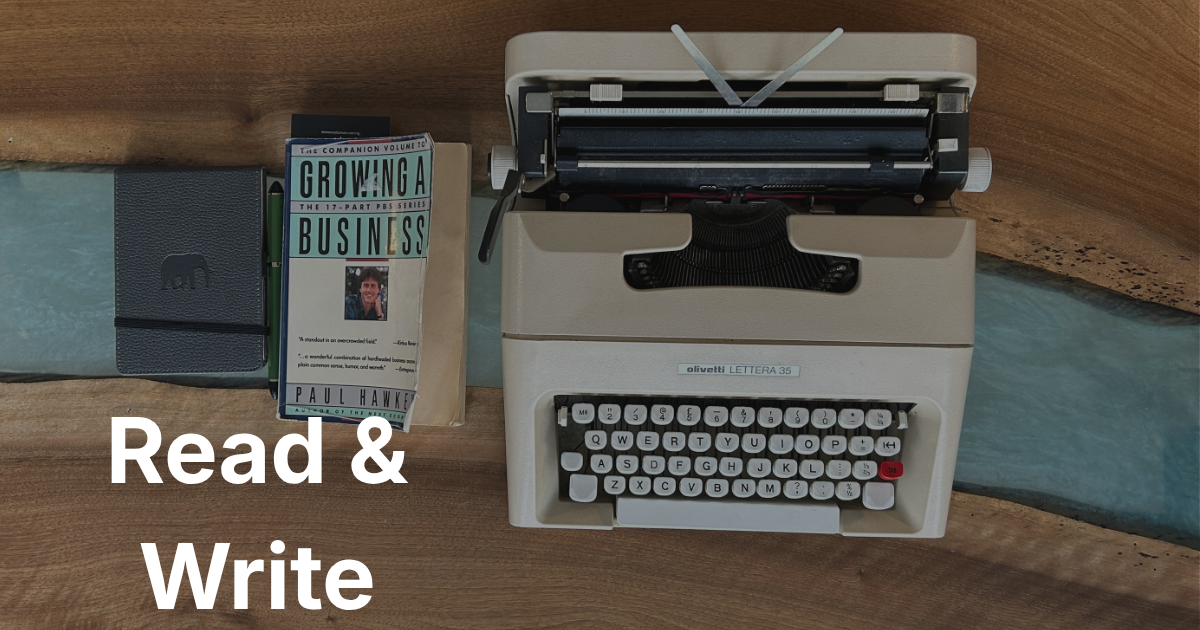
Speed is not the objective. In many cases, the slower the medium, the clearer the thinking. Handwritten notes, journals, or deliberate drafting on a typewriter can produce more precise language simply because they resist haste. You must slow down — to think, and to capture thought on paper.
The purpose is not publication. Most writing that improves communication is private — notebooks, drafts, reflections, sketches of thought. The value lies in the act of articulation rather than the artefact itself.
Low barrier, long arc
Neither of these practices requires specialised tools. A library card, a modest book collection, a simple notebook.
Communication rarely improves through occasional effort. It improves through repetition — exposure to well-formed language and regular attempts to express your own thinking with care.
Over time, reading widens the palette. Writing sharpens the brush. And effective communication is the result.
Communication Superpower
162-page workbook · PDF download
A practical workbook for developing communication as a deliberate personal capability — including the habits, styles, and practices that make expression clearer, more precise, and more effective over time.
£21.99
Get the workbook →Zero to Keynote
195-page guide · Digital & print
The craft of shaping ideas into language that lands — from forming a clear point of view to delivering it with calm presence. For people who want their thinking to travel further than the room they're in.
From £9.99
Explore the guide →