No fish in the studio
Every workplace runs on rules — the only question is whether they're written where everyone can see them, or unwritten and known only to the insiders. Why explicit rules are fairer, kinder to newcomers, and freer than unspoken norms.


The rules nobody told you about
Every workplace has rules. Mine has one explicitly about no fish being allowed. In the workplace though, the problem isn't the number of them. It's how many of them nobody has written down.
Everyone has been the new person who broke a rule they didn't know existed. You sit in the wrong chair. Reply-all when you shouldn't. Ask the obvious question in the meeting where obvious questions aren't apparently encouraged.
And then comes the little pause from other. The sideways glance. A wry smile. We don't really do that here.
Congratulations. You've just discovered a workplace rule and you didn't learn it from the handbook. You learned it by breaking it. This happens everywhere. I've done it more times than I care to admit. And I've started to think it's one of the more interesting ways an organisation creates an insider class without ever intending to.
Because the people who have been around longest possess something the newcomer doesn't: the map.
They know the rules nobody wrote down. They know which meeting matters and which ones don't. Which deadline is real. What can be challenged. What cannot. Which behaviours are admired. Which ones will get you labelled as "not quite the right fit".
None of this is often malicious. It's just invisible. And that's the problem. An unwritten rule gives an advantage to the person who already knows it.
The longer you're somewhere, the more rules you accumulate. The newer you are, the more likely you are to discover them accidentally. That makes unwritten culture a rather peculiar sort of private members' club. The membership fee is time. The initiation ceremony is embarrassment.
Make the invisible visible
I've always liked rules. Not bureaucracy. Not seventeen-page policies about where you're allowed to put a stapler. I mean simple constraints that make a shared environment work as we all try to turn ideas into something valuable.
And the older I get, the more suspicious I become of the phrase: "We don't really have many rules around here." Usually what it means is: "We have lots of rules. Our existing people know them. But we don't believe in writing them down."
This is why I think explicit rules are underrated. Not hundreds of them. Not rules for the sake of rules. Not to stop people having freedom, creative expression and growth. Writing a rule down doesn't necessarily make an organisation more bureaucratic. Sometimes it actually makes it more democratic. Because now everyone can see the game.
The rule can be explained. Questioned. Disagreed with. Changed. Even abolished when it makes no sense anymore. And, importantly, it can be applied to the person who wrote it. That's something an unwritten norm struggles to do. An unwritten rule is incredibly powerful but slippery to grab hold of. Where did it come from? Why was it created? Why has it become a norm?
When challenged, it can simply disappear behind: "That's just how we do things." Well, is it? If so, write it down. Because once a rule is visible, it stops being tribal knowledge and becomes shared knowledge. And that is a remarkably important distinction.
The freedom of knowing the edges
There is a second reason to make important rules visible. They give people somewhere to move. This is the bit I took from Tom Sachs' 10 Bullets. Sachs describes the operating principles of his studio, including the fabulous "always be knolling" – keeping the tools and materials of the work organised and visible, at neat angles to each other.
The rules sound restrictive but they aren't. They are designed to get good work done, and make being part of doing that work worthwhile. Knowing where everything is means you can concentrate on what you're making. Knowing what the room is for means you don't have to decide what the room is for every time you walk into it. Knowing the boundaries means you can stop thinking about the boundaries and work creatively within them.
This is the wonderful thing about constraints: the absence of boundaries doesn't feel like freedom. Sometimes it feels like uncertainty, overwhelm, confusion, vastness. A blank page offers infinite possibility, along with absolutely no idea where to start.
Give someone a frame and suddenly they can paint, operate and create within it. Give a team a clear definition of good work and they can improvise, improve, adapt within it. Tell people what matters, what doesn't, what is allowed and what isn't, and you remove a whole category of questions from their heads. Can I do this? Is this okay? Will somebody object? Is this one of those things we don't really do here?
That background noise costs more than we think and many people are playing within it everyday. So I don't think good rules constrain freedom. Good rules create the conditions in which freedom is possible. The trick is knowing which rules deserve to exist.
The rules in my studio
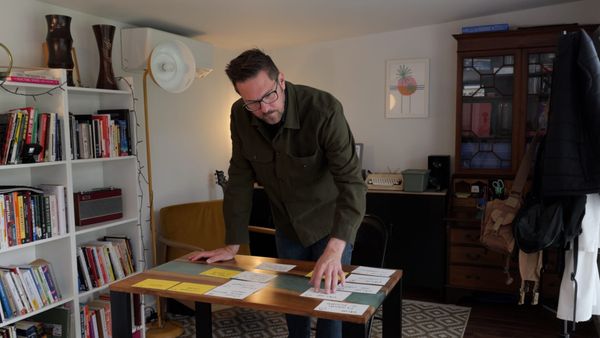
Which brings me to my own studio. I have ten rules. Not because I believe ten is a particularly magical number, although much of my work does run in tens. But because I find that writing things down changes the relationship you have with a space and ten rules seemed to be enough to create clarity.
These aren't rules for visitors. They're rules for me. A little contract between the person I am today and the person who will walk through the door tomorrow.
- Treat the building with respect.
The space is a privilege. Keep it functional and cared for. - Reset between projects.
Mess is evidence of work. Permanent mess is evidence of unfinished work. - No outdoor shoes.
Small rituals create care. - Organise around outcomes.
Objects should earn their place. Spaces should have a purpose. - Don't squander the space.
If I'm here, I'm here to use it. - Don't get distracted.
This is a room for thinking, making, writing, reading and paying attention. - Everything goes back to where it lives.
Entropy is real. - It's not all about work.
Reflection, play, reading and rest count too. - Keep evolving the space.
The work changes. The room should change with it. - No fish in the studio.
Nine of these are useful. One is there because rules can be fun. And that matters too.
Write the rules
I'm not advocating for workplaces with more rules, that's a form of self sabotage. However, I think a workplace benefits from fewer invisible ones. Take the things that genuinely matter; how we treat each other, how we make decisions, what good work looks like, what behaviours we want, and don't want, how we use the space.
These are things somebody new needs to know. We capture them, we define them, we say them out loud. We put them somewhere people can find them. And let people challenge them. Because the choice isn't really between a workplace with rules and one without them. The choice is between rules everyone can see and rules that only insiders know.
One creates clarity. The other creates hidden hierarchy. One gives a newcomer a map. The other gives people a series of traps to fall into. And if you want people to feel that they belong, the kindest thing you can do is probably not tell them to fit in. Give them the map. Then let them find their own way around it.
And, obviously, no fish. Certainly not in the microwave.
Where this sits in the Atlas
Orientation·Idea to Value·Communication·Creativity & Climate·Learning
Creative Soul Projects
There's a video that goes with this piece, on Creative Soul Projects. Same person, same observation — just followed on camera instead of on the page. Explore the channel.