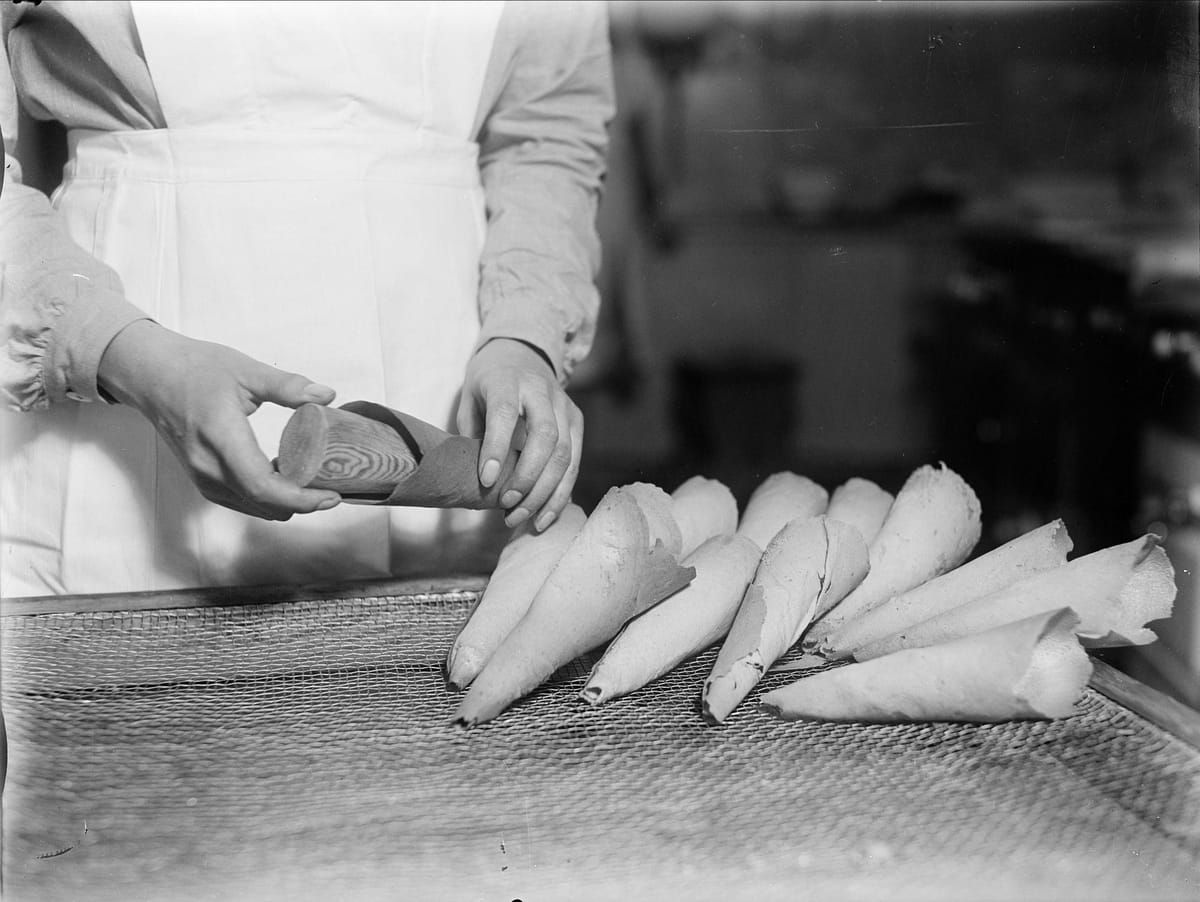
My youngest son loves to bake. His signature dishes are flapjacks (my favourite) and a truly excellent treacle pudding (also, as it happens, my favourite). He's really rather good, in spite of – or possibly because of – the trail of devastation he leaves across the kitchen. The other day, mid-way through mashing eggs and flour into something delightful, he stopped and asked me what would happen if we just served the cake without cooking it.
It's a completely fair question, and I gave him the honest answer: you'd get a stodgy, gluey mess, it would probably make everyone feel a bit squiffy, and it would almost certainly go back to the kitchen untouched. It needs heat.
And it reminded me of the near-endless analogies that drift across LinkedIn about teams as recipes. Get the ingredients right – the skills, the personalities, the behaviours – and something wonderful will rise. It's a nice idea, and almost all of them miss the one thing. The heat.
Mix flour, eggs, milk and butter and what you have is batter. To get pancakes, you need a hot pan. Teams are exactly the same. Capable people, well combined, are pure potential – and potential just sits there, at room temperature, drinking coffee, being potential. Heat is what turns our human potential into movement. It's what turns ideas into value.
Capable people are just batter – well-mixed and going nowhere – until something adds heat; and a leader's real choice is never whether to apply heat, but which kind.
Because not all heat is equal.
Some of it cooks beautifully and can be sustained for years. Some flares up and nukes the ingredients. And some, applied for too long, burns the whole thing to the pan. Knowing the difference is one of the most practical things a leader can do. So let's jump in.
The heat that scorches: fear
Let's start with the fiercest, because it's the one people reach for by accident, or, dare I say, by default. Fear is genuinely powerful heat – and almost never the right kind to apply on purpose.
At the level of a single person, fear can be the thing that finally moves you. I spoke recently with someone whose job was crushing her. What got her out wasn't the pull of something better – it was the fear of what staying would keep doing to her. She left without another role lined up, and the fear moved her forward. Sometimes it does.
But fear applied by a leader, onto a team is a different substance entirely. It burns bright and fast, like a gallon of lighter fluid. A satisfying whoosh, flames, heat, intensity and then nothing but a cold, greasy, charred pan. Teams led by fear often go quiet. They disengage, they stop surfacing the problems that most need surfacing, they engage in watermelon reporting, and the good ones trundle out of the door.
Which is why Deming's instruction was so clear and blunt: drive out fear. Not because fear produces no movement – it produces plenty – but because the movement is all in the wrong directions: away from honesty, away from sensible risk, away from the creative work that actually makes things better.
There's one real exception, and it's worth naming so nobody feels lied to: a startup running low on runway. I've been there. The fear of not making payroll is real, legitimate, and marvellously concentrating. But notice what that is – fear arriving as context, a fact of the situation, not fear manufactured and aimed at people as a management style. One is the climate. The other is something you're doing to somebody.
The heat that cooks: clarity, and growth
Now the remarkably good stuff – the heat you can actually keep your hands near.
Clarity and alignment is my heat of choice, by a long way. When people genuinely know where they're going, why the work matters, how they play a role in it and how the particular obstacle in front of them connects to something worth building, energy simply appears.
You don't have to crank it out of anyone. Clarity makes its own heat by giving people a future they can lean into. Something hopeful, spirited, exciting, interesting. The mechanisms for doing this are unglamorous and completely learnable, but astonishingly absent for many: a painted picture clear enough that everyone can see it in their mind, understand it and move towards making it real. A strategy credible enough to be trusted and used to lead (which is what a strategy should do). And well understood problems compelling enough that people actually want to solve them.
Get those three in place and like minded talented people are drawn to the challenge, and the team warms itself. You could almost suggest that the role of management (and leadership) is simply making the problems that the business has interesting enough for people to want to solve them.
You're not manufacturing heat, motivation and inspiration – you're building the climate and conditions in which motivation is simply the rational response. That's a nice kind of heat.
Personal growth is the other sustainable flame, and possibly the most reliable of the lot. When work visibly develops people – when they can feel themselves getting more capable, more confident, more themselves – they bring an energy to it that refuels itself. The work is paying them in something more durable than salary alone. The manager's job here is the balancing act: honour the demands of delivery while genuinely developing the people doing it. Get that balance right, tie it to a clear purpose, and you've got heat that doesn't need you standing over it throwing fuel into the mix.
The heat you engineer: deadlines, shared goals, incentives
Then there's the heat you build into the structure and cadence of the work itself – and here the craft is all in the design.
Deadlines are little bursts of heat: contained sparks rather than a sustained flame. A side effect of travelling to help companies and do talks is that everything seems to get done at home. I am very productive the night before.
We all know the holiday-packing law of physics – there are a thousand things to do before a trip, and they all, somehow, get done the night before, because the departure time is fixed and fantastically immovable.
Used well, considered deadlines give work rhythm and a useful urgency. Used badly – arbitrary, relentless, with no honest resourcing behind them, as a stick to force fast work – they just cook people into frazzled stress balls, and boil away any semblance of trust. The question is whether the deadline is real or merely mythical. People can feel the difference immediately.
Sadly, there's is often plenty of heat that gets wasted, which is its own small tragedy. In big organisations the surest source of squandered heat is teams generating plenty of energy – pointed straight at each other.
I worked in a company where Delivery was measured on shipping new features fast, and Operations was measured on keeping the platform rock-stable. Structurally opposed goals: to release software is to risk wobbling the platform, so the rational move for a stability-measured team is to release as rarely as humanly possible. The two were in permanent friction – not because anyone was difficult, but because their objectives had been designed to fight.
So we gave both teams a single shared goal: weekly releases, at 99.999% uptime. And that one objective forced them to play nicely with each other. Development couldn't ship recklessly without Operations pushing back; Operations couldn't freeze the platform without Development pushing back. All the heat that had been going into the conflict swung round to face the shared problem instead. We'd built DevOps, as it turned out, a little before the name existed. The principle generalises nicely: give teams competing goals and their energy makes friction; give them a shared goal and the heat lines up and points forward towards the future.
Incentives are the trickiest fuel of all, because everyone assumes they're the main engine and they're so easily misused. Individual incentives are a remarkable way to make things go wrong, especially in work that is naturally cross team wide. When the reward is personal, people quite rationally play to the personal reward, which tends to mean not sharing what they know, not helping the colleague, not taking the risk that would help the team, shooting down good ideas that compete and doing anything to look after their own numbers. Cooperation starts to cost you; competition starts to look sensible.
Team wide incentives seems like a logical progression to solve this but seems to only solve half the problem, and open up a new one just for fun too. If one half of a team is carrying the other, rewarding everyone feels like an insult to the ones doing the carrying.
Neither model works cleanly without real behavioural standards and genuine shared ownership underneath it. The version I've seen work best is a real stake in the shared outcome – equity, collective metrics, honest shared accountability, managers tending to the right behaviours – so that everyone wins together or sweats together or fails together. It isn't always on the menu, but it's worth designing toward.
And competition as a deliberate management tool seems popular, but I suspect is has fear's exact flaw: lovely short-term heat, nasty long-term bill, with a new pan needed too. Make internal competition the main source of a team's energy and people stop sharing, stop collaborating across boundaries, and start playing for their own position on the ladder. You get heat, all right, plenty of it. It's just aimed sideways instead of forward.
The heat worth building
The blend I keep coming back to, the one that cooks most reliably, sounds a little like this: a compelling picture of where we're going, a credible strategy for getting there, people who are drawn to the obstacles rather than dragged toward them, deadlines that create urgency without human cruelty, goals that force cooperation across the silos, incentives tied to shared outcomes, and work that grows the people doing it.
Get enough of those in the pan at once and the team tends to generates its own heat – steadily, and without you hovering over all day long. Just a check here and there.
And that's the pivot at the heart of it all. The manager's job stops being to inject energy, shovelful by shovelful like an old steam engine, and becomes to protect the conditions that let the energy exist at all.
Because without heat, the finest ingredients in the world stay exactly what they were. Capable, beautifully mixed, and going absolutely nowhere. Batter.
Now, those muffins smell pretty good. I'll have just one, whilst I watch my son tidy the kitchen.
Where this sits in the Atlas
Orientation·Idea to Value·Communication·Creativity & Climate·Learning
The Field Guide — digital
The Life of an Idea
A portable field guide for anyone who is helping good ideas turn into something valuable.
It's a book about paying attention. About the most precious of all things – time, energy and attention – that people pour into their ideas, and the reverence that ought to sit underneath any work worth doing. Almost everything that helps good ideas land is visible, if you know how to look. Learning to see it clearly is the whole thing.
The link has been copied!