KPIs, Metrics, and Measures — How to Track What Actually Matters in Business
Organisations drown in metrics but starve for insight. This essay explores what KPIs really are, the four measures that matter most, and why measurement should guide understanding, not control behaviour.
Editor’s Note: Measures and metrics are often treated as neutral tools. In practice, they shape behaviour, priorities, and culture. This piece sits in the Cultivated library as a practical companion to the Idea → Value system, exploring how measurement can either clarify work or quietly distort it.
KPIs, Confusion, and the Blending of Measures and Metrics
One of the perennial challenges in organisations is how we talk about measurement.
OKRs, KPIs, objectives, scorecards — the terminology proliferates, and clarity recedes.
In practice, this confusion rarely helps. It creates unnecessary complexity, fragments accountability, and encourages people to argue about frameworks and mechanics rather than outcomes.
At their core, measures are simple: they are signals.
A Key Performance Indicator is merely a signal that matters — something that helps you understand whether the system is moving towards value.
Good measures help answer a small set of enduring questions: Are we making the business better? Are we doing the right things? What should we do next? Is this a good place to work?
If a measure does not help answer those questions, it is likely noise.
Four Categories That Matter
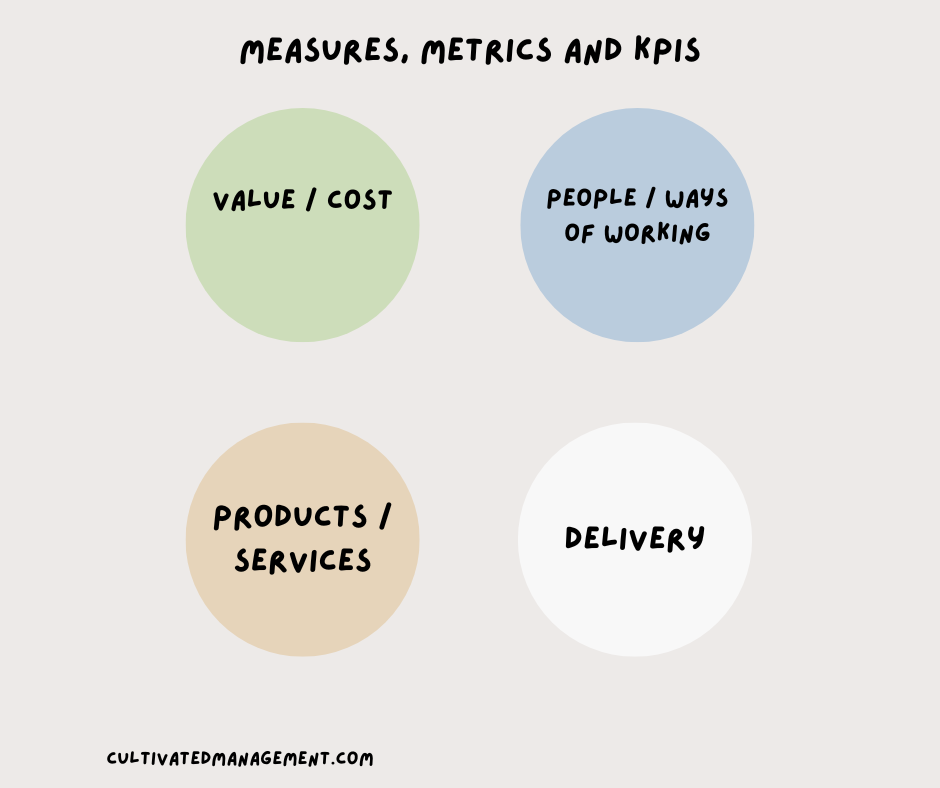
In practice, organisational measures cluster into four broad domains. Most organisations over-invest in some and neglect others.
Financial Value and Cost Financial value keeps the organisation alive. It is created outside the organisation —customers paying for something worth paying for.
Money is not the purpose of the work. It is the side-effect of doing work that matters.
But it is a necessary side-effect. Without financial value, the organisation cannot continue to exist, serve customers, or support its people.
Cost, by contrast, exists inside the organisation. Everything internal — people, processes, governance, tools — consumes resources and money.
This distinction matters.
Other forms of value matter too: cost reduction, enablement, and experiments that expand future possibility. These forms of value often precede financial return. But financial value remains the primary constraint. It is the oxygen that allows everything else to continue.
Tracking value and costs over time reveals whether the organisation is creating things worth paying for —or merely staying busy.
Products and Services Every organisation produces something, even if it is intangible.
Measures here signal reliability, usability, stability, and customer experience.
They tell you whether the thing you are making is fit for purpose.
People This is the most neglected category.
People are the system that creates value, yet their experience is often treated as secondary or anecdotal.
Measures here are often qualitative — morale, learning, retention, growth.
Ignoring them is a long-term strategic risk.
Delivery Delivery measures reveal flow.
They show how smoothly ideas become valuable outcomes.
Cycle time, delays, and blockers surface friction that often hides beneath status reports and dashboards.
The four measures I lean in to
Measures as Insight, Not Control
Measures shape behaviour. This is their quiet power — and their danger.
Used well, they illuminate reality and guide decisions to make things better. Used poorly, they become instruments of control that distort behaviour, incentivise gaming, and erode trust.
Every measure has a cost: defining it, collecting it, storing it, interpreting it. Measurement itself consumes attention and energy.
The discipline, then, is restraint — measuring what matters, not what is easy.
Trends matter more than snapshots. Patterns reveal systems. Single numbers rarely do.
The Quiet Discipline of Measurement
Measurement is not neutral. It expresses what an organisation values.
If you measure only delivery, people optimise speed and getting things done. If you measure only cost, people optimise cheapness. If you measure only output, people optimise activity. If you measure people, product, value, and delivery together, you begin to see the system.
Clarity emerges not from more dashboards, but from fewer, better questions.
Explore the work
This piece forms part of Cultivated’s wider body of work on how ideas become valuable, and how better work is built.
To explore further:
→ Library — a curated collection of long-form essays → Ideas — developing thoughts and shorter writing → Learn — practical guides and tools from across the work → Work with us — thoughtful partnership for teams and organisations
The link has been copied!
Your link has expired. Please request a new one.
Your link has expired. Please request a new one.
Your link has expired. Please request a new one.
Great! You've successfully signed up.
Great! You've successfully signed up.
Welcome back! You've successfully signed in.
Success! You now have access to additional content.