Backcasting: Turning Imagined Futures into Momentum
Most organisations struggle not because they lack ambition, but because they cannot translate imagined futures into focused momentum. Backcasting offers a disciplined way to bridge that gap.
Backcasting: Turning Imagined Futures into Momentum
Editorial Note: This essay is part of the Cultivated canon exploring how organisations move from imagination to value. It examines future casting and backcasting not as planning techniques, but as leadership practices that convert clarity into momentum.
Backcasting: Turning Imagined Futures into Momentum
One of the hardest things for organisations to do is imagine a future — and then move towards it without losing energy, focus, or belief along the way.
Many teams can describe where they are. Fewer can articulate where they are going. Fewer still can explain how today’s work meaningfully connects to that future.
This is the gap future casting and backcasting are designed to close.
Not through optimism or slogans, but through disciplined imagination.
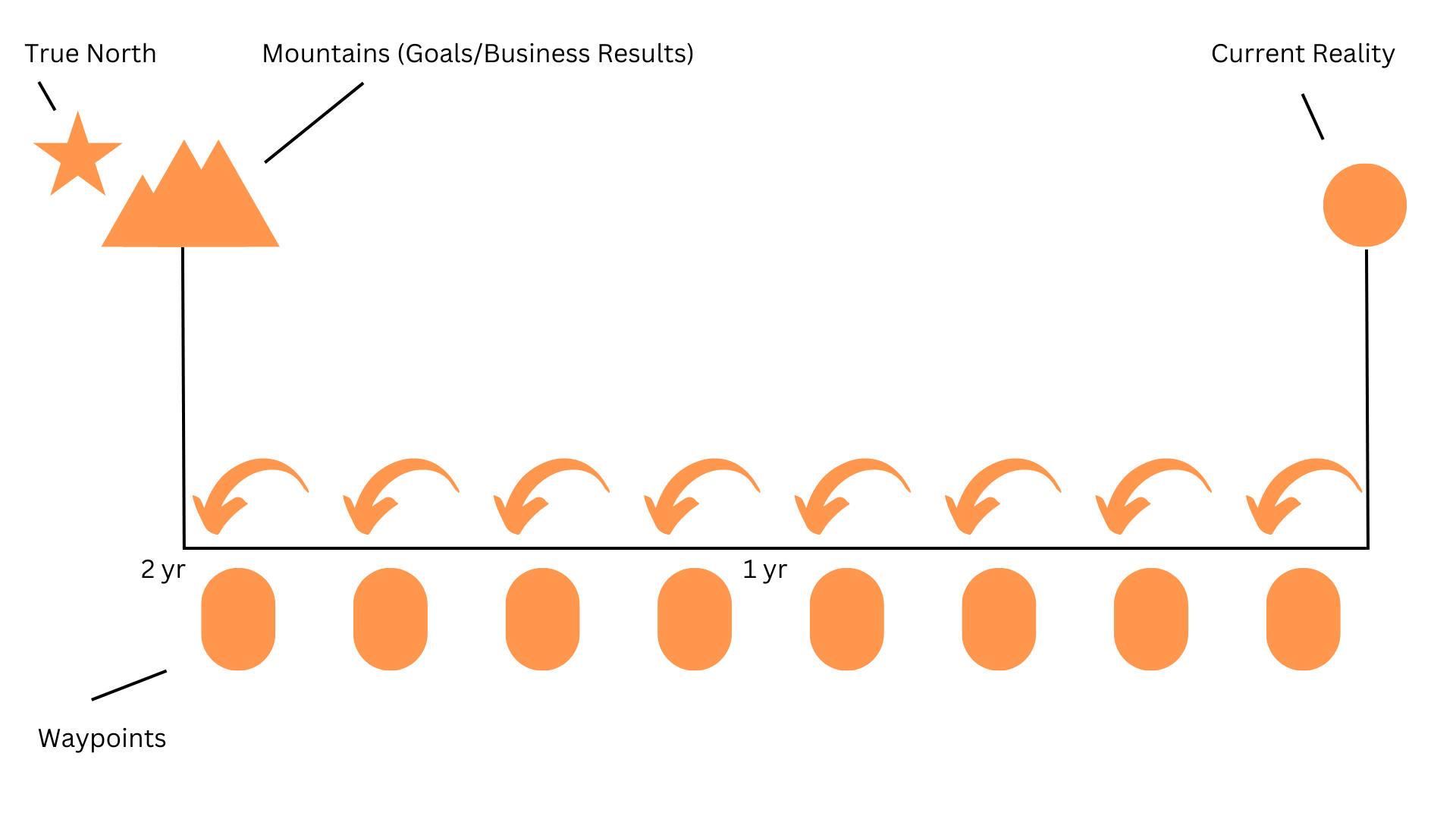
In leadership work, this is often referred to as True North — a clear sense of the value the organisation exists to create, how it will operate differently, and why that future is worth pursuing. At Cultivated, we call this the Painted Picture of the Future.
Crucially, this future needs form.
Words alone are rarely enough. Teams often make progress when the future is made tangible: drawn, built, mapped, turned into a story or physically represented. Not because it is decorative, but because abstraction dissolves commitment.
Alongside this future sit what I often describe as mountains — the outcomes that can realistically be reached along the way. These are not the ultimate destination, but meaningful elevations that move the organisation closer to it. You could consider these goals.
You may never fully reach this Painted Picture. That’s not the point.
What matters is that each mountain delivers real value and reinforces belief that progress is possible.
Backcasting: Working Backwards with Intent
Where traditional planning often moves forward from today, backcasting does the opposite.
It starts with the future — and works backwards.
The discipline here is important. Instead of asking, What can we do next?, teams ask, What would need to be true just before we reached this outcome?
By beginning at the last meaningful waypoint and working back toward current reality, teams escape the trap of incrementalism. They stop assuming the future will be achieved by simply doing more of the present.
Backcasting creates space for different answers.
Not more people. Not more money. But better decisions, removed constraints, and changed ways of working.
This is where agility becomes real.
From Waypoints to Momentum
Imagination without structure fades quickly.
Once future waypoints are identified, they need translating into something that can guide action without overwhelming the system. This is where constraint becomes helpful.
Limiting the number of initiatives forces choice. It exposes trade-offs. It makes stopping explicit.
Each period of time asks the same quiet questions:
What matters most now?
What, if improved, would unlock progress?
What must stop to make this possible?
Momentum is not created by activity. It is created by focus sustained over time.
Leadership, Communication, and Capacity
Backcasting fails when it is treated as an exercise rather than a commitment.
Leaders play a critical role here — not by controlling the plan, but by protecting it. That means:
making ownership visible
ensuring progress is discussed honestly
communicating why priorities exist
and removing work that competes with what matters most
Without this, plans become performative. Progress looks green on paper while remaining fragile in reality.
It works just as well in personal life — where imagined futures often feel distant, overwhelming, or vague. By identifying nearer mountains and working backwards, change becomes navigable.
The same principle applies: clarity creates alignment, alignment creates momentum, and momentum is how value — personal or organisational — is realised.
Backcasting is not about predicting the future.
It is about choosing one — and then doing the disciplined work required to move toward it.
Not perfectly. Not linearly. But deliberately.
That is how imagined futures become lived reality.
An example diagram of backcasting - start with the future and work backwards
Explore the work
This piece forms part of Cultivated’s wider body of work on how ideas become valuable, and how better work is built.
To explore further:
→ Library — a curated collection of long-form essays → Ideas — developing thoughts and shorter writing → Learn — practical guides and tools from across the work → Work with us — thoughtful partnership for teams and organisations
The link has been copied!
Your link has expired. Please request a new one.
Your link has expired. Please request a new one.
Your link has expired. Please request a new one.
Great! You've successfully signed up.
Great! You've successfully signed up.
Welcome back! You've successfully signed in.
Success! You now have access to additional content.