A podcast is the whole system in miniature
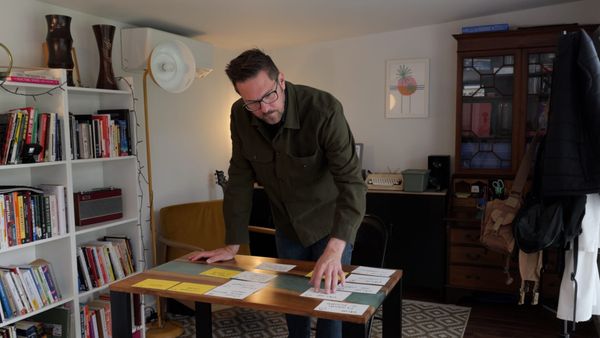
I was in a room of small business owners when one of them asked me to explain how ideas become value.


I was in a room of small business owners. During the break I'd been talking with one of them about how ideas become value, and he asked me to get up and share it — to help the others see their own businesses through the same lens.
It's a harder ask than it sounds. Most of my work has been in large corporates and tech startups, and this room was chefs, marketing people, a writer and a dozen other trades besides. One system, all these different businesses. So I reached for the thing I most love doing, and know from the inside: podcasting.
What that conversation left out was the sheer complexity of larger companies — the politics, the confusion, the duplicated work, the governance, the competing priorities at scale, the slow movement of change. Not flaws, just the economics of being big. The wider set of principles covers much of that for companies of all sizes, and I didn't have time for those. So I showed them something smaller and complete: how the same system produces a podcast. The principles travel well.
Editor's note — where this sits
This one is tactical — the system at its smallest. Rather than a large company, I use something I make with my own hands: a podcast, from first idea to finished episode. It sits in the Physics layer of the Idea to Value system — how ideas move to value, the gap between the two, and the cost of crossing it. The example is small; the principle is the same at any size.
The Idea to Value system — five layers
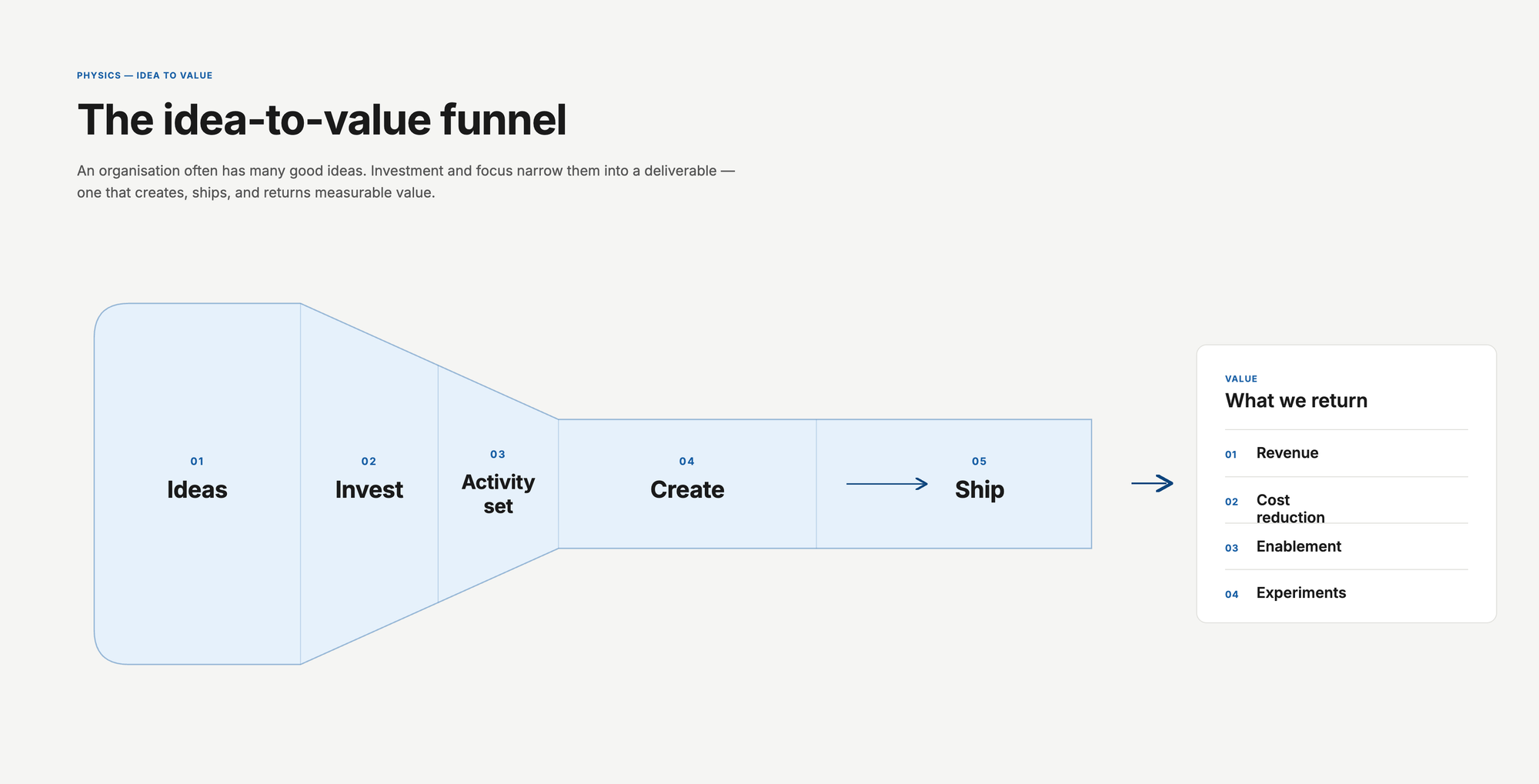
How an idea moves to value
An idea emerges in someone's mind — always. A seed that takes root and takes hold until you can see some value attached to it. In personal work that value might be intrinsic, the love of the thing itself, and that counts. But most ideas in a business are seeds pointing at one of four kinds of value: financial (revenue, money coming in), enablement (compliance, legal, operational), cost reduction (doing the work more efficiently), or learning (insight and data you didn't have before).
Then we invest — and not only money, but people's time, energy and attention, the finite resources we can never buy back once they're spent.
Then we give the idea some shape. Sketches, models, plans, task lists, roadmaps — what I call activity sets. It's easy to get stuck here, admiring an idea's potential without ever making it. Sometimes though, the idea needs a small investment of time just to noodle with it, sketch, play with it a little more, mash it together with other ideas – to see what it might become. The value here is learning. This is a micro version of idea to value – to spend time with the idea to learn more about it.
Making it is what comes next: creative action, the human work of turning the idea into something real and tangible, typically learning how to make the thing and feeding that back into the activity sets and future decisions.
Then we ship — one big release or in increments, that's contextual to your business, but we don't generate value often unless we put something out there, or in hands of those who will use it, or into the market. Though it's worth saying you can ship something and still generate no value at all.
And then, if we've shaped it well, the value arrives. Underneath all of it, ideally, people grow — they learn, they develop, they find meaning in the work. This isn't a system built to worship speed and cost reduction. It's a way to see how an idea changes shape on its way to value, and to weigh whether being part of that is worth it. At heart it is a human system, built to see potential released — not activity for its own sake.
The same system, applied to a podcast
Now to the podcast. I'll use my own numbers.
When I started, it went like this. I'd have an idea for an episode and sit with it a while to work out what it wanted to be. I capture every idea, review them, and choose the ones worth pursuing — a hopper of seeds. Deciding to make one was the investment: yes, this is the idea I'll turn into a cast.
My activity set is a simple Apple Notes checklist — a list of tasks (record, edit, artwork, upload, test, embed, share) and a rough podcast episode frame giving each episode a beginning, middle and end, so it had some structure.
Then the creative action. I'd write the script, refine it, fix what needed fixing, and get it ready. Then record — usually making a mess of it in GarageBand and going again until it cleared my own bar for what good sounds like. Then edit, edit again, export, upload to Transistor.fm (my hosting platform), add the artwork, write the blurb, add the tags. Then publish, share, embed here on Cultivated.
In the early days, the value is learning
At that point the podcast had shipped, out into the world. For anyone starting out, the value isn't financial — there's no money coming in yet. The value is learning: you are learning how to make a good podcast. And since this was a business audience rather than a hobby room, that matters. In the early life of a business, before revenue, the value you're usually generating is learning. Learning what works and what doesn't, what the market wants, what parts of the work you enjoy, or don't — and, most of all, learning how to shrink the distance between having an idea and turning it into value.
That's exactly what happened. I got better at recording and editing. I refined the task list and the episode structure. I learned the tools properly. I used snippets and Ghost elements to make the site cleaner and adding audio easier.
At the start, a single episode took two to three days, idea to value — and in those early days the value was the learning itself. Within a few weeks I had it down to about a day.
Everything in between is cost
Everything between the idea and the value is cost. Mostly time, energy and attention when you're making a podcast — but also the money you didn't earn doing something else, and, in a business, the salaries and overheads sitting underneath. You can't remove cost entirely; to make anything you have to spend something. The goal is only to reduce the cost of reaching the value — never by dropping the quality, cutting corners, or burning people out. Knowing what good looks like, what risks you'll accept, and what it means to ship something that matters — that is what holds you to a standard and gives you edges to work within.
You could hand the whole thing to AI, keep none of the original thought, none of your personality, none of your own voice, and ship it anyway. That still costs something. And it rarely leads to the value you actually wanted. By now, though, I understood the work well enough to ask two questions at once: could I shrink the gap further, and could I raise the quality? Both, it turned out.
Where AI comes in
Here's the line I hold. The parts that are mine stay mine — the ideas, the judgement, the voice. What I hand off is the admin between the idea and the finished cast.
I still generate every idea; I always have and always will. But I now use AI for the research, working across Claude and ChatGPT and checking one against the other so it's solid — with the citations it drew from.
I write the outline now rather than the whole script, trusting myself to flow through the recording. I do a quick pass in GarageBand for mistakes and retakes. I export the audio and run it through Auphonic (AI), which trims the breaths, gaps and noise and normalises it to production quality — something I never used to do because I didn't know how. It hands me back my cast, sounding better than it went in.
I upload to Transistor, save a draft, and use their AI to transcribe it. I feed that transcript to Claude, which drafts a summary in my tone of voice, plus the SEO details and tags. Then I edit it — sometimes lightly, sometimes heavily — and drop it into the hosting fields. Then it ships, and I embed it on the site.
I could automate the uploading and embedding too. I don't, because it's my work, my brand, my voice, and I want my hands on it.
That process now takes about three hours.
Two to three days, to a day, to three hours. But let's be careful before calling that simply "less cost". The AI in Transistor and Claude isn't free — there's an ongoing bill. What has really happened is a trade: I've spent a little money to buy back a lot of my own time, and that time now goes into other work. The saving is real, but it's a shift, not a disappearance. And notice what I protected in the trade — the ideas, the words, the voice. It is still entirely my podcast. What I optimised was only the admin between the idea and the podcast reaching the world.
The physics — from idea to value
2–3 days → ~1 day → ~3 hours
The stages never disappear. The cost between idea and value does.
The same principle in every business
Some gaps we narrow through learning, personal growth, coaching and mentoring. Some we narrow by standardising how work gets done — putting the organisation's philosophy and brand into consistent editorial guidelines and the structure of the work. Some we narrow with technology, AI and automation doing the repetitive work that quietly eats time. And running through all of it is the human learning that returns every time we do anything, and especially every time we ship: we find out what resonated, what worked, and what value we actually made.
That was what I showed them — a single funnel, an idea changing shape until it becomes value, and how at almost every stage there is a chance to see, to truly notice, how the idea is moving, and to step in wherever it makes sense for your business.
The conversations afterwards were the best part. Small business owners know instinctively that everything between an idea and its value is cost, and that naming the value you're chasing is essential before you can join the dots. What they often lack is a way to see it. This group has one now.
And yes — a podcast is simple next to managing dependencies between teams, customer interruptions, and the politics, relationships and competing goals that live in every company. But ideas aren't value on their own. Value doesn't arrive cleanly unless it is shaped. And everything between the good idea and the value is cost. Seeing that gap — the idea, the work, and the ways to help it on its way — is the work of everyone in the business. Creating the conditions for people to carry that work with meaning is the work of leadership.
There's a video that goes with this piece, on Creative Soul Projects. Same person, same observation — just followed on camera instead of on the page.
Take this further with Cultivated
The Idea to Value system
Guidebook & self-paced course
The whole funnel, written down. How ideas move to value, what the gap costs, and how to read where your own work is flowing and where it's slowing.
Guidebook £19.99 · Course £29.99
Explore the system →From idea to sustainable work
Guide · for solo makers & small businesses
Written for people turning their own ideas into work that lasts — moving from idea to value without burning out, or losing the thing that made it yours.
£9.99
Get the guide →