On Music, Work, and the Shape of Attention
Music reliably helps with mood and stress at work. Its effect on performance is task-dependent and personality-dependent. What the research says — and what I actually do.


What the Research Actually Says — and Why It Is Messier Than You Would Hope
Listening to music while I work has been a lifelong habit. Not during meetings, not on video calls — but always during deep, solitary work. I assumed it helped. It felt like it did. It lifted my mood, softened stress, made long stretches of thinking feel possible.
But I kept wondering whether that was preference or something deeper. So I started paying attention. Reading. Testing it on myself.
The research is large, varied, and genuinely untidy. Which turns out to be the most honest and useful thing to say about it.
What the research actually says — and why it is messier than you would hope
A lot of modern work is cognitively demanding and emotionally loaded. Deadlines, ambiguity, constant switching, pressure without pause. Against that backdrop, music often acts less like a productivity tool and more like a regulator — a way to steady the nervous system, create a container for attention, and soften the edges of a demanding day.
The research on mood and wellbeing is the most consistent. Studies show that patients with major depression who listened to their own choice of music for two weeks showed significant improvements in mood — and the effect was cumulative, building over time rather than peaking immediately.
Music therapy has also been shown to reduce pre-operative anxiety, with classical and meditative music showing the strongest effects. A meta-analysis found that music can meaningfully alleviate pain in medical settings. Another found that listening to any genre of music increases immunoglobulin A — the antibody linked to immune function.
None of this is a productivity hack. It is evidence that music has genuine physiological and psychological effects. That alone matters — particularly in workplaces where the human cost of sustained pressure is poorly understood and rarely addressed.
The performance research is where things get complicated. Some studies find that music through headphones boosts productivity and improves mood, turnover intentions, and satisfaction — with relaxation emerging as the key mechanism. The effect was strongest in relatively simple, repetitive jobs.
One study found that employees who took a break and danced to music subsequently performed better in their roles — and dance outperformed stretching alone. These findings are real, if limited.
But others show no improvement at all.
A study of workers in a skateboard factory found zero performance increase when music was introduced — though attitudes toward the music were positive. And one study found that introverts experienced significantly worse recall when music was present compared to silence, while extraverts also performed worse but less dramatically. The researchers concluded that for deep comprehension tasks — reading, studying, trying to understand something new — silence is likely the better choice, particularly for introverts.
There is also the rhythm finding, which I keep returning to. Research showed that it was rhythm specifically — not music — that improved memory recall. When information was embedded in a rhythm, with or without accompanying music, people remembered it better. This may explain why poems, rhyming sentences, mnemonics, and flowing stories are effective communication and teaching tools. The pattern matters as much as the sound.
The summary is not tidy: music reliably helps with mood, stress, and pain. Its effect on performance is task-dependent and personality-dependent. And silence has a role — a more important one than most open-plan offices acknowledge.
The keynote
Years ago I was delivering a major keynote and I knew something was wrong. The night before, in a hotel room in Romania, pacing back and forth, I could not work out what the problem was. But I knew something did not work. Panic was rising. Thinking was narrowing. I considered going home. I considered going to the bar. Neither felt right.
Instead I opened a binaural beats app, put on low-fi beta beats, and found a bench outside in the hotel grounds. The science on binaural beats specifically is not strong — I am not making a claim for it. But sitting in the dark with something rhythmic in my ears, the panic dropped to something more manageable. A low level irritability rather than genuine alarm. I tuned into the environment. I stayed with the beats. My thinking began to move again.
I went back to the room, opened the talk, and asked the harder questions. What is this actually about? What does it not need? It came to me. I deleted an entire section — that was the problem, I had been trying to cover too much — read through it several times, and slept reasonably well.
The talk won best presentation at the conference. It has been delivered around the world since.
Music did not solve the problem. But it changed my state enough that I could. That is not a performance claim. It is a human one.
What I actually do
Over many years of paying attention to this, I have arrived at a few personal patterns that seem to hold.
When I am writing, sketching, or connecting ideas — music opens something. Not lyrical music, not anything that demands attention. Rhythm, texture, flow. Instrumental hip hop, jazz, funk, acid jazz. Things that create a container without competing for the same cognitive space as the words.
When I am studying — actually studying, reading slowly, trying to understand something new — silence. The material needs to land without competition. The research on introverts and recall supports what I noticed about myself long before I read it.
When I need an energy shift, I use music as a state-change tool rather than a background one. Hip hop for creativity. Classical for focus. Heavy metal for exercise. Lo-fi beats for stress management and, occasionally, for pain. And music tied to memory — specific artists from my past — to access a version of myself that felt more capable, more open, or simply younger.
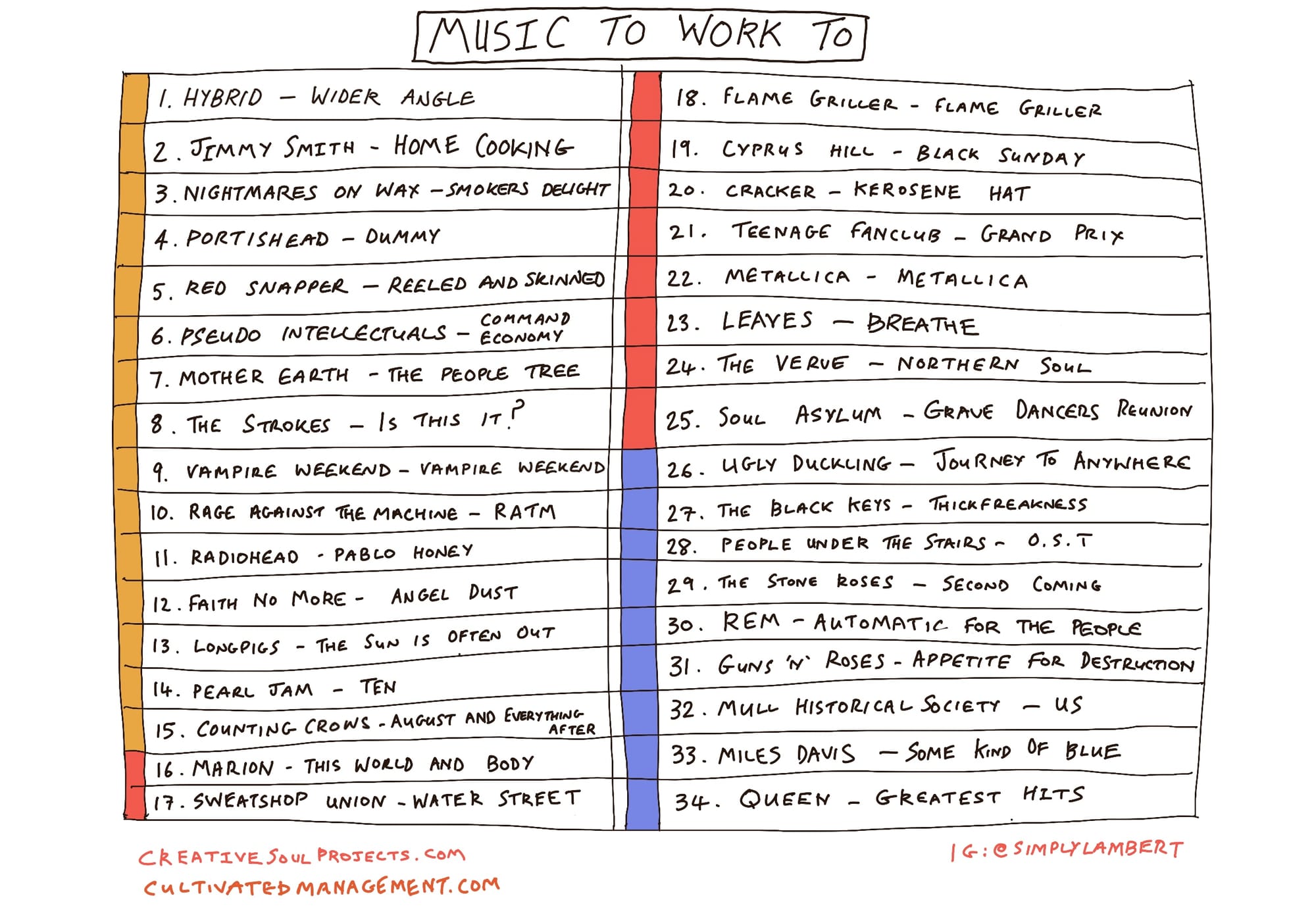
What has not worked for me: broadcast music in open offices, where the genre is chosen by whoever controls the speaker and everyone else absorbs it regardless of what they need. The research supports individual listening through headphones rather than ambient sound — partly because the effect is more direct, and partly because any team that has tried to agree on a shared playlist will understand immediately why that cannot scale.
What this means for organisations
The most practical implication of all this is straightforward: let people choose.
Music through headphones for those who want it. Silence for those who need it. No broadcast soundtracks. No forced focus playlists. Decent headphones provided — which is a lower-cost investment than most organisations spend on a single catered meeting, yet routinely refused.
Attention is personal. Rhythm is personal. What steadies one person distracts another. And the people best placed to know which they need in any given moment are the people doing the work, not the people designing the office.
Music, for me, is not a productivity tool. It is a companion — a way of shaping the internal environment in which thinking happens. In a working world that is increasingly abstract, pressured, and cognitively heavy, that feels like something worth protecting. Not to make us faster. But to help us stay human while we work.
From the Cultivated library — take this further
The Creativity of Constraints
Interactive workshop · Co-facilitated
Music shapes the internal environment for thinking. The Creativity of Constraints workshop explores the external conditions — constraints, structure, and permission — that allow creative thinking to emerge at a team level.
2–3 hour interactive session
Explore the workshop →10 Behaviours of Effective Employees
Free eBook · Coaching guide · Digital
Managing your own attention, energy, and working environment is one of the behaviours that compounds into effectiveness over time. This free guide maps all ten — including the environmental and personal disciplines explored here.
Free to start
Get the free eBook →Resources
If you need some help with low mood, depression and anxiety here are some resources:
👉 Mind.Org have a big list of helpful resources, support lines and advice.
👉 CALM - Campaign Against Living Miserably
👉 NHS iTalk
👉 Shout
Bibliography
[1] S. Tottle, ‘Dropping like flies: the rise of workplace burnout and how to tackle it’, The Conversation. Accessed: July 18, 2024. [Online]. Available: http://theconversation.com/dropping-like-flies-the-rise-of-workplace-burnout-and-how-to-tackle-it-67494
[2] ‘Listen while you work? Quasi-experimental relations between personal-stereo headset use and employee work responses.’. Accessed: July 18, 2024. [Online]. Available: https://psycnet.apa.org/buy/1996-93458-001
[3] J. Hutabarat, S. Soeparman, P. Pratikto, and P. B. Santoso, ‘Influence of Singing Dancing During a Rest Break Towards Productivity and Product Quality’, World Applied Sciences Journal, pp. 1239–1250, 2013, doi: 10/influent%2520singing.pdf.
[4] A. Furnham and A. Bradley, ‘Music while you work: the differential distraction of background music on the cognitive test performance of introverts and extraverts’, Applied Cognitive Psychology, vol. 11, no. 5, pp. 445–455, 1997, doi: 10.1002/(SICI)1099-0720(199710)11:5%3C445::AID-ACP472%3E3.0.CO;2-R.
[5] J. H. , ‘The Effects of Music on Pain: A Meta-Analysis’, Journal of Music Therapy, vol. 53, no. 4, pp. 430–477, Dec. 2016, doi: 10.1093/jmt/thw012.
[6] D. Fancourt, A. Ockelford, and A. Belai, ‘The psychoneuroimmunological effects of music: A systematic review and a new model’, Brain, Behavior, and Immunity, vol. 36, pp. 15–26, Feb. 2014, doi: 10.1016/j.bbi.2013.10.014.
[7] H.-J. Trappe, ‘The effects of music on the cardiovascular system and cardiovascular health’, Heart, vol. 96, no. 23, pp. 1868–1871, Dec. 2010, doi: 10.1136/hrt.2010.209858.
[8] G. Schlaug, A. Norton, K. Overy, and E. Winner, ‘Effects of Music Training on the Child’s Brain and Cognitive Development’, Annals of the New York Academy of Sciences, vol. 1060, no. 1, pp. 219–230, 2005, doi: 10.1196/annals.1360.015.
[9] S. Vanderark, I. Newman, and S. Bell, ‘The Effects of Music Participation on Quality of Life of the Elderly’, Music Therapy, vol. 3, no. 1, pp. 71–81, Jan. 1983, doi: 10.1093/mt/3.1.71.
[10] P. Purnell-Webb and C. P. Speelman, ‘Effects of Music on Memory for Text’, Percept Mot Skills, vol. 106, no. 3, pp. 927–957, June 2008, doi: 10.2466/pms.106.3.927-957.
[11] W.-C. Hsu and H.-L. Lai, ‘Effects of music on major depression in psychiatric inpatients’, Archives of Psychiatric Nursing, vol. 18, no. 5, pp. 193–199, Oct. 2004, doi: 10.1016/j.apnu.2004.07.007.
[12] S. E. Schwartz, B. Fernhall, and S. A. Plowman, ‘Effects of Music on Exercise Performance’, Journal of Cardiopulmonary Rehabilitation and Prevention, vol. 10, no. 9, p. 312, Sept. 1990.
[13] R. I. Newman Jr., D. L. Hunt, and F. Rhodes, ‘Effects of music on employee attitude and productivity in a skateboard factory’, Journal of Applied Psychology, vol. 50, no. 6, pp. 493–496, 1966, doi: 10.1037/h0024046.
[14] N. Kahar et al., ‘Perceptions of Music and its Effect on the Productivity of Students’, ASEAN Journal of Educational Research and Technology, vol. 3, no. 1, Art. no. 1, 2024.
[15] Schoenwald, Kyle ‘Music in the Workplace Environment and Productivity - ProQuest’. Accessed: July 18, 2024. [Online]. Available: https://www.proquest.com/openview/015f705e41066bc680df9aa0489e7010/1?pq-origsite=gscholar&cbl=18750&diss=y