The sound of thinking
A practical guide to using sound while you work — and knowing when to switch it off.

Updated 25th August 2025. Tidied references. Added new atlas location.
What the research actually says – and how to use music while you work
I have spent most of my working life with music playing. Not in meetings, obviously. There are limits to professionalism. But when I’m alone, writing, thinking, editing, working on a client's problem, staring at a visual that has somehow become a personal nemesis – there is usually something playing in the background.
I always assumed it helped. This is a dangerous sentence, because it feels like it helps is one of the main pieces of evidence we routinely accept without actually having any evidence at all.
So I started looking at the research.
The answer, rather pleasingly for me, is much less tidy than the advice you usually get. Music can improve mood, reduce stress and even change our experience of pain. But whether it improves performance is a different question entirely. It depends on the task, the music, the person, and apparently how much of your brain you are asking to do something difficult at the same time.
Sometimes music helps you work. Sometimes it gets in the way. And sometimes the best thing you can do is turn the music off and sit in silence.
What follows is a practical guide to what the evidence actually says, alongside what I’ve learned from paying rather more attention to my own brain than was probably needed. The studies are at the end, partly for completeness and partly because there is no better way to ruin a good opinion than to discover the evidence disagrees with you.
A hotel bench in Romania
A few years ago I was delivering a major keynote in Romania, and the night before, pacing the hotel room, sipping local beer, eating random crisps, I knew something was wrong with it. I couldn't work out what. The panic set in: thinking narrowing, the walls coming in a little, the voice in my head telling me it wouldn't go well. I considered going home. I considered the bar. Neither was a real option – I was in Romania, and both roads led somewhere I didn't want to go. Not when I had committed to delivering a keynote worth listening to.
Instead I opened a binaural beats app on my phone, put on some low, rhythmic beta beats, and found a bench in the dark of the hotel grounds. I'll be honest with you: the science on binaural beats specifically isn't strong, and I'm not making a claim for them. But sitting outside with something calming in my ears, the panic dropped to a manageable, low-grade irritation that I could work with. I tuned into the cold and the quiet and watched people go by. My thinking began to clear again, then move again.
I went back up, opened the talk, and asked it the harder questions. What is this actually about? What does it not need? There it was – I'd been trying to cover far too much. I cut an entire section, read the rest through a few times, and slept. The talk went on to win best presentation at the conference, and I've delivered it around the world since. (If wrestling a talk into shape is your problem too, that's the whole subject of Zero to Keynote.)
The music didn't fix the talk. It changed my state enough that I could fix it. That's not a performance claim – it's a human one, and it's the distinction the rest of this guide keeps coming back to. Music, it turns out, is a very human experience.
Mood, stress and pain – the strong evidence
If there's one place the research is close to settled and agreed, it's here.
Patients with major depression who listened to their own choice of music for two weeks showed significant improvements in mood – and the effect was cumulative, meaning the more they listened, the more positive effect it had over the fortnight (Hsu and Lai, 2004). The compounding is the interesting part: this behaves less like a pick-me-up and more like cultivating the right climate.
Music therapy has also been shown to reduce anxiety before surgery, with classical and meditative music doing the work. Worth one caveat that I enjoy more than I should: in the same cardiovascular research, heavy metal and techno were not merely unhelpful but associated with a raised risk of dangerous heart rhythms (Trappe, 2010). Genre, it turns out, is not a small detail in this research.
On pain, a meta-analysis – a study of many other studies – found that music can meaningfully relieve pain in medical settings, enough that the authors recommend it as a complementary tool for clinical staff (Lee, 2016). I have my own small evidence here. I used to get furious migraines that wiped out whole days, and somewhere along the way, through plenty of trial and painful error, I found that lying in the dark with music playing, describing the pain to myself in terms of its colour and size and breathing slowly through it, took the edge off. It sounds counterintuitive. It helped.
And there's a subtler finding: listening to music of any genre has been shown to raise levels of immunoglobulin A, an antibody tied to immune function (Fancourt, Ockelford and Belai, 2014). None of this is a productivity hack. It's evidence that music does real physiological and psychological work – which matters most in exactly the settings where the human cost of sustained pressure often goes unnoticed.
Performance – the messy middle
This is where the tidy story and science falls apart, and where most of the confident advice you've read ignores half the evidence.
Some of it points one way. Listening through headphones has been found to improve performance, mood and satisfaction, with relaxation identified as the mechanism doing the hard work here – and the effect strongest in relatively simple, repetitive work (Schoenwald, n.d.). The author's practical recommendation is one I'd happily underline twice and suggest to every single CEO: give people a decent pair of headphones and let those who want to listen, listen.
Separately, workers who took a short break and danced to music went back and performed better. Dancing to music also beat stretching and other relaxation efforts (Hutabarat et al., 2013). Real, if modest. And precisely why, in Zero to Keynote, when you're nervous before a talk, I recommend pulling funny faces to yourself in a mirror, listening to music, getting up and around, and watching something that makes you laugh. Likely a similar mechanism.
And then the other way. When music was introduced in a skateboard factory, the improvement in performance was exactly zero – though the workers rather liked having it on, which is worth something on its own (Newman et al., 1966). Music playing during exercise did nothing for running performance either; the researchers concluded it simply wasn't a factor (Schwartz et al., 1990).
So the summary won't sit neatly in a box. Some tasks and some people respond; others don't; and where music does help, the genre it helps with tends to be the calm, instrumental end – classical, jazz, relaxed beats – rather than anything loud or lyric-heavy. My own tip is the unglamorous but effective one: try it, notice it, and match the sound to the task rather than to your mood.
Learning and comprehension – where silence often wins
Now the finding most likely to annoy the person who studies with a playlist on. Like my sons.
When people were set to read text and memorise objects, both introverts and extraverts recalled less with music playing than in silence – and for introverts the drop was steep (Kahar et al., 2024; and see Furnham and Bradley, 1997, on the same split). For deep comprehension – reading slowly, studying, trying to understand something genuinely new – silence is the safer bet, and more so if you lean introvert. I noticed this about myself years before I read the research: when the material has to land, competition for the same part of the mind is the last thing I want.
Then there's the finding I think reframes how we use music and learning. It was rhythm, specifically – not music – that improved memory for text. When information was set into a rhythm, with or without music behind it, people remembered it better (Purnell-Webb and Speelman, 2008). That single result likely explains poems, rhyming couplets, mnemonics, the flowing shape of a good story: the pattern carries the meaning. The sound is optional; the rhythm is not.
One aside for the ambitious, and a positive and hopeful one: children who learn a musical instrument show long-term gains in visual-spatial, verbal and mathematical ability (Schlaug et al., 2005). It is never too late to pick one up.
What to actually do
Here's what I've settled on after years of paying attention. None of it is prescription, rather a starting grid, and overwrite it with what you notice about yourself.
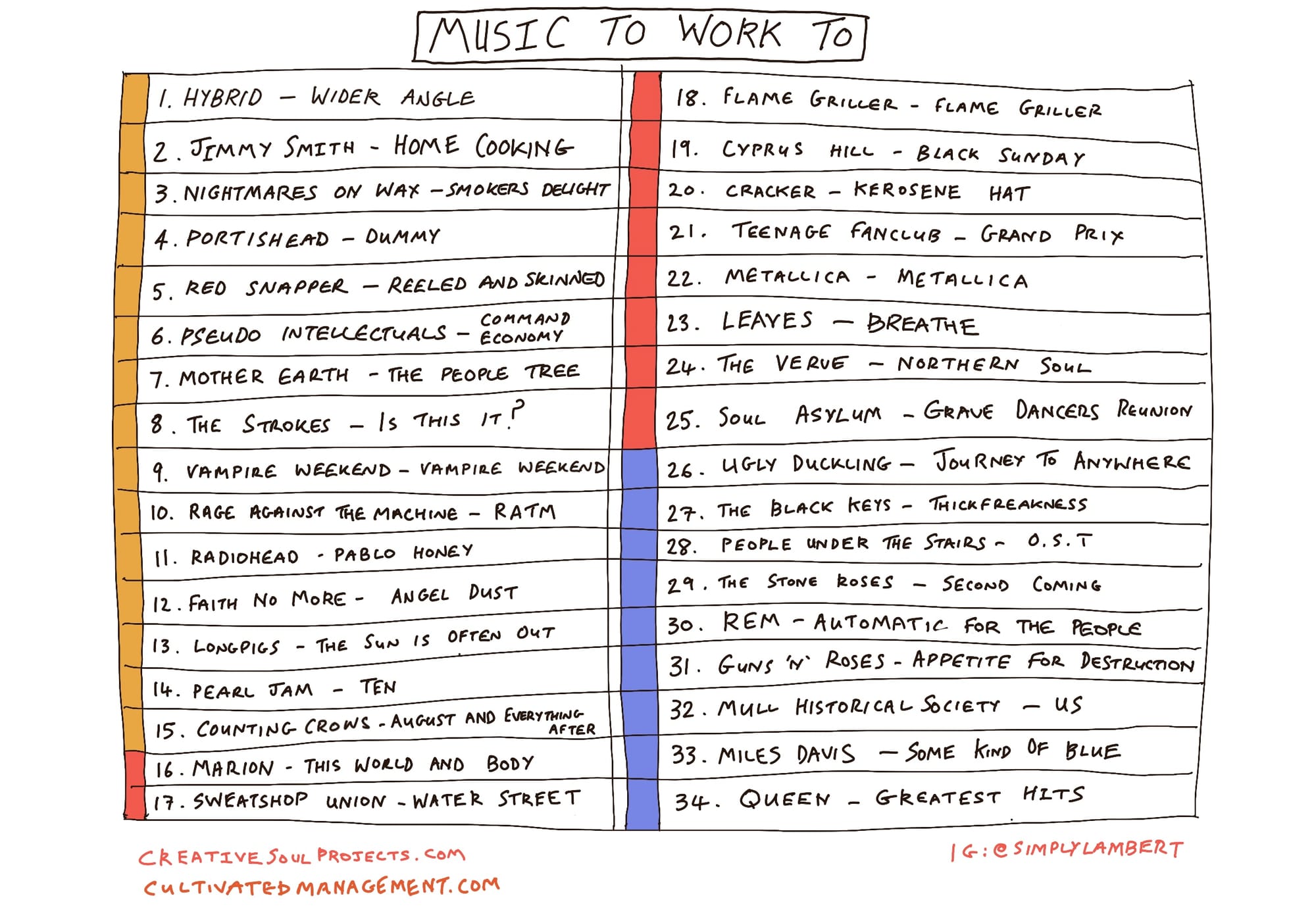
When you're writing, sketching or connecting ideas, reach for music with no words. Not anything that demands attention – rhythm, texture, flow. Instrumental hip hop, jazz, funk, acid jazz. The job is to build a container for thinking without competing for the same cognitive space as the words themselves. In my own work I always listen to two albums on repeat; Wider Angle by Hybrid and Home Cookin' by Jimmy Smith. Both are light on lyrics and heavy on rhythm.
When you're studying – like properly studying, reading slowly to understand – sit in silence. Let the material land without a rival fighting in your mind. The research on introverts and recall simply confirmed what my own attention had been telling me for a decade.
When you need to change state, use music deliberately rather than as background. I've written before about open and closed thinking. Closed for action and getting things done, open for wonder and creativity. But, getting into these states takes time. This is where I use music strategically to drop into the mode quicker.
Hip hop to open up creativity. Something calmer for focus. Loud rock for the gym. Lo-fi beats for stress, and occasionally for pain. And music tied to a specific time in my life – certain artists from years back – to reach a version of myself that felt more capable, or simply younger, and borrow a little of it for the afternoon. I even have a creative project around this very idea called Spaces Between The Songs, over on Creative Soul Projects.
In shared spaces, headphones win over broadcasts, every time. Here's the important point of the whole piece: attention is personal, and rhythm is personal – what steadies one person distracts another. Music piped through office speakers means one person's choice becomes everyone's climate, whether it suits their task or not.
Individual listening, through headphones, is both better supported by the evidence and easier for all involved. Anyone who has watched a team try to agree on a single playlist already understands why. When we had our house built, the builders had the classic-hits on, the painters had banging dance music, and the kitchen fitters had another station entirely – each to their own, and quite right too.
The one thing worth spending money on is the headphones. A decent pair costs less than a single catered lunch, and yet I've watched a company refuse to buy staff a headset good enough to take a call on. The kit here is trivially cheap. Withholding it is a strange economy of frugality that will not go unnoticed by your people.
Music as a companion, not a tool
For me, music is not a way to go faster. It's a door into another part of the mind – a way of shaping the inner environment in which thinking happens, and reaching rooms that would otherwise stay shut. Whether every effect is scientifically nailed down or not is not the point. The ones that matter to me work, and I've stopped needing them to be certified to trust my own experience.
In work that's increasingly abstract, pressured and heavy on the mind, that feels like something worth keeping – not to make us more productive, but to help us stay a bit more human while we think and work.
The research, in short
Large and genuinely untidy. Here's the honest summary across three areas.
Mood, stress and wellbeing – strong evidence. Music reduces anxiety, lifts mood in depression, relieves pain, and raises immune markers. The mood effect is cumulative, building over time. The most consistent finding in the literature. Music choice matters a lot though.
Performance – mixed evidence. Headphone listening helps in some studies, especially for simple, repetitive work, with relaxation as the mechanism; a dance in a break helps too. Other studies find no effect at all. Where it helps, the genre tends to be calm and instrumental rather than loud or lyrical.
Learning and comprehension – silence often wins. Both introverts and extraverts recall less with music than in silence, introverts markedly so; for deep reading and study, silence is the safer choice. And rhythm with or without music improves memory – the pattern matters as much as the sound.
The practical conclusion. Music through personal headphones, by individual choice, matched to the task. Silence for deep reading and study. No broadcast soundtracks. The person doing the work is best placed to know which they need.
Sources: Hsu & Lai (2004), Trappe (2010), Lee (2016), Fancourt et al. (2014), Schoenwald (n.d.), Hutabarat et al. (2013), Newman et al. (1966), Schwartz et al. (1990), Purnell-Webb & Speelman (2008), Kahar et al. (2024), Furnham & Bradley (1997), Schlaug et al. (2005). Full bibliography below.
A note on the harder days
This piece touches on low mood, anxiety and depression, and it's worth saying calmly: music is a companion for a difficult day, not a treatment for one. If you're having a hard time, these are good places to start.
- Mind — a large list of helplines, support and advice.
- CALM — Campaign Against Living Miserably
- NHS iTalk
- Shout
Where this sits in the Atlas
Orientation·Idea to Value·Communication·Creativity & Climate·Learning
Here's a fun diagram of the music I listen to whilst working, thinking, relaxing and creating.
Creative Soul Projects
There's a video that goes with this piece, on Creative Soul Projects. Same person, same observation — just followed on camera instead of on the page. Explore the channel.
Bibliography
Fancourt, D., Ockelford, A., Belai, A., 2014. The psychoneuroimmunological effects of music: a systematic review and a new model. Brain, Behavior, and Immunity 36, 15–26. https://doi.org/10.1016/j.bbi.2013.10.014
Furnham, A., Bradley, A., 1997. Music while you work: the differential distraction of background music on the cognitive test performance of introverts and extraverts. Applied Cognitive Psychology 11(5), 445–455.
Hsu, W.-C., Lai, H.-L., 2004. Effects of music on major depression in psychiatric inpatients. Archives of Psychiatric Nursing 18(5), 193–199. https://doi.org/10.1016/j.apnu.2004.07.007
Hutabarat, J., Soeparman, S., Pratikto, P., Santoso, P.B., 2013. Influence of singing dancing during a rest break towards productivity and product quality. World Applied Sciences Journal, 1239–1250.
Kahar, N., et al., 2024. Perceptions of music and its effect on the productivity of students. ASEAN Journal of Educational Research and Technology 3(1), 81–92.
Lee, J.H., 2016. The effects of music on pain: a meta-analysis. Journal of Music Therapy 53(4), 430–477. https://doi.org/10.1093/jmt/thw012
Newman, R.I. Jr., Hunt, D.L., Rhodes, F., 1966. Effects of music on employee attitude and productivity in a skateboard factory. Journal of Applied Psychology 50(6), 493–496. https://doi.org/10.1037/h0024046
Purnell-Webb, P., Speelman, C.P., 2008. Effects of music on memory for text. Perceptual and Motor Skills 106(3), 927–957. https://doi.org/10.2466/pms.106.3.927-957
Schlaug, G., Norton, A., Overy, K., Winner, E., 2005. Effects of music training on the child's brain and cognitive development. Annals of the New York Academy of Sciences 1060, 219–230. https://doi.org/10.1196/annals.1360.015
Schoenwald, K., n.d. Music in the workplace environment and productivity. Available at: https://www.proquest.com/openview/015f705e41066bc680df9aa0489e7010/
Schwartz, S.E., Fernhall, B., Plowman, S.A., 1990. Effects of music on exercise performance. Journal of Cardiopulmonary Rehabilitation and Prevention 10(9), 312.
Trappe, H.-J., 2010. The effects of music on the cardiovascular system and cardiovascular health. Heart 96(23), 1868–1871. https://doi.org/10.1136/hrt.2010.209858