It looks like it's been through a fire
My middle son apologised for his Christmas ornament before he'd even shown it to us - "it looks like it's been through a fire." I watch grown, capable adults do exactly the same thing in every workshop. On the very human fear of sharing what we make, and the only thing that softens it.

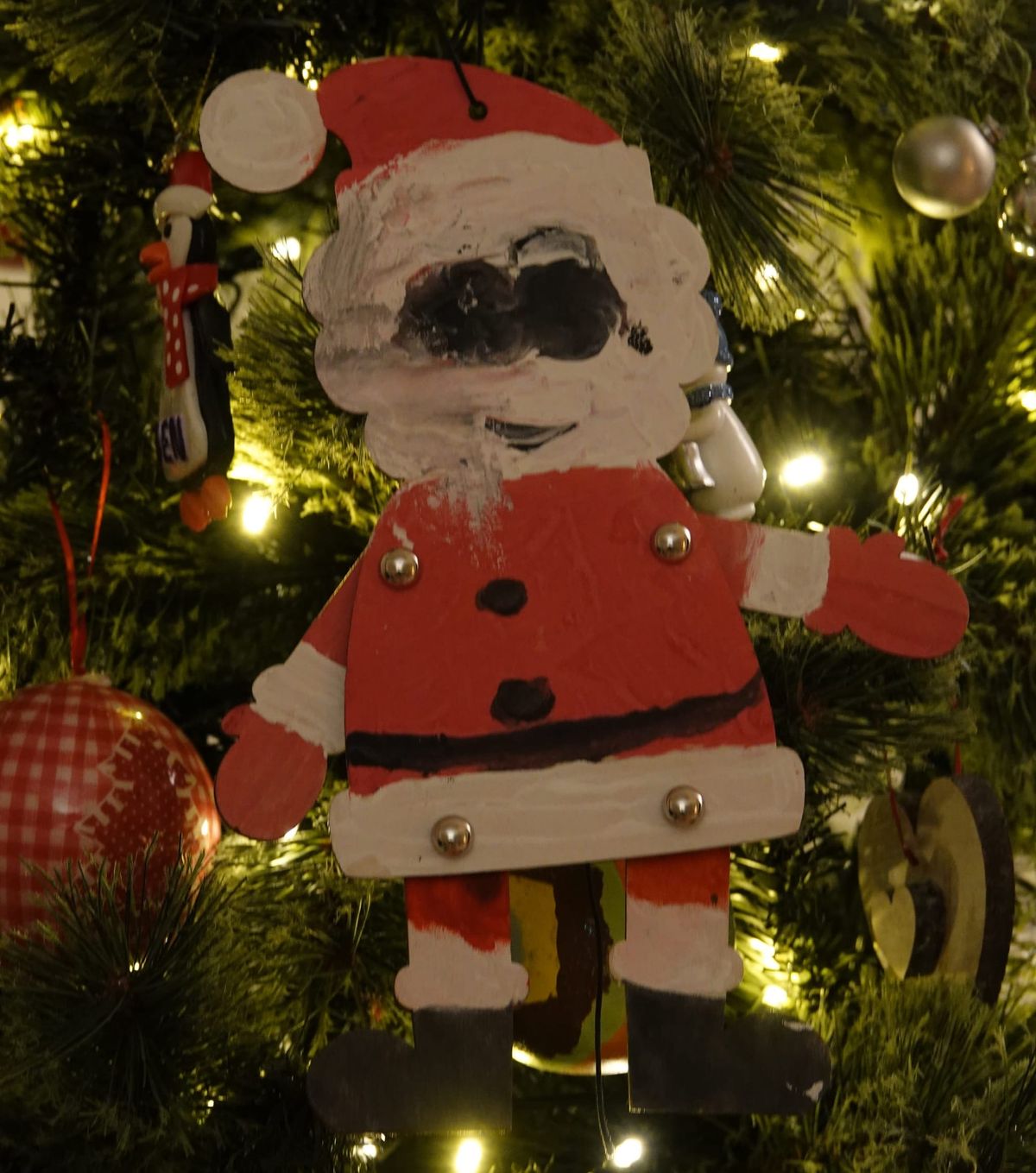
I'll never forget this moment. My youngest, home from school, rooting through his bag for the little Father Christmas ornament they'd been making that week. Before he'd even shown us what he'd made, he looked up and said,
"It's not very good. It looks like it's been through a fire."
I thought it was perfect. It went straight onto the tree, a great many photographs were taken, and we told him – truthfully – that it was exactly right. But I'll be honest: somewhere in that lovely moment I felt a small pang of having let him down.
Because I've spent most of my life, and most of my working life, being openly creative in front of my boys. Sharing the ideas, the thinking, the experiments that failed, the ones that came off, the books, the videos, the photographs, the writing. My three sons have built projects with me, wandered around taking photographs with me, told each other stories. Even the consulting work, underneath the suit of it all, is the creative act of having a good idea and turning it into something worth having for customers.
And I've never once hidden the obvious truth of creative work: it might not work. That's true of any creative work – including the work we've somehow convinced ourselves isn't creative at all, the ordinary work of the office.
So what on earth had happened? Why was he apologising before he'd even shown us? Why was he doing the very thing so many grown adults do – getting the excuse in first, before anyone could judge? Had I, somewhere along the way, built a climate at home where he didn't feel free to simply have a go, and then to be pleased with what he'd made?
Maybe I was being hard on myself. Maybe it's school that quietly does it – Sir Ken Robinson made a gloriously persuasive case that we train the creativity out of children. Or maybe, as I've slowly come to believe, it's something older and more universally a human trait than any of that – and the way through it isn't reassurance at all. It's practice.
I know this because I watch it happen in rooms full of confident, capable adults, almost every time. At the start of nearly every in-person workshop I run, I ask people to draw the person sitting next to them. They get thirty seconds. And before a single pen touches paper, the same thing happens, without fail: laughter, nervous smiles, a rumble of dread.
Then the disclaimers enter the room. "I can't draw." "This is going to be terrible." "There isn't enough time." When they've finished and I ask them to share, the apologies arrive right on cue here too. "I'm so sorry." "I told you it'd be bad." "This really isn't my strong suit."
It's a playful exercise, and it lifts the room. But what it reveals isn't playful at all. It's the very thing I'd seen on my son's face – grown, accomplished people apologising for something they made thirty seconds ago, for fun.
Because when it comes to creativity – which I take to mean seeing the potential in an idea and making something from it that didn't exist before – a great deal of us start apologising before we've even begun. We doubt the skill, and the idea, and ourselves. We brace for rejection. And the moment we've made something, we rush to make it small and somehow less valuable – to get our own self-deprecation in first, before anyone else can beat us to the judgement.
It's deeply, achingly, astonishingly human, because to create is to put a piece of yourself out into the world, and that makes you visible, and visible means vulnerable. You might be wrong. It might not work. It might not be what anyone wanted.
That is why creativity is hard.
Not technically hard, necessarily – emotionally and spiritually hard. Making something new and letting it be seen takes a kind of courage most of us badly underestimate, and most organisations manage to discourage without ever meaning to.
Here's the beautiful part worth holding onto, though, because it's remarkably hopeful. The fear doesn't leave through reassurance – you can't simply tell someone to be brave, not give a damn about others and act like you don't care. That way leads to viral social media posts.
Fear softens through repetition.
The more often you create, the less power fear holds over any single act of it. You build the muscle. You lean into every day. You make it visible. You play with it. You work with it. You learn to ship things that aren't quite polished, aren't perfect, aren't quite what you saw in your head. You slowly learn to unhook your sense of self from the reception of any one thing you make.
David Bayles put it perfectly in Art & Fear:
"You make good work by making lots of work that isn't very good, and gradually weeding out the parts that aren't good, the parts that aren't yours. It's called feedback, and it's the most direct route to learning about your own vision." – David Bayles, Art & Fear
Creativity isn't a single act of brilliance. It's a practice – built out of repetition, reflection, trial, error, and the accumulation of both skill and nerve.
For me there came a point, eventually, when the pain of not making things grew larger than the fear of what making them might expose.
"Artists don't get down to work until the pain of working is exceeded by the pain of not working," – David Bayles, Art & Fear
That, I think, is the little turn everyone who keeps creating eventually reaches.
Organisations reach it too, in their own way, and not always very efficiently. There's a growing, obviously panicked recognition in a lot of them that without new ideas and new approaches something essential goes missing, and that its absence carries a real cost. The market moves on leaving them behind, revenue starts to dry up and new products and services aren't even a thought in someone's mind, it's painfully slow to get ideas out to value, self-sabotage takes over rather than investing in the obvious problems that need solving, politics takes over thinking, busy action replaces noticing how things could be better, and good people start to give up or leave.
Noticing the need for creativity was never the hard part, not really. The hard part is building the conditions that let it come back and thrive where it's present – because seen through all of this, it's no wonder creativity struggles in most workplaces. It needs a particular climate to survive – care and meaning, space, attention, safety, and shape – one that removes fear and opens up human potential. When a place doesn't feel safe, creativity is one of the very first things to hand in its notice and leave the building. It's the same fear that flickered across my son's face and hums around that workshop room – only wearing a lanyard and is on the payroll.
Which is, as it happens, the work I find most interesting of all: finding the people already inside an organisation trying to solve real problems with their creativity and innovative potential, giving them a bit of cover to experiment, and making the air around them just a little less hostile to the act of making something new and moving the business, and themselves, forward.
So it's worth asking, honestly, about your own working life. Do you feel able to create there? Do you have the space and the energy to imagine and build something that doesn't yet exist? Do you feel safe enough to share a half-formed idea – to put something unfinished in front of other people without knowing quite how they'll take it? And have you been given enough chances to practice so the fear has softened?
Because every meaningful thing – every product, every service, every idea worth having – began as something someone was brave enough to bring into the world when it wasn't yet very good. In hindsight the finished thing always looks inevitable. The false starts and the flinching and the mistakes and the learning that came first almost never do.
Creating is hard. But not creating, over a life, tends to pay an exacting price on your wellbeing, human condition and potential. My son's ornament, for the record, is still on the tree every year. It still looks like it's been through a fire. It's still perfect.
01
Meaning
Care needs a future
A compelling future, for themselves and the organisation - one that they can see themselves inside of. We are rarely creative around things we don't care about.
02
Space
Creativity needs rhythm
Open mode to explore. Closed mode to deliver. Without rhythm, urgency drives out innovation.
03
Attention
Creativity begins with noticing
Insight starts with observing what's real — not what we assume or what the dashboard says.
04
Safety
Creativity requires edges
Clarity about where to explore and where to get it right. Edges are an invitation, not a warning.
05
Shape
Creativity needs somewhere to land
Constraints, priorities, decision rights. Without shape, creativity spills. With it, it becomes progress.
Where this sits in the Atlas
Orientation·Idea to Value·Communication·Creativity & Climate·Learning