Creativity at Work Is a Rhythm: It Needs Space & Time
Editorial Note: This piece sits in Cultivated’s “Work in Practice” shelf — not as a set of tips, but as a usable way of seeing how creativity actually happens inside organisations.
Creativity at Work Is a Rhythm
Creativity is an essential part of many people's lives.
It’s also an essential part of any good business. Without it, problems remain unsolved. Opportunities go unseen. Organisations stagnate. Ideas don't flow to value.
Most of the time, creativity isn’t “having ideas”.
It’s navigating a cycle.
A problem opens an opportunity. An opportunity creates new problems. Round it goes.
Sales slow in a market. That’s a problem.
A new region opens up. That’s an opportunity.
Then come the fresh problems: recruitment, compliance, delivery, language, culture, logistics. Solve those, and the next opportunity appears.
A business moves forward by moving through that cycle. Creativity is how it finds its way through.
A Studio companion guide explores this rhythm as a Creative Operating System, with a maturity model and practical scaffolding for turning attention into a body of work.
Creativity gets squeezed — quietly
Most organisations say they value creativity.
Then they run the week at full capacity.
Calendars packed. Work stacked. Little margin. No space to think.
Creativity gets pushed into corners. It becomes something reserved for “creative departments”. Or something that happens at the start of a project, before the “real work” begins. Or at the end, if we have time.
But creativity doesn’t behave like that.
It doesn’t arrive on cue. It doesn’t respect the timetable.
What it tends to require is something modern work often forgets to provide:
Time. Space. Energy.
And a culture that doesn’t punish people for noticing what isn’t working. It needs the right climate.
Problems belong to leadership
Problems have a reputation issue.
People prefer softer language. They rename problems. They reframe them. They move them around.
But unsolved problems don’t vanish. They linger.
They slow things down for years. Sometimes decades.
In most organisations, there are more problems than can ever be solved. That’s normal.
The question isn’t whether problems exist. It’s whether anyone takes responsibility for the ones that matter.
Leaders and managers have the levers: attention, priorities, resources, permission. They can create conditions where real problems get named and worked on — or they can keep the system in constant motion, solving symptoms forever.
Creativity isn’t separate from this.
It’s the mechanism.
Two modes: open and closed
One of the clearest ways to describe creative work is to notice that it doesn’t happen in one state.
There are two.
Closed mode is delivery. Tasks. Meetings. Email. Output. Deadlines. Decisions.
Open mode is different. Curiosity. Wonder. Noticing. Looking at something sideways. Letting the mind move.
Most workplaces live in closed mode. All week. All year.
Creativity tends to arrive in open mode.
Not because open mode is “soft”. But because it’s where the mind can see, wander and connect insights.
The important part is the movement between them.
Open mode produces possibilities. Closed mode makes something real.
Then open again — to test, to refine, to see what the work is actually doing. Then closed again — to build the next version.
That rhythm is the point.
Open. Closed. Open. Closed.
A surprising amount of “creative genius” is just someone protecting that rhythm.
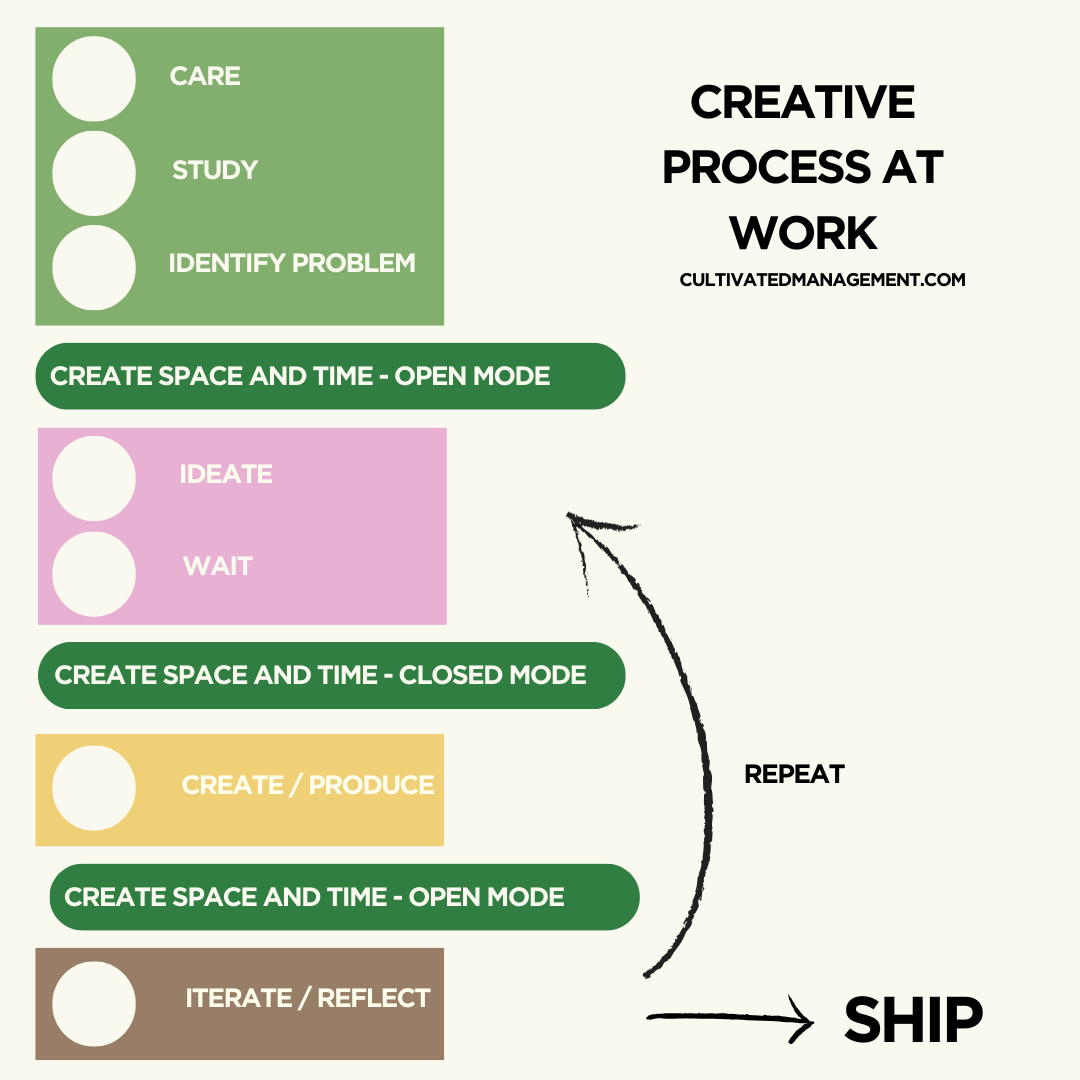
The creative process - switching between open and closed modes
A cycle that repeats
Creative problem solving usually follows a shape.
Not a sprint. A cycle.
It begins when someone cares. It moves through clarity. It requires space. It benefits from incubation. It demands the discipline of building. Then it returns to reflection.
It looks something like this:
A problem becomes compelling. It gets named cleanly. It gets studied until it’s understood. Space is created — not as a luxury, but as a condition. Ideas emerge. Time passes. Something gets built. Reality responds and tests. The work gets refined.
Then the next problem appears.
This isn’t a flaw in the system. It is the system.
The mistake: treating creativity like an event
Many organisations treat creativity as a moment.
A workshop. A brainstorm. A sprint. A playbook.
Sometimes those create energy. Sometimes they surface good ideas.
But without the rhythm — without the return to open mode and the discipline of closed mode — the ideas stay where most ideas die: in a document, or in someone's mind.
Creativity is not an event. It’s a way of working.
A pattern that repeats.
Visibility without suffocation
Teams often need a way to hold problems without losing them.
A place where frustrations can live long enough to become insight. A place where half-formed thoughts can become clearer.
But the mechanism is never the point.
A board, a backlog, a document — those are containers. They can help.
They can also smother the thing they were meant to support, if they turn creative work into administration.
The important part is still the rhythm:
Space to explore. Discipline to build. Time to return and refine.
A quieter question about work itself
Looking at this cycle raises an uncomfortable thought.
A lot of modern work keeps people in closed mode permanently. Constant delivery. Constant motion.
But most meaningful work — the kind that improves systems, reduces friction, creates better workplaces and experiences — requires open mode too.
Not endlessly. Not indulgently.
Just enough to notice what’s true. And to imagine what could be different.
Creativity isn’t decoration.
It’s one of the ways organisations stay alive. Creativity is the engine of the business, and care is the fuel.
Closing
Creativity in business isn’t a brainstorm every so often.
It’s the steady practice of moving through the cycle: problem → opportunity → problem again.
It requires open mode and closed mode. It needs both wonder and discipline.
And it works best when leaders protect the time and space needed — not as a perk, but as a condition for better work.
Because when creativity has room to breathe, businesses tend to improve.
And when businesses improve, working life improves too.
What Is Kanban? A Beginner’s Guide for Agile Teams [2024] • Asana [WWW Document]. Asana. URL https://asana.com/resources/what-is-kanban (accessed 7.22.24).Clear, J., 2013.