The Change Narrative Playbook: How Narrative Aligns People and Change
A Cultivated framework for leading organisational change through narrative. This playbook defines a canonical narrative spine and explains how narrative acts as infrastructure for aligning people, decisions, and action.
A Studio operating system for aligning people around transformation
Editor’s Note: This Studio playbook documents a narrative system for leading change. It expands the Cultivated canon on communication and Idea → Value by providing templates, canvases, and a maturity model for turning strategy into shared understanding and coordinated action.
Narrative as Infrastructure for Change
Many organisational change programmes wobble not because the strategy is wrong, but because the story is missing.
People are asked to execute without first understanding what is happening, why it matters, and where they belong within it.
In the Cultivated view, communication is not decoration. It is infrastructure.
A change narrative is a shared map that allows hundreds or thousands of people to coordinate without constant explanation. It reduces the friction between intent and action — the cost between idea and value.
Written change artefacts are not substitutes for dialogue. They are anchors for it.
They give leaders a consistent spine for presentations and workshops, and they give teams a stable reference for sense-making.
Without them, organisations rely on memory, hearsay, and interpretation — and alignment becomes accidental.
This Studio playbook formalises the narrative structure I use when leading change. It is deliberately simple. Simplicity is what allows meaning to travel.
The structure mirrors how humans understand change: a signal that something is worth time, energy and attention, a promise (or picture) of a better state, a challenge worth taking on, a reason to act now, and a clear role for participation.
Narrative, in this sense, is not just storytelling. It is operational clarity with emotional grounding.
When narrative is treated as infrastructure, organisations move faster, people experience less uncertainty, and change becomes something people can locate themselves within — rather than something done to them.
The sections that follow define the narrative spine, the operational playbook, and the maturity model for embedding narrative into organisational practice.
Why Narrative Is Infrastructure
Written artefacts are not substitutes for dialogue, alignment, and action. They are infrastructure.
A change narrative acts as:
Shared memory — a durable reference for intent and context.
Coordination device — a common map for distributed action.
Sense-making scaffold — a structure for interpreting uncertainty.
In the Idea → Value system, narrative reduces friction between intent and execution. It turns abstract strategy into a lived story that people can locate themselves within.
The Change Narrative Spine
Every effective change story follows a simple spine.
This spine is format-agnostic: it works in documents, presentations, conversations, video, audio and workshops.
Signal — What’s Happening? The problem, its cost, and why it matters.
Promise — What Changes? Tangible benefits and the future state.
Challenge — The Journey What will be hard, uncertain, and worth doing.
Urgency — Why Now? Timing, opportunity, and constraints.
Participation — How We Act Roles, milestones, governance, and learning.
This spine mirrors human meaning-making and storytelling: problem → journey → resolution → identity.
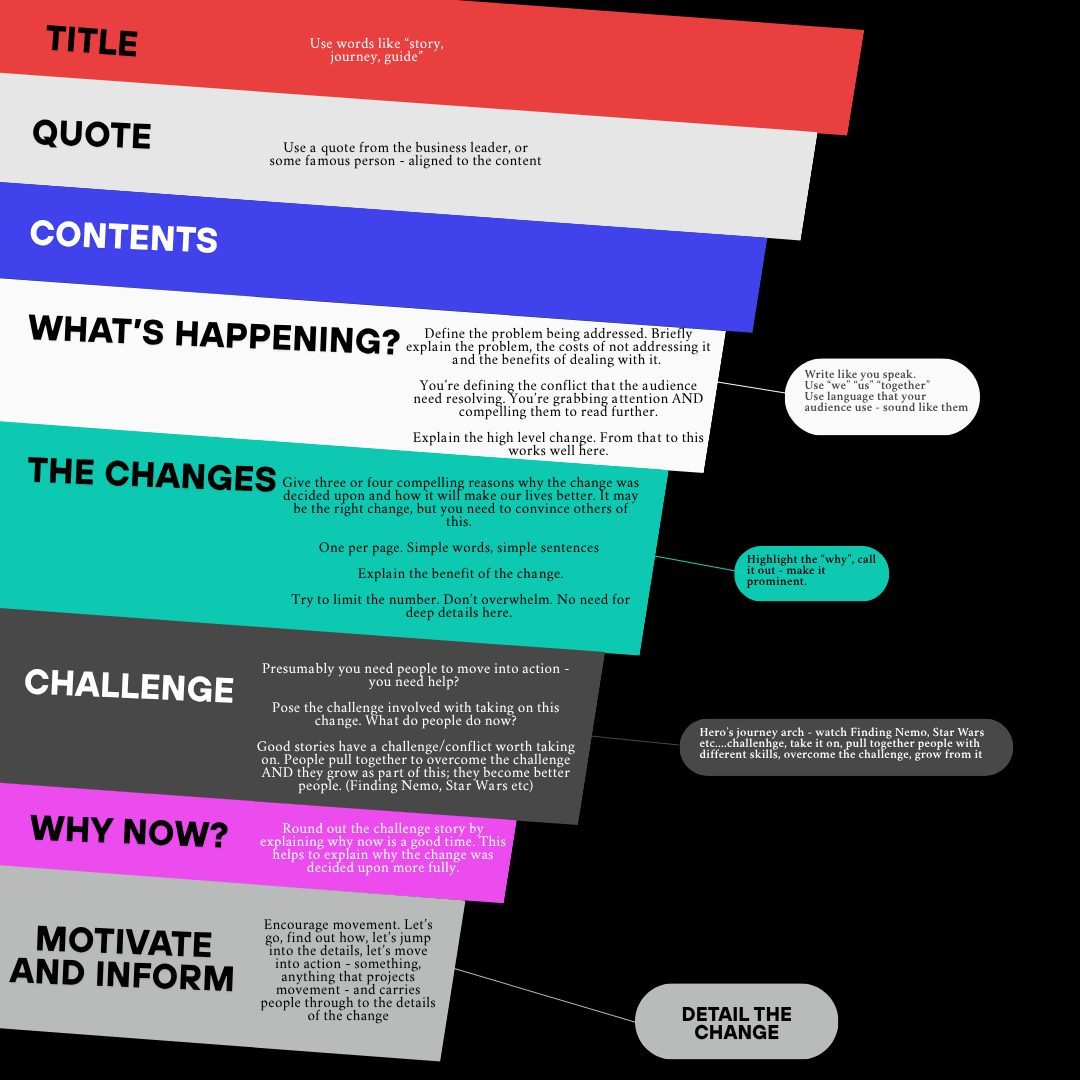
The Change Narrative Playbook
1. Title Page — Name the Journey
Prompt: If this were a documentary, what would it be called?
2. Leadership Quote — Anchor Meaning
Prompt: What is at stake, in human terms, according to leadership?
3. Contents — Cognitive Scaffold
A simple contents page that signals structure and progression.
4. Signal — What’s Happening?
Checklist:
One core problem statement.
Three costs of inaction (time, money, morale, risk, etc).
Three tangible benefits of change.
5. Promise — The Changes
Template: Before → After table view for processes, behaviours, and outcomes.
6. Challenge — The Journey
Prompts:
Where will this be difficult?
What will surprise us?
Why is the challenge meaningful?
7. Urgency — Why Now?
Forcing Function Prompts:
Market or customer pressure
Technology shifts
Organisational readiness
Timing and opportunity windows
8. Participation — Motivate & Inform
Operational Elements:
Timeline and milestones
Roles and responsibilities
Learning and enablement plan
Governance and feedback loops
Communication channels and cadence
The sections above define the conceptual structure of a change narrative. The Studio section below provides practical artefacts — canvases, templates, checklists, and workshop guidance — for applying this approach in organisational settings.
This post is for paying subscribers only
Subscribe now and have access to all our stories, enjoy exclusive content and stay up to date with constant updates.