Why I Use an Analogue Personal Knowledge Management System
Slowing down learning is sometimes the fastest way to grow. This essay explores why analogue tools help turn information into knowledge — and how a personal knowledge system should change behaviour, not just store notes.
Why I Use an Analogue Personal Knowledge Management System
Editor's Note: This essay forms part of Cultivated’s wider body of work on learning, creativity, and how ideas become valuable through behaviour — not just information.
Why I Use an Analogue Personal Knowledge Management System
At their best, these systems don’t just help us store information. They help us change — how we think, how we decide, and how we act. And over time, they help us become better at our work and more deliberate in our lives.
For me recently, that has meant going mostly analogue.
Not because digital tools aren’t powerful — they are — but because slowing the pace of learning has helped me digest ideas more deeply and put them into action. And action, not accumulation, is where knowledge is formed.
In an earlier piece, I shared my Personal Knowledge Management System and the four-part model I still use today: Capture, Curate, Crunch, and Contribute.
That model hasn’t changed.
What has changed is how I do the work inside it.
Today, much of that work happens on paper.
A mostly analogue system (by design)
My personal knowledge management system has evolved slowly over many years. It began with scraps of paper and half-filled notebooks and has become more intentional and more useful with time.
The key word here is personal.
These systems should work for you — your mind, your habits, your energy. But it’s often helpful to see how others organise their thinking so you can adapt ideas into something that fits your own way of working.
The goal of a PKMS is not to capture everything.
It’s to support learning that changes behaviour, improves judgement, and helps you contribute something meaningful back to others.
That’s what mine is for.
Why I work mostly analogue
Here are the reasons I continue to use a predominantly analogue approach — even in a deeply digital world.
1. To avoid distraction and transcription
Screens are efficient. They are also relentless.
When I work digitally, I’m never far from email, search, notifications, or the temptation to collect more information instead of thinking about what I already have.
Writing by hand removes that entire layer.
It also stops me transcribing information verbatim. When you write by hand, you’re forced to process, compress, and reinterpret ideas in your own words. That act alone deepens understanding.
The goal is not to store information perfectly. It’s to understand it well enough to use it.
2. I was sacrificing effectiveness at the altar of efficiency
Digital tools made me faster — but not better.
I noticed I was capturing more, but learning less. I was relying on retrieval rather than understanding. Information sat neatly stored, but rarely changed how I behaved.
That’s a failure of a knowledge system.
Effectiveness matters more than efficiency when learning. Slowing down corrected that imbalance.
3. Slowing down creates real learning
There is always more to read, watch, and consume.
But learning isn’t about volume. It’s about integration.
Reading fewer things more carefully — and then acting on them — has proven far more valuable than racing through endless material.
Analogue work naturally slows the pace. It creates space for reflection, experimentation, and adjustment. That’s where learning actually happens.
4. I write to remember now, not later
There’s strong evidence that writing by hand improves retention.
I see it in my own work constantly. When I write something down, I’m not writing for future reference. I’m writing so I understand it now.
That shift alone has changed how much I remember, how quickly I recall ideas, and how often I apply them.
5. I enjoy the tools — and that matters
I like good stationery.
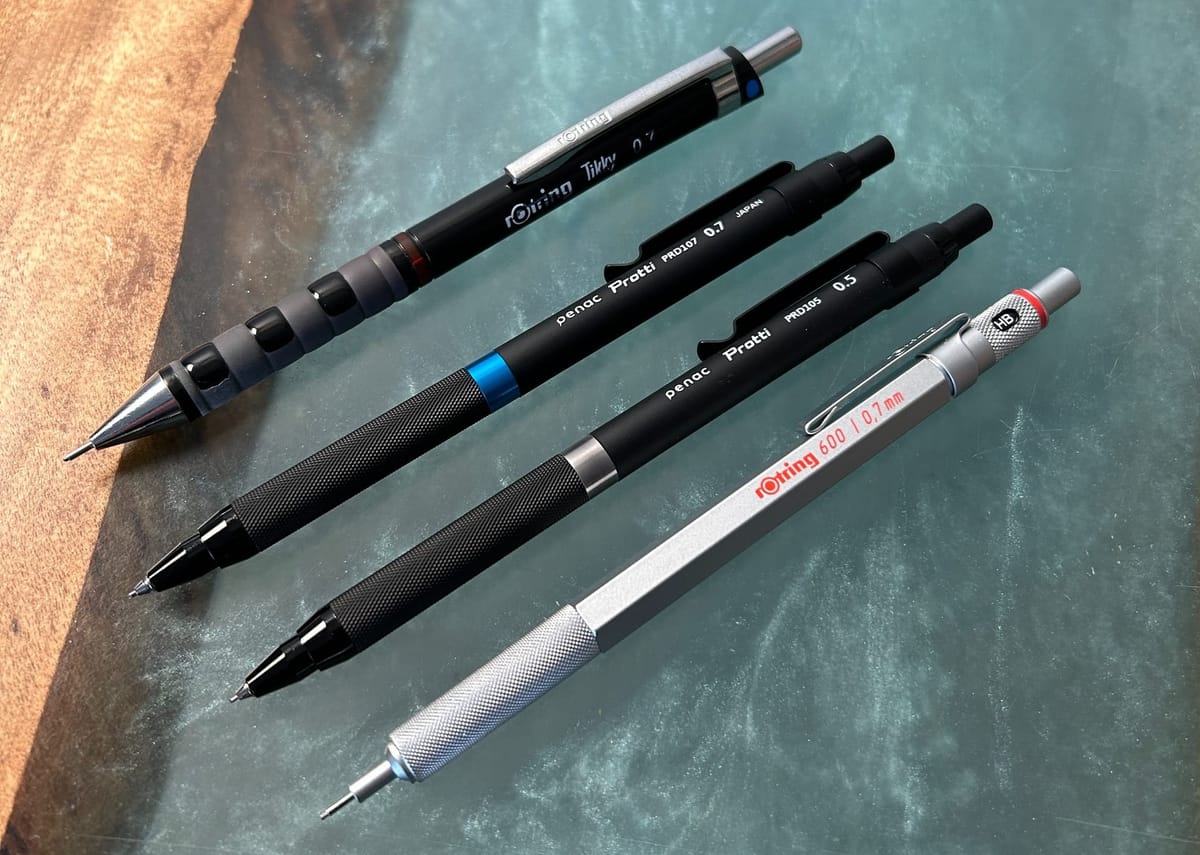
Pens, paper, notebooks — the physicality of them matters to me. That’s why I co-host a podcast called Stationery Freaks.
Enjoyment might sound trivial, but it isn’t. If you enjoy the tools of learning, you’re more likely to return to the practice. And consistency beats novelty every time.
6. I have a dedicated place for this work
I’m fortunate to have a studio space with a dedicated writing bureau where only analogue work happens.
No laptop. No screens.
This is a simple form of environmental affordance. When I sit there, I do this kind of thinking. The space cues the behaviour.
Even without a studio, most people can create small physical signals like this — a table, a notebook, a corner — that gently guide attention and habit.
7. A quiet bonus: legacy
There’s something comforting about the idea that these notebooks may outlast me.
They’re filled with my interpretations, questions, sketches, and half-formed ideas. They represent how I thought about work, learning, and life.
Whether my children ever read them is another matter entirely — but the act of creating something tangible feels meaningful.
Bringing analogue and digital together
This is not an anti-digital manifesto.
Everything important eventually ends up in my digital system for long-term storage and retrieval. Digital tools are excellent for that.
But analogue is where the thinking happens.
Digital is where the archive lives.
Together, they form a system that supports real learning — learning that leads to better judgement, clearer communication, and more intentional work.
That, ultimately, is the point.
Video
Editor’s note: This essay grows from an earlier exploration in another medium. The thinking remains central, even as the format has changed.
A video on my analogue knowledge management system
Explore the work
This piece forms part of Cultivated’s wider body of work on how ideas become valuable, and how better work is built.
To explore further:
→ Library — a curated collection of long-form essays → Ideas — developing thoughts and shorter writing → Learn — practical guides and tools from across the work → Work with us — thoughtful partnership for teams and organisations
The link has been copied!
Your link has expired. Please request a new one.
Your link has expired. Please request a new one.
Your link has expired. Please request a new one.
Great! You've successfully signed up.
Great! You've successfully signed up.
Welcome back! You've successfully signed in.
Success! You now have access to additional content.