What DISC really measures: performing the wrong personality
A leadership away day, a CEO who walked out — and why DISC is less a communication tool than an energy one. On style, flex, and working with your grain instead of against it.


Updated 31st August 2026.
Performing the wrong personality
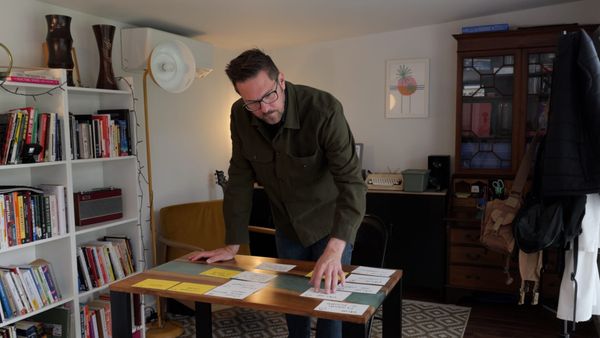
I thought it was going to be a very ordinary training day. A nice old hotel on the edge of Reading. Good room. Good coffee. Surprisingly good biscuits. Twelve senior leaders from a large telecoms company settling into their chairs.
Introductions with a couple of gentle exercises to get everyone talking. Then into the bit I genuinely love: helping people work out how they naturally communicate, and why it works when they stop trying to sound like somebody else.
An hour later, I was doing counselling. I should point out that I have no qualifications in counselling whatsoever. I can listen, certainly. But that is about the extent of my professional qualifications. The person doing the talking was the CEO, and he was upset, out in the hall and thanking me for saving his energy. We'll come to that.
This is one of the funny things about communication training. We tend to treat communication as though there is a correct approach for a human being. Be confident. Project authority. Own the room. Speak up. Be more assertive.
In other words: become the sort of person who walks into a room and makes everybody else aware that they've just walked into a room, and slightly on edge.
It is a peculiar ambition. As though somebody saw what they thought good looked like, and decided that everyone else should embody and mimic that communication approach as the best single way.
But people aren't built that way. Some think out loud and on paper. Some think first and then speak. Some don't appear to think at all but project everything with wild confidence. Some persuade through energy; others through precision, others through careful conversations with people they trust. Some are brilliant in a crowd and terrible in a room of three. Some are animated and energetic, some are quiet and more reserved. Some make people listen by talking more. Others make people listen because, when they finally say something, everyone knows it is worth hearing. And some people have that gravitas that projects confidence, kindness and trust without saying anything at all.
Trying to turn all of them into the same communicator is a little like running a drama school in which the goal is to turn everybody into copies of Matthew McConaughey. Great actor by the way.
So I start somewhere else. Not with the ideal communicator but with the actual person. What comes naturally to you? What do people already respond to? Where are you strongest? What happens to that strength when the stakes go up? What is your natural, default, communication style?
And then, rather than sanding off the awkward bits and replacing them with a carbon copy, we work out how to flex what is already there. Because the aim isn't to become a better version of someone else. It's to become a more capable version of yourself.
Which was how, on a brilliantly cold but pleasant morning in a hotel near Reading, a communication workshop became a conversation with a CEO about something rather more complicated than communication.
The tool I reach for is DISC – a model of behavioural and communication preferences. There are others, all decent: Insights, the animal styles, and a shelf of other variations. None of them are fully scientific, and I'd never pretend otherwise, but used honestly they're remarkably useful – a solid, insightful map of how a person is wired. And it was during the exploration of that map, that the room turned emotional.
The company, it turned out, was having a hard time. Good ideas were taking an age to turn into anything of worth, costs were climbing – which is exactly what happens when the gap between an idea and its value widens – and morale had dropped through the floor.
And in that room the CEO had a revelation – an untangling of a person. He looked around at his leadership team and realised they were all, more or less, wired identically – and that he wasn't.
Worse, he'd been spending every working day morphing himself into their shape to keep up with them, and the business. He slid his notepad away, said he needed a minute, and pretty much legged it out of the door. The team looked baffled. I had a fairly good idea what had just happened, so I followed him out.
What DISC is really measuring
Here's the thing he'd understood, and that had opened the floodgates of personal boundaries. DISC isn't just a great communication tool – it's an energy tool: it shows you what it costs to perform a personality that isn't yours, all day, every day.
Because the trick to communicating well is not to pick the "right" style, i.e. your natural preferences, and force everyone into it. The best communicators are chameleons – they stay entirely themselves, but shift their colour depending on who's in front of them, the context, and what they're actually there to do.
The goal is always the same: understanding between you and the other people. And the techniques for it are learnable, which is exactly what I teach – how to adjust your pace, your language, your posture, the volume of your presence, non-verbal communication, clarity of thought – all while remaining unmistakably you.
The catch is simply that flexing costs energy. A little flexing, now and then, is nothing, and is how you become a great communicator. But perform a version of yourself you're not, every hour of every day, and it drains those energy reserves far faster than doing the same work in your own style ever would. (The real magic, incidentally, is when the other person flexes to meet you halfway – that's where the good listening, good communication and proper understanding lives.)
The CEO's problem was that he was flexing to meet everyone else, and nobody was flexing back. He was spending his days doing a monumentally good impression of a hard-charging alpha kind of person, when every fibre of him wanted to slow down, understand the problem, build some alignment, and then move. Everyone around him wanted to decide now and move faster. He wasn't tired because the job was hard. He was tired because he was pretending to be someone he wasn't.
And, although I don't know for sure, this might be why the company was where it was now. There was a time the organisation was a mirror of him (he was the founder too), and growth was good. Careful but accurate. Steady but not slow. Focused but on the right things. But growth, demands, new hires and investment morphed the company to be an image of the current leadership team; move fast on everything before truly understanding why, where or on what. And in doing so, they were moving fast on the wrong things, in the wrong direction, at a remarkable pace.
DISC is a map
DISC reads two simple things. How you tend to face your world – more toward the tasks, or more toward people. And how you tend to express yourself – more assertive, or more reserved. Cross those two and you get four broad leanings. And I use the word tend here on purpose, as there are always exceptions.
- D — Dominance: direct, decisive, results-orientated. Assertive and task-focused; thinks in outcomes and tends to moves fast.
- I — Influence: warm, expressive, persuasive. Assertive and people-focused; moves people through energy and connection. Hopeful, positive, fun, and would rather not slow down for the small print. (That one's me.)
- S — Steadiness: calm, dependable, kind. The glue that makes a team feel safe and orientated on the right things. Listens well. Connects with individuals.
- C — Conscientiousness: precise, analytical, thorough. Wants the data before the decision, thinks in systems and quality, and tends to catch what everyone else sailed straight past.
Most of us are a blend, with one or two settings sitting louder than the others. And that's the whole point – it's a map, not a box to squash people in to. Nobody lives inside a single letter, and the map exists to remind us we can flex without losing ourselves, not to distribute labels to hide behind.
When I first took DISC, twenty-odd years ago, I was almost pure I. Leadership roles and building a business since has genuinely grown some D in me – decisions, structure, the commercial nerve to sell – and I mean grown, not just faked in the moment. That difference matters: the map can track who you're becoming, not only who you are today.
It's an energy thing, not a character thing
A useful way to use DISC though isn't just about how people talk. It's about what drains them and what fills them back up – their energy.
Take two people I know well. Me, and my accountant.
I thrive on a stage. Give me a room full of strangers and a workshop or talk, and I light up. This is my sweet spot. I pour energy out and get more back; I love a good conference for exactly that reason. I enjoy sharing, teaching and seeing that moment when people are moved by something.
Put me in front of a spreadsheet for a day, alone, with nobody to talk to, and you'll find a shadow of me by five o'clock, snaffling down biscuits and wondering what I've done with my life. And that's just from one day. I need people. I need a little chaos. I need a sense of fear to bring out my best.
My accountant is almost my mirror image. She gets genuine joy from a well-kept spreadsheet – the detail, the quiet, the accuracy, the one-to-one conversations she has with clients and colleagues. But she also has to go and spread the word about her business, so she turns up at the meetups and the networking evenings, and – this is the good bit – she's brilliant at it. She can flex onto that stage beautifully with charisma, clarity and enthusiasm. It just costs her, and she needs a day in the quiet to recover afterward. I need the same day off after too many hours of detail and back-to-back meetings. Neither of us is broken. We're just wired differently, and the wiring has a energy meter and bill associated with it.
This is the subtle, almost equine, common source of exhaustion nobody puts on the time sheet or in the P&L. You can work perfectly reasonable hours and still end each week a hollowed and whittled down version of yourself, if the work has spent all day rubbing against your grain. And because the cost doesn't show up the way a heavy workload does, it almost never gets named correctly. People assume they're tired of working. Often they're just tired of pretending to be someone they're not, with people who don't always appreciate differences, using communication styles that aren't natural to them.
I know it from the inside. In the early, chaotic years of a startup I was in my absolute element – money short, everything on fire, direction desperately needed. Painting a picture of where we were headed and rallying people around it. Getting to know people, bringing out the best in them, dealing with the confusion, aligning people around the direction, providing the energy for other people. Offering hope and spirit towards a better business. That's my sweet spot, and I loved every mad minute.
Then the money came in, we grew to the size we needed, and – to our credit – we fixed the long, tangled path between our good ideas and the value we were chasing, until an idea could become something real in weeks rather than months. Smooth. Flowing. From the outside, the moment to sit back and enjoy it. And I was bored senseless. The work now wanted someone steady and exacting, all careful maintenance and fine detail – pure C and S – and my energy comes from I and D.
I was spending my finite resources of time, energy and attention every day and refilling almost nothing. So, I made the sideways move that looked remarkable odd on paper and made perfect sense in the body and mind: into HR, back into a world of people and problems and travel and change and rallying. The tiredness lifted within days. That, more or less, was the CEO's revelation, arriving all at once in a hotel corridor. And no amount of delicious biscuits was going to help him.
It sounds all dramatic and dour, but here's the high spirited part.
He went back in and we finished the day in good spirits. He knew what needed to happen. Over the following months he did the most effective thing available to him: he stopped trying to be a D all day everyday and reclaimed his stake as CEO. He built a team around him that no longer required him to pretend to be someone he wasn't.
He brought in a lovely and focused man, an I, to warm the room, think about the people, consider how the decisions made in the room would land in the business, and bring a sense of optimism back in.
He hired two people, of S profiles, to steady the leadership team; to raise the bar of thinking, of slowing down, of considering, of thinking about the people. The meetings got calmer and more considered around the problems at hand. There was no more jumping on everything that made it to the leader's table. And, surprisingly, the meetings, reviews and general conversations were quicker; fewer items were considered through better focus; more balance in the team meant problems were properly considered and resolved, therefore not coming back next week.
He rang me a few months on, sounding like a man who'd reclaimed himself. He'd stopped performing for the team he built (I know, funny how things happen). And the mix of communication styles had become the team's biggest strength – because a room of identical wiring has identical blind spots, and a room of different wiring covers for each other and, if trust is high, tend to make each other better.
That's the forward-facing reality under all of this. Most friction at work isn't really about strategy or tools or structure. It's often mismatched expectations about how people think, decide and communicate resulting in misunderstanding and confusion. Plus the slow energy drain of working against your own natural preferences with no flexing from others. Make those differences visible and most of the friction has somewhere to go.
Using DISC well, without hiding behind it
A few honest guidelines, if you go looking at your own map. Start with yourself. The first step to any kind of self development is knowing yourself as well as you can.
Learn to flex toward other people's preferences without abandoning your centre. In an ideal world, they would do the same too, although that's not always the case.
Don't, whatever you do, use your natural communication style as a hall pass for being unprofessional or adding dysfunction in the workplace – "I'm a high D, deal with it" is not the point; the map is for understanding, not for excusing.
Where you can, build teams with a real spread of styles on purpose, and hand people the work that runs with their grain rather than against it. It's always amazing just how much potential people bring when the work they're doing matches more closely to their behaviours and communication style.
The aim isn't harmony for its own sake, or everyone holding hands, or circles of hope and meditation. It's the humbler, better goal of building conditions where people can do good work without a constant, invisible fight against themselves and others. A climate where more of their energy goes into the work and less into managing the gap between who they are and who they think they're supposed to be. Understanding the Drama Triangle is a useful adjunct to this idea too.
Plenty of DISC assessments exist, including free ones; any reputable one is a reasonable place to start, as long as you hold the result lightly. They are indicative, never a verdict of who you are. And if you'd like to go properly into the flexing part – the actual techniques for shifting your style while staying yourself – that's covered in two forms; the Effective Workplace Communication for individuals, or the Everyday Communication Workshop for teams.
Effective communication is not about losing who you are, far from it. It's about learning to flex, and – just as importantly – learning what gives you energy back, so you can spend more of your working life in your element and less of it doing an impression of Matthew McConaughey.
The CEO worked that out in a corridor near Reading, over a cup of remarkably good coffee with a good ear to listen to him. Most of us get to work it out somewhere less scenic, sometimes too late in our working life, and often with regret. But it's the same lesson, and it's a genuinely hopeful one: you don't have to become someone else to be good at this. You mostly have to stop pretending to be someone else, and find the right way to accentuate who you are.
Where this sits in the Atlas
Orientation·Idea to Value·Communication·Creativity & Climate·Learning